Imagine you’re starting a business and need someone to handle your taxes. You come across a Certified Public Accountant (CPA) and an Enrolled Agent (EA). Both can prepare tax returns, but what exactly is the difference between CPA and EA?
The difference between CPA and EA lies in their education, licensing, and scope of services. While both are tax professionals, CPAs have broader accounting qualifications, and EAs specialize in taxation. Many people search for CPA vs EA comparisons when choosing the right expert for tax or financial services.
Understanding the difference between CPA and EA helps businesses and individuals make informed decisions. Knowing the difference between CPA and EA ensures you hire the right professional for tax preparation, audits, or financial planning. Exploring CPA vs EA can save time, money, and legal complications.
Key Difference Between the Both
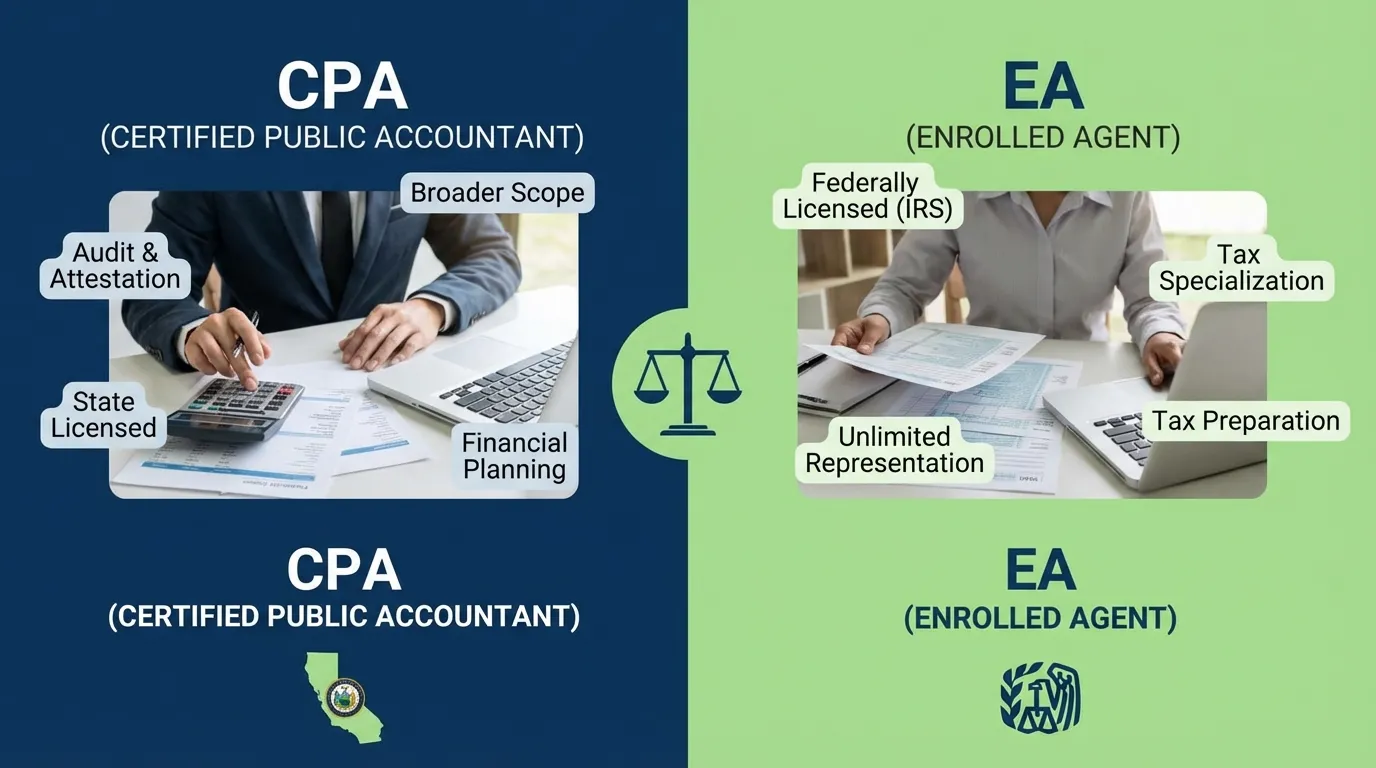
The main difference between CPA and EA is that a CPA is licensed to provide a wide range of accounting services, including auditing, financial planning, and consulting.
An EA is federally authorized by the IRS to represent taxpayers before the IRS for tax matters.
In simple terms, when people compare CPA vs EA, CPAs handle broader accounting functions, while EAs specialize in tax-related matters.
Why Is Their Difference Necessary to Know for Learners and Experts?
Understanding the difference between CPA and EA is crucial for both students and professionals.
For learners, knowing the difference between CPA and EA helps in choosing the right career path in accounting or taxation. Many search for CPA vs EA to understand which credential suits their goals.
For experts, understanding the difference between CPA and EA ensures proper professional advice for clients. It helps businesses, taxpayers, and financial planners assign the right professional for tax preparation, audits, or representation.
Pronunciation of the Both (US & UK)
CPA (Certified Public Accountant)
- US: /si pi eɪ/
- UK: /si pi eɪ/
EA (Enrolled Agent)
- US: /ɪnˈroʊld ˈeɪdʒənt/
- UK: /ɪnˈrəʊld ˈeɪdʒənt/
Knowing the pronunciation is helpful when discussing CPA vs EA in professional or academic settings.
Difference Between the Keywords
1. Definition
CPA is a licensed accountant qualified to perform audits, financial reporting, and consulting.
- Example 1: A CPA audits a company’s financial statements.
- Example 2: A CPA prepares complex business reports.
EA is a tax professional authorized by the IRS to represent taxpayers.
- Example 1: An EA represents a client in an IRS audit.
- Example 2: An EA files tax returns for individuals and businesses.
2. Licensing Authority
CPA is licensed by state boards of accountancy.
- Example 1: Passing the CPA exam and meeting state requirements.
- Example 2: CPAs must complete continuing education.
EA is federally authorized by the IRS.
- Example 1: Passing the IRS Special Enrollment Examination (SEE).
- Example 2: Maintaining a valid enrollment status with the IRS.
3. Education Requirement
CPA requires a minimum of 150 college credits, usually including accounting courses.
- Example 1: A bachelor’s degree in accounting.
- Example 2: Graduate courses in taxation.
EA does not require a college degree but must pass the SEE or have IRS work experience.
- Example 1: Tax preparer with IRS experience becomes an EA.
- Example 2: Passing all three parts of the SEE exam.
4. Scope of Practice
CPA handles accounting, auditing, consulting, and tax preparation.
- Example 1: Performing corporate audits.
- Example 2: Advising on financial strategy.
EA specializes in taxation and representation before the IRS.
- Example 1: Filing personal or business tax returns.
- Example 2: Representing clients in tax disputes.
5. Continuing Education
CPA must complete state-specific continuing education hours.
- Example 1: 40 hours of CPE annually.
- Example 2: Ethics courses for renewal.
EA must complete IRS-mandated continuing education.
- Example 1: 72 hours every three years.
- Example 2: Tax law updates.
6. Geographic Authority
CPA licenses are state-specific.
- Example 1: A CPA licensed in California cannot audit in Texas without reciprocity.
- Example 2: CPA may practice accounting only within authorized states.
EA license is recognized nationwide.
- Example 1: An EA can represent taxpayers anywhere in the US.
- Example 2: EAs can handle multi-state tax issues.
7. Exam Difficulty
CPA exam covers accounting, auditing, and business topics.
- Example 1: Financial accounting and reporting.
- Example 2: Business environment and concepts.
EA exam focuses entirely on taxation.
- Example 1: Individual tax returns.
- Example 2: Business tax law.
8. Representation Rights
CPA can represent clients in financial and audit matters, including taxes if licensed for tax practice.
- Example 1: Audit of financial statements.
- Example 2: Tax planning advice.
EA has unlimited representation rights before the IRS.
- Example 1: Representing clients in audits.
- Example 2: Handling appeals with the IRS.
9. Cost and Maintenance
CPA licensing may be more expensive due to state fees and education costs.
- Example 1: Exam fees, study materials, and CPE courses.
- Example 2: Annual license renewal fees.
EA is generally less expensive, focusing on IRS exam and enrollment maintenance.
- Example 1: SEE exam fees.
- Example 2: Renewal of enrollment every three years.
10. Career Flexibility
CPA can work in accounting firms, corporate finance, and auditing.
- Example 1: Big Four accounting firms.
- Example 2: Corporate financial departments.
EA usually works in taxation, consulting, or self-employment.
- Example 1: Tax preparation companies.
- Example 2: Independent tax consultants.
Nature and Behaviour of Both
CPA behaves as a broad financial professional with expertise in accounting, auditing, and consulting.
EA behaves as a tax specialist focused on IRS compliance, preparation, and representation. Understanding these distinctions explains the difference between CPA and EA in professional practice.
Why People Are Confused About Their Use?
| Feature | CPA | EA | Similarity |
| Authority | State-licensed | Federally authorized | Both can handle taxes |
| Scope | Accounting, audit, tax | Tax preparation & IRS representation | Both are financial professionals |
| Education | College + 150 credits | No degree required | Both require exams |
| Geographic | State-specific | Nationwide | Both require certification |
| Continuing Ed | State-mandated | IRS-mandated | Both require ongoing education |
Confusion arises because both CPAs and EAs can handle taxes, making people compare CPA vs EA.
Which Is Better in What Situation?
CPA is better for comprehensive financial services, corporate accounting, and auditing. Individuals or businesses seeking strategic financial advice or audit services should hire a CPA.
EA is better for tax-focused services, IRS representation, and preparation of complex returns. Individuals facing IRS issues or needing tax expertise nationwide often prefer an EA. The choice between CPA vs EA depends on whether broader accounting or tax-specific expertise is required.
How the Keywords Are Used in Metaphors and Similes
Examples:
- “A CPA is like a Swiss Army knife of finance, versatile and multi-functional.”
- “An EA is like a tax shield, protecting clients from IRS penalties.”
These metaphors illustrate the difference between CPA and EA effectively.
Connotative Meaning of Both Keywords
CPA – Positive
Example: “A CPA provides trusted financial guidance and audits.”
EA – Positive
Example: “An EA ensures accurate taxes and defense against IRS disputes.”
Idioms or Proverbs Related to the Words
“Don’t put all your eggs in one basket.”
Example: Diversify financial advice by consulting a CPA or EA when needed.
“Better safe than sorry.”
Example: Hiring an EA for IRS issues is better safe than sorry.
Works in Literature Using the Keywords
- The CPA’s Guide to Tax Strategy — Professional, John Smith, 2015
- Enrolled Agents Handbook — Professional, Jane Doe, 2017
- Accounting and Taxation Simplified — Educational, Mark Allen, 2018
Movie Names Related to the Keywords
- The Accountant — 2016, USA
- Inside Job — 2010, USA
- Moneyball — 2011, USA
These films explore finance, accounting, and professional expertise.
Frequently Asked Questions
1. What is the main difference between CPA and EA?
CPA is a state-licensed accounting professional; EA is a federally authorized tax expert.
2. Can an EA do audits like a CPA?
No, EAs focus on taxes, not auditing.
3. Which license is recognized nationwide?
EA is recognized nationwide; CPA is state-specific.
4. Who requires more education?
CPA requires more formal education (150 college credits).
5. Can a CPA represent a client before the IRS?
Yes, but only if they are authorized for tax representation.
How Both Are Useful for Surroundings
CPAs and EAs provide crucial financial and tax services, helping individuals, businesses, and governments maintain compliance and make informed decisions. Understanding the difference between CPA and EA ensures the right professional is chosen for financial or tax matters.
Final Words for the Both
CPAs and EAs are essential in financial and tax services. Knowing the difference between CPA and EA and comparing CPA vs EA helps businesses and individuals make informed professional decisions.
Conclusion
The difference between CPA and EA lies in scope, licensing, education, and representation rights. CPAs offer broad accounting, auditing, and consulting services, while EAs specialize in taxation and IRS representation.
Understanding the difference between CPA and EA ensures that taxpayers, businesses, and financial professionals select the right expert for their needs. Exploring CPA vs EA allows individuals to navigate tax and accounting responsibilities efficiently, legally, and strategically.