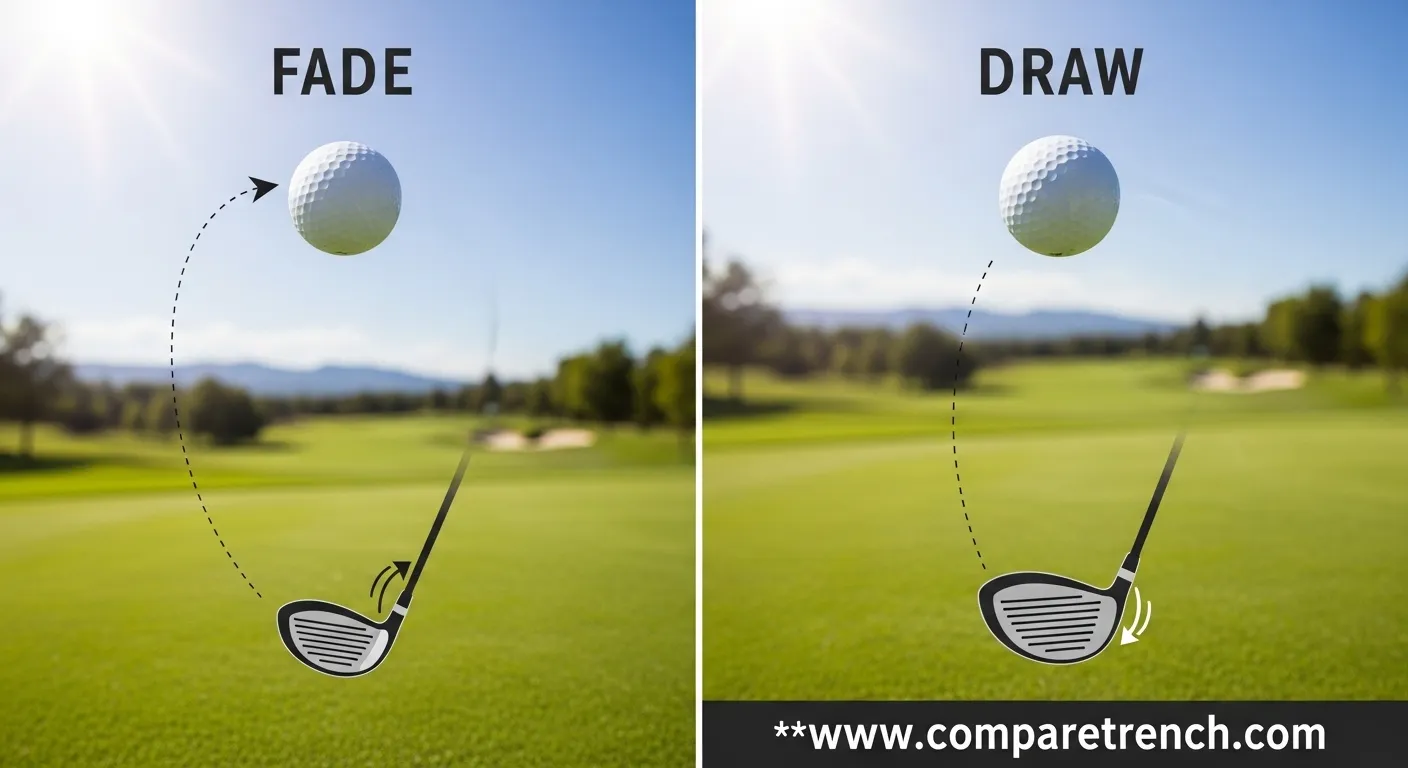
🟩 Featured Snippet: A fade curves slightly away from your dominant side, while a draw curves gently toward your dominant side, helping golfers control their shots.
Imagine you are on the golf course. You hit the ball, and it curves slightly to the right—this is called a fade. Another shot curves gently to the left—that’s a draw. Understanding the difference between fade and draw is essential for every golfer.
The difference between fade and draw is about ball spin and direction. A fade curves away from the golfer’s dominant side, while a draw curves toward it.
Knowing the difference between fade and draw helps beginners control shots better and experts strategize. In golf, mastering the difference between fade vs draw can improve accuracy and lower scores. Learning the difference between fade and draw also builds confidence on the course.
Key Difference Between the Both
The main difference between fade vs draw is the direction of ball spin.
Fade moves away from your dominant side. Draw moves toward your dominant side.
Both are intentional techniques to control ball trajectory.
Why Is Their Difference Necessary to Know for Learners and Experts?
Understanding the difference between fade and draw helps golfers control distance and accuracy. Beginners can learn safer shot techniques.
Experts use the difference between fade vs draw to navigate obstacles and plan strategy.
In golf, knowing the difference between fade and draw improves game performance and reduces errors, making it essential for all players.
Pronunciation of Both (US & UK)
- Fade
- US & UK: fayd
- Draw
- US & UK: draw
Now that you know how to say them, let’s explore the difference between fade vs draw in detail.
Difference Between the Keywords
1. Ball Spin
- Fade: spin makes the ball move away from dominant side
- Draw: spin makes the ball move toward dominant side
- Example (Fade): Right-handed player hits fade to the right
- Example (Draw): Right-handed player hits draw to the left
2. Direction
- Fade curves slightly right for right-handers
- Draw curves slightly left for right-handers
- Example (Fade): Avoiding a tree on the left
- Example (Draw): Navigating around a bunker on the right
3. Swing Path
- Fade: slightly open clubface
- Draw: slightly closed clubface
- Example (Fade): Clubface aimed slightly right of target
- Example (Draw): Clubface aimed slightly left of target
4. Trajectory
- Fade: higher ball flight
- Draw: lower ball flight
- Example (Fade): Clear tall trees
- Example (Draw): Travel longer under wind
5. Control
- Fade: safer, more predictable
- Draw: longer, more powerful
- Example (Fade): Beginner shot for control
- Example (Draw): Expert shot for distance
6. Usage
- Fade: approach shots and accuracy
- Draw: tee shots and distance
- Example (Fade): Approaching green
- Example (Draw): Long fairway shot
7. Common Mistakes
- Fade: accidental hook if overdone
- Draw: accidental slice if overdone
- Example (Fade): Ball curves too much right
- Example (Draw): Ball curves too much left
8. Risk Level
- Fade: low risk
- Draw: moderate risk
- Example (Fade): Safe near hazards
- Example (Draw): Risky near trees
9. Professional Preference
- Fade: many pros for accuracy
- Draw: many pros for power
- Example (Fade): Tiger Woods uses fade for approach
- Example (Draw): Rory McIlroy uses draw for tee shot
10. Learning Curve
- Fade: easier for beginners
- Draw: harder, requires practice
- Example (Fade): Beginners control ball better
- Example (Draw): Requires swing adjustment
Nature and Behaviour of Both
Fade is defensive, higher and safer.
Draw is offensive, longer and aggressive.
In fade vs draw, one prioritizes control, the other distance.
Why People Are Confused About Their Use?
| Aspect | Fade | Draw | Similarity |
| Ball curve | Away from dominant side | Toward dominant side | Both control direction |
| Swing | Open clubface | Closed clubface | Golf technique |
| Flight | Higher | Lower | Both intentional |
| Use | Accuracy | Distance | Improve game |
Which Is Better in What Situation?
Fade is better when accuracy matters and hazards need to be avoided. It is safer for approach shots.
Draw is better for longer shots where distance is important, such as tee shots or fairway drives. In fade vs draw, knowing which to use is key to scoring well.
How the Keywords Used in Metaphors and Similes
- Fade: “His mood faded like a ball drifting right.”
- Draw: “Her energy drew people in, like a ball curving perfectly.”
Connotative Meaning
- Fade: Neutral/Positive (controlled, safe)
- Example: He played a fade to stay safe.
- Draw: Positive (powerful, skillful)
- Example: He hit a draw to cover distance.
Idioms or Proverbs
- “Fade away” (Fade)
- Example: The opponent’s lead faded away.
- “Draw attention” (Draw)
- Example: The perfect shot drew attention from the crowd.
Works in Literature
- The Golfer’s Mind – Dr. Bob Rotella – 2001 (Sports/Psychology)
- Golf My Way – Jack Nicklaus – 1974 (Instructional)
Movie Names
- The Greatest Game Ever Played – 2005, USA
- Tin Cup – 1996, USA
How Both Are Useful for Surroundings
Fade helps players avoid obstacles and stay accurate.
Draw helps players gain distance and strategic advantage.
Together, fade vs draw improves overall golf strategy.
Top 10 Comparison Table
| No | Fade | Draw |
| 1 | Curves away | Curves toward |
| 2 | Higher flight | Lower flight |
| 3 | Open clubface | Closed clubface |
| 4 | Safer | Powerful |
| 5 | Accurate | Longer distance |
| 6 | Beginner-friendly | Advanced technique |
| 7 | Low risk | Moderate risk |
| 8 | Approach shots | Tee shots |
| 9 | Predictable | Requires skill |
| 10 | Defensive | Offensive |
Final Words for the Both
Fade is safe, controlled, and accurate. Draw is powerful, long, and skillful.
Both are important for golfers to master fade vs draw.
Conclusion
The difference between fade and draw lies in ball spin, direction, and flight. Fade curves away from the dominant side, draw curves toward it.
In fade vs draw, both techniques serve unique purposes: fade for control, draw for distance. Understanding the difference between fade and draw improves accuracy, strategy, and confidence on the golf course.
Frequently Asked Questions
1. What is the main difference between fade and draw?
Fade curves away; draw curves toward dominant side.
2. Which is easier for beginners?
Fade is easier and safer.
3. Can both be used in the same game?
Yes, golfers often use both strategically.
4. Does fade fly higher than draw?
Yes, fade usually has higher trajectory.
5. Is draw more powerful than fade?
Yes, draw generally covers more distance.