🟩 Featured Snippet: RNA is a general molecule involved in protein synthesis, while mRNA is a type of RNA that carries genetic instructions from DNA to ribosomes.
Imagine a busy factory where instructions are needed to build products. The master plan is stored safely, but copies are sent to workers. In cells, RNA works like a system of communication, while mRNA carries specific instructions. This is where the difference between RNA and mRNA becomes clear.
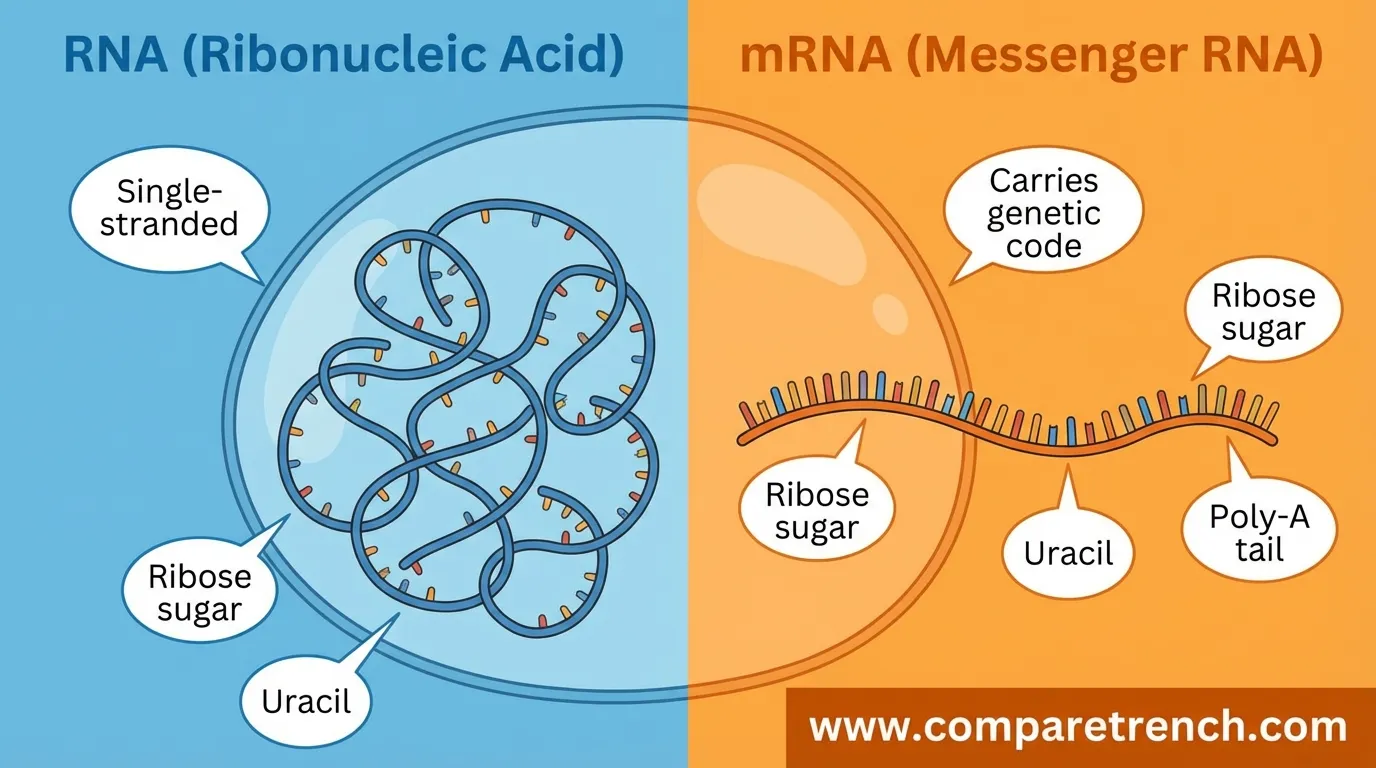
The difference between RNA and mRNA is about function and type. RNA is a broad group of molecules that help in protein making, while mRNA is one special type that carries messages from DNA to the cell machinery.
Understanding the difference between RNA and mRNA helps students, scientists, and learners understand life processes. This difference between RNA vs mRNA is key in biology, genetics, and medicine.
Key Difference Between the Both
The main difference between RNA vs mRNA is type and role.
RNA is a broad category. mRNA is a specific type of RNA with a messaging role.
Both are important in protein synthesis.
Why Is Their Difference Necessary to Know for Learners and Experts?
Understanding the difference between RNA and mRNA helps learners study genetics and cell biology.
Experts use the difference between RNA vs mRNA in research, medicine, and biotechnology.
In society, this knowledge supports vaccines, disease study, and medical advancements. Knowing the difference between RNA and mRNA is important in modern science.
Pronunciation of Both (US & UK)
- RNA
- US & UK: ar-en-ay
- mRNA
- US & UK: em-ar-en-ay
Now let’s explore the difference between RNA vs mRNA in detail.
Difference Between the Keywords
1. Definition
- RNA: General molecule group
- mRNA: Specific type of RNA
- Example (RNA): Includes many forms
- Example (mRNA): One specific form
2. Function
- RNA: Helps in protein synthesis
- mRNA: Carries genetic message
- Example (RNA): Works with ribosomes
- Example (mRNA): Sends instructions
3. Types
- RNA: Includes mRNA, tRNA, rRNA
- mRNA: Only one type
- Example (RNA): Multiple roles
- Example (mRNA): Message carrier
4. Role in Cell
- RNA: Supports protein production
- mRNA: Directs protein making
- Example (RNA): Assists process
- Example (mRNA): Gives blueprint
5. Structure
- RNA: Single-stranded
- mRNA: Also single-stranded but specific sequence
- Example (RNA): General strand
- Example (mRNA): Message-coded strand
6. Origin
- RNA: Made from DNA
- mRNA: Specifically copied from DNA genes
- Example (RNA): General transcription
- Example (mRNA): Exact gene copy
7. Lifespan
- RNA: Varies
- mRNA: Short-lived
- Example (RNA): Some stable
- Example (mRNA): Quickly used and broken
8. Location
- RNA: Found in nucleus and cytoplasm
- mRNA: Moves from nucleus to cytoplasm
- Example (RNA): Works in many areas
- Example (mRNA): Travels to ribosome
9. Importance
- RNA: Essential for life
- mRNA: Critical for protein instructions
- Example (RNA): Overall function
- Example (mRNA): Specific role
10. Example Use
- RNA: General biology processes
- mRNA: Used in vaccines
- Example (RNA): Cell function
- Example (mRNA): Modern medicine
Nature and Behaviour of Both
RNA is a broad and versatile molecule with many roles.
mRNA is specific and focused on carrying messages.
In RNA vs mRNA, one is general while the other is specialized.
Why People Are Confused About Their Use?
| Aspect | RNA | mRNA | Similarity |
| Meaning | General molecule | Specific type | Both genetic material |
| Role | Multiple roles | Message carrier | Help protein synthesis |
| Types | Many | One | Work together |
| Function | Broad | Specific | Essential in cells |
Which Is Better in What Situation?
RNA is better when talking about overall cell function and biology. It includes all types and roles.
mRNA is better when focusing on gene expression and protein instructions. In RNA vs mRNA, mRNA gives specific detail.
How the Keywords Used in Metaphors and Similes
- RNA: “Like a whole communication system.”
- mRNA: “Like a message sent to workers.”
Connotative Meaning
- RNA: Neutral (scientific)
- Example: RNA plays many roles.
- mRNA: Positive (innovative, modern)
- Example: mRNA helps in vaccines.
Idioms or Proverbs
(No direct idioms; scientific terms)
- “Send the message” (mRNA idea)
- Example: The system sends the message clearly.
Works in Literature
- The Double Helix – James Watson – 1968 (Science Memoir)
- Molecular Biology of the Gene – James Watson – 1965 (Textbook)
Movie Names
- Lorenzo’s Oil – 1992, USA
- Contagion – 2011, USA
How Both Are Useful for Surroundings
RNA helps in all basic life processes.
mRNA helps in advanced medical science like vaccines.
Together, RNA vs mRNA supports health and scientific progress.
Top 10 Comparison Table
| No | RNA | mRNA |
| 1 | General molecule | Specific type |
| 2 | Many roles | Message role |
| 3 | Includes types | One type |
| 4 | Broad function | Specific function |
| 5 | Variable life | Short life |
| 6 | Found everywhere | Moves to ribosome |
| 7 | Supports process | Directs process |
| 8 | General structure | Specific sequence |
| 9 | Basic biology | Advanced application |
| 10 | Wide importance | Focused importance |
Final Words for the Both
RNA is a broad and essential molecule. mRNA is a specific and important messenger.
Both are key to life and science.
Conclusion
The difference between RNA and mRNA is simple but important. RNA is a general group of molecules involved in protein synthesis, while mRNA is a specific type that carries instructions from DNA.
In RNA vs mRNA, both work together to keep cells functioning properly. One supports the system, and the other delivers the message.
Understanding the difference between RNA and mRNA helps learners and professionals understand biology, medicine and modern science better.
Frequently Asked Questions
1. What is the main difference between RNA and mRNA?
RNA is general; mRNA is a specific type.
2. Is mRNA part of RNA?
Yes, mRNA is a type of RNA.
3. What does mRNA do?
It carries genetic instructions.
4. Where is mRNA used?
In protein synthesis and vaccines.
5. Why is RNA important?
It supports life processes.