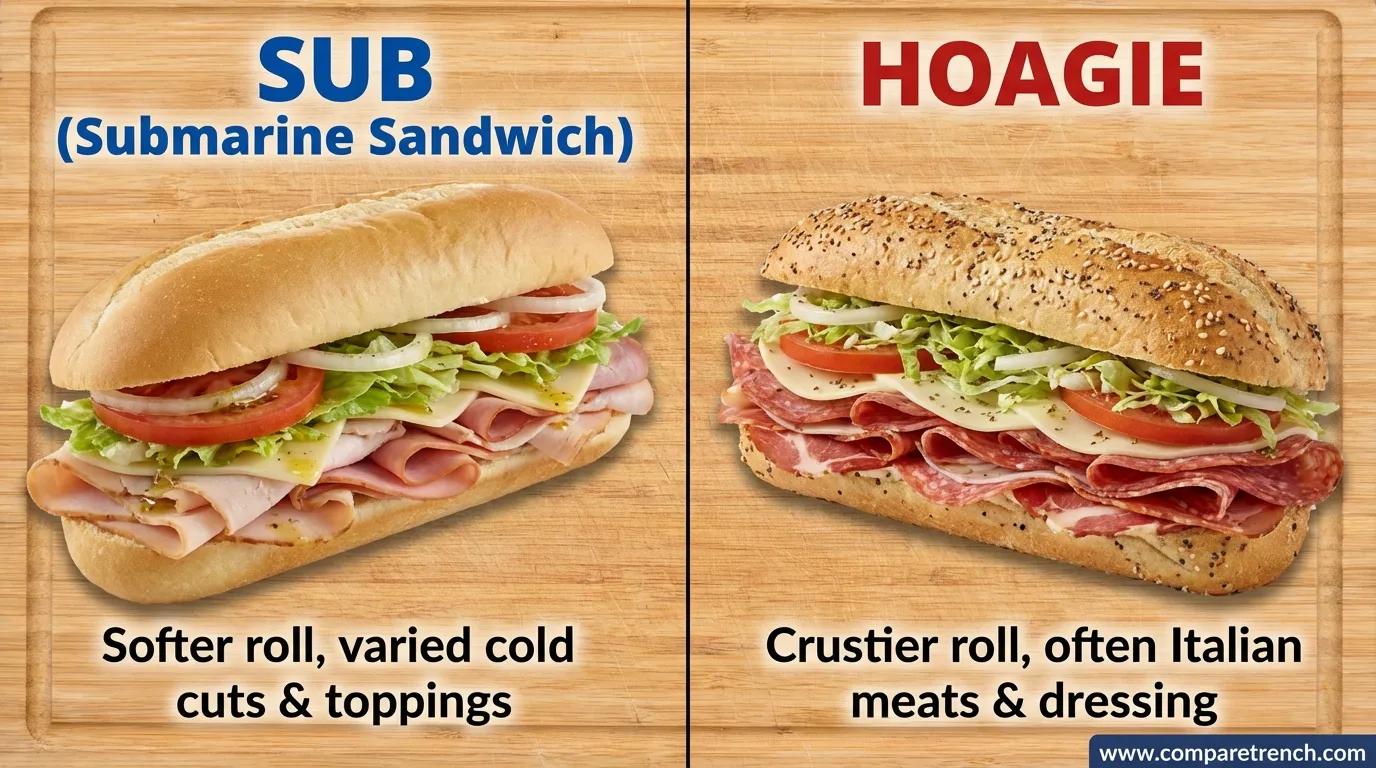
🟩 Featured Snippet: A sub is a long sandwich served in many places, while a hoagie is a regional name for a similar sandwich, mainly used in Philadelphia.
Imagine you walk into a sandwich shop and see two names: sub and hoagie. You may think they are the same, but there is a small twist. This is where the difference between sub and hoagie becomes interesting.
The difference between sub and hoagie is not just about food, but also about region and tradition. In some places, people say “sub,” while in others they say “hoagie” for a similar sandwich.
Understanding the difference between sub and hoagie helps you order the right meal and learn food culture. This difference between sub vs hoagie also shows how language changes with location. Knowing the difference between sub and hoagie makes your food experience more fun and clear.
Key Difference Between the Both
The main difference between sub vs hoagie is the name and region.
A sub is a general term used widely. A hoagie is a regional name used mostly in specific areas.
Both look similar but have cultural differences.
Why Is Their Difference Necessary to Know for Learners and Experts?
Understanding the difference between sub and hoagie helps learners explore food culture and language. It shows how the same item can have different names.
Experts in food and hospitality use the difference between sub vs hoagie to understand customer preferences.
In society, knowing the difference between sub and hoagie helps in communication, travel, and business in the food industry.
Pronunciation of Both (US & UK)
- Sub
- US: sub
- UK: sub
- Hoagie
- US: HOH-gee
- UK: HOH-jee
Now let’s explore the difference between sub vs hoagie in detail.
Difference Between the Keywords
1. Name Usage
Sub is widely used. Hoagie is regional.
- Example (Sub): “I ordered a chicken sub.”
- Example (Hoagie): “I got an Italian hoagie.”
2. Region
Sub is global. Hoagie is common in Philadelphia.
- Example (Sub): Used in many countries.
- Example (Hoagie): Popular in Philly.
3. Origin
Sub comes from “submarine sandwich.” Hoagie has local origin.
- Example (Sub): Named after shape.
- Example (Hoagie): Named by local workers.
4. Bread Style
Sub uses long roll. Hoagie uses similar but sometimes softer roll.
- Example (Sub): Crispy bread.
- Example (Hoagie): Slightly soft bread.
5. Fillings
Sub fillings vary widely. Hoagie often has classic meats.
- Example (Sub): Veggie or tuna sub.
- Example (Hoagie): Italian meats and cheese.
6. Popularity
Sub is more popular worldwide. Hoagie is local favorite.
- Example (Sub): Found everywhere.
- Example (Hoagie): Loved in one region.
7. Cultural Identity
Sub is general food. Hoagie is cultural symbol.
- Example (Sub): Fast food item.
- Example (Hoagie): Local pride dish.
8. Naming Variations
Sub has many names. Hoagie is one specific name.
- Example (Sub): Hero, grinder.
- Example (Hoagie): Only hoagie.
9. Restaurant Menus
Sub appears on most menus. Hoagie appears in local menus.
- Example (Sub): Global chains use it.
- Example (Hoagie): Local shops use it.
10. Identity in Food Industry
Sub is a category. Hoagie is a type.
- Example (Sub): Broad term.
- Example (Hoagie): Specific style.
Nature and Behaviour of Both
Sub is flexible and widely accepted. It changes based on region and taste.
Hoagie is more traditional and linked to a specific place and culture.
In sub vs hoagie, one is general while the other is regional.
Why People Are Confused About Their Use?
| Aspect | Sub | Hoagie | Similarity |
| Meaning | General sandwich | Regional sandwich | Same type |
| Region | Worldwide | Local | Both popular |
| Bread | Long roll | Similar roll | Same shape |
| Use | Common name | Local name | Same food idea |
Which Is Better in What Situation?
Sub is better when you want variety and flexibility. It is easy to find anywhere and offers many choices. In sub vs hoagie, sub works well in global settings.
Hoagie is better when you want an authentic local experience. It connects you to culture and tradition. In sub vs hoagie, hoagie is perfect for regional taste.
How the Keywords Used in Metaphors and Similes
- Sub: “His plan was like a sub, full of layers.”
- Hoagie: “Her idea was like a hoagie, rich and classic.”
Connotative Meaning
- Sub: Neutral
- Example: He grabbed a quick sub.
- Hoagie: Positive (cultural, special)
- Example: They enjoyed a local hoagie.
Idioms or Proverbs
(No direct idioms, but creative use)
- “Layered like a sub”
- Example: The story was layered like a sub.
- “Classic like a hoagie”
- Example: His style is classic like a hoagie.
Works in Literature
- Fast Food Nation – Eric Schlosser – 2001 (Non-fiction)
- The Omnivore’s Dilemma – Michael Pollan – 2006 (Food Writing)
Movie Names
- Cloudy with a Chance of Meatballs – 2009, USA
- Julie & Julia – 2009, USA
How Both Are Useful for Surroundings
Sub offers variety and quick meals.
Hoagie preserves culture and tradition.
Together, sub vs hoagie shows diversity in food culture.
Top 10 Comparison Table
| No | Sub | Hoagie |
| 1 | Global term | Regional term |
| 2 | Flexible | Traditional |
| 3 | Many fillings | Classic fillings |
| 4 | Widely used | Locally used |
| 5 | Generic | Cultural |
| 6 | Fast food | Local specialty |
| 7 | Many names | One name |
| 8 | Common | Unique |
| 9 | Broad category | Specific type |
| 10 | Worldwide appeal | Regional pride |
Final Words for the Both
Sub is universal and flexible. Hoagie is local and special.
Both represent delicious sandwich culture.
Conclusion
The difference between sub and hoagie is simple but meaningful. A sub is a widely used term for a long sandwich, while a hoagie is a regional name with cultural roots.
In sub vs hoagie, both refer to similar food but differ in identity and usage.
Understanding the difference between sub and hoagie helps you explore food culture, order correctly, and enjoy meals better. It shows how language and food connect in everyday life.
Frequently Asked Questions
1. What is the main difference between sub and hoagie?
Sub is general, hoagie is regional.
2. Are they the same sandwich?
Yes, mostly similar.
3. Where is hoagie used?
Mainly in Philadelphia.
4. Which is more popular?
Sub is more popular worldwide.
5. Can I use both words?
Yes, but depends on location.