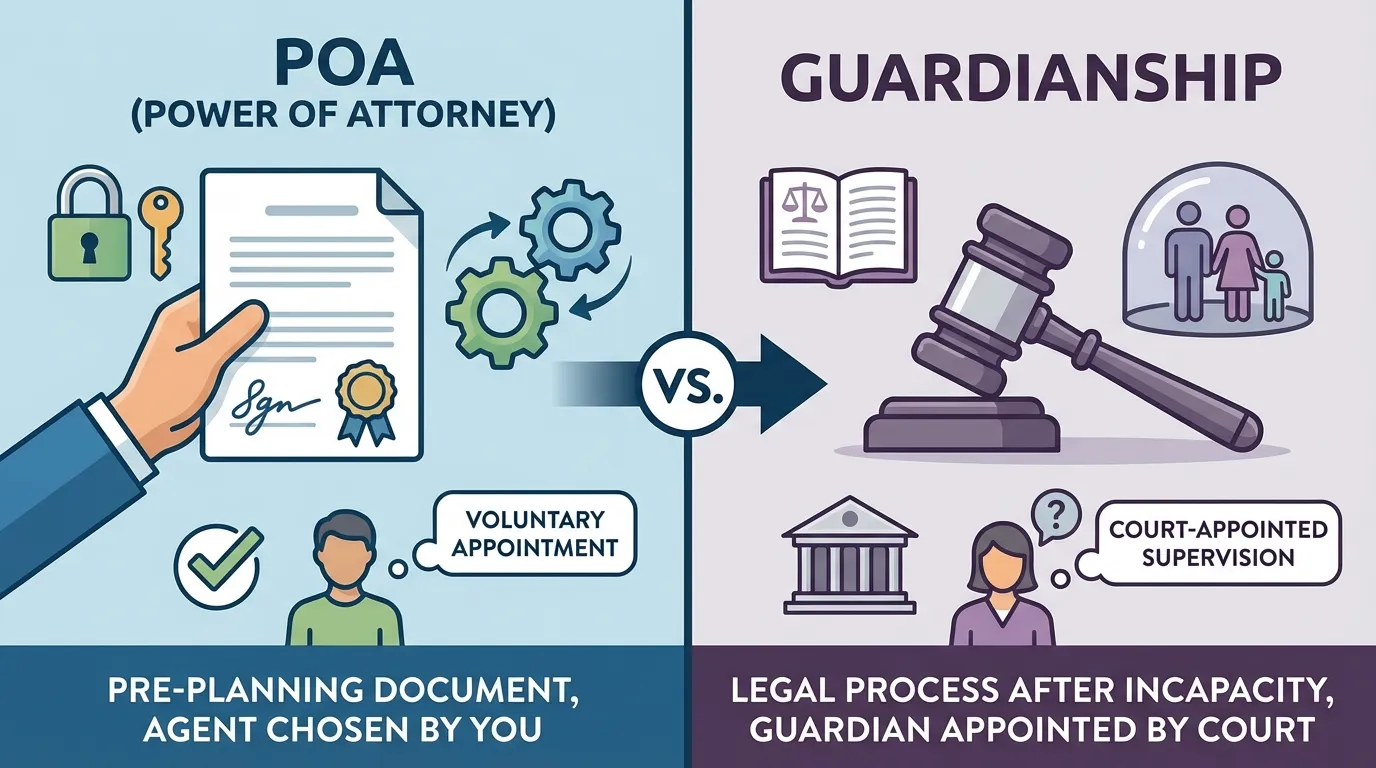
Imagine a situation where an elderly parent needs someone to manage their financial matters. They might sign a legal document allowing their adult child to act on their behalf. Another scenario involves a minor child whose parents are unable to care for them, requiring a court-appointed guardian. These situations highlight the difference between POA and guardianship.
The difference between POA and guardianship lies mainly in legal authority, purpose, and applicability. While both give someone the power to act for another, their scope, requirements, and legal implications are very different. Many people search for POA vs guardianship when navigating family, financial, or legal matters.
Understanding the difference between POA and guardianship is crucial for protecting rights and responsibilities. Whether for healthcare, finance, or personal care, knowing the difference between POA and guardianship ensures proper legal actions are taken. This knowledge is especially important for families, lawyers, and caregivers managing these responsibilities.
Key Difference Between the Both
The main difference between POA and guardianship is that a POA (Power of Attorney) is a voluntary legal document allowing a person to authorize another to act on their behalf.
Guardianship is a court-appointed arrangement where a guardian is legally empowered to make decisions for someone unable to do so themselves.
In discussions about POA vs guardianship, the key distinction is choice: a POA is created by the principal voluntarily, whereas guardianship is imposed by the court.
Why Is Their Difference Necessary to Know for Learners and Experts?
Understanding the difference between POA and guardianship is vital for both legal learners and family decision-makers.
For individuals, knowing the difference between POA and guardianship helps ensure that the correct legal tool is used for financial, medical, or personal matters. Many people compare POA vs guardianship to determine which is appropriate for their situation.
For legal experts, caregivers, and social workers, understanding the difference between POA and guardianship ensures compliance with laws and protects the rights of vulnerable individuals. This knowledge is important in society for planning, dispute resolution, and protecting personal interests.
Pronunciation of the Both (US & UK)
POA (Power of Attorney)
- US: /ˌpaʊər əv əˈtɜrni/
- UK: /ˌpaʊə əv əˈtɜːni/
Guardianship
- US: /ˈɡɑrdiənˌʃɪp/
- UK: /ˈɡɑːdiənʃɪp/
Understanding the pronunciation helps when discussing POA vs guardianship in legal or educational contexts.
Difference Between the Keywords
1. Definition
POA is a legal document granting someone authority to act on another person’s behalf.
- Example 1: An adult child handles their parent’s bank transactions.
- Example 2: A spouse manages finances temporarily while the partner is abroad.
Guardianship is a court-appointed legal arrangement for a person unable to make decisions themselves.
- Example 1: A guardian manages a minor child’s daily care.
- Example 2: A guardian oversees an incapacitated adult’s health and finances.
This is the primary difference between POA and guardianship.
2. Purpose
POA is often created for financial or healthcare decisions.
- Example 1: Managing investments or paying bills.
- Example 2: Making medical decisions when someone is temporarily unavailable.
Guardianship protects individuals unable to care for themselves.
- Example 1: Ensuring minors are safe and provided for.
- Example 2: Overseeing the welfare of an incapacitated adult.
3. Voluntary vs Court-Ordered
POA is voluntary.
- Example 1: A parent signs a POA document for an adult child.
- Example 2: Someone creates a healthcare POA in advance.
Guardianship is court-ordered.
- Example 1: The court appoints a guardian for a disabled adult.
- Example 2: A guardian is assigned to a minor without parental care.
4. Duration
POA can be temporary or permanent, depending on the document.
- Example 1: A temporary POA for a business trip.
- Example 2: A durable POA for ongoing care during illness.
Guardianship typically lasts until the minor becomes an adult or the adult recovers capacity.
- Example 1: Guardianship of a child until age 18.
- Example 2: Guardianship continues for an adult with permanent incapacity.
5. Scope of Authority
POA authority is limited to what the document specifies.
- Example 1: Only handles financial matters.
- Example 2: Only manages healthcare decisions.
Guardianship authority is broader and determined by the court.
- Example 1: Guardian manages personal, financial, and medical decisions.
- Example 2: Guardian oversees housing and daily living arrangements.
6. Revocation
POA can be revoked by the principal anytime if they have capacity.
- Example 1: Changing financial POA to another trusted person.
- Example 2: Revoking healthcare POA after recovery.
Guardianship can be modified only through the court.
- Example 1: Petitioning the court to remove or replace a guardian.
- Example 2: Requesting adjustments in guardianship duties.
7. Legal Documentation
POA requires signing and notarization or witnesses.
- Example 1: Bank POA for financial transactions.
- Example 2: Healthcare POA filed with medical providers.
Guardianship requires a court petition and hearing.
- Example 1: Court appointment for minor children.
- Example 2: Guardianship order for incapacitated adults.
8. Relationship Requirement
POA can be granted to anyone the principal trusts.
- Example 1: Family member, friend, or lawyer.
- Example 2: Professional fiduciary services.
Guardianship often favors family members but is court-approved.
- Example 1: Parent becomes guardian of a child.
- Example 2: Adult sibling appointed guardian of incapacitated relative.
9. Financial Control
POA can include financial authority.
- Example 1: Paying bills for the principal.
- Example 2: Managing investments temporarily.
Guardianship generally includes full control over finances for the protected person.
- Example 1: Guardian managing all assets of an incapacitated adult.
- Example 2: Guardian managing minor’s inheritance.
10. Risk and Oversight
POA relies on trust between the principal and attorney-in-fact.
- Example 1: Misuse is a risk if the agent acts dishonestly.
- Example 2: Proper oversight and instructions reduce risk.
Guardianship is monitored by the court.
- Example 1: Annual reporting to the court is required.
- Example 2: Court supervision ensures the guardian acts in the ward’s best interest.
Nature and Behaviour of Both
POA behaves as a voluntary legal tool for temporary or ongoing assistance. It is flexible and allows the principal to choose who can act on their behalf.
Guardianship behaves as a court-enforced arrangement for protection. It ensures the ward’s welfare is managed when they cannot make decisions themselves. These differences highlight the difference between POA and guardianship in legal practice.
Why People Are Confused About Their Use?
| Feature | POA | Guardianship | Similarity |
| Authority | Voluntary | Court-appointed | Both give legal authority |
| Scope | Limited to document | Broad as court decides | Both manage decisions for another person |
| Duration | Temporary or durable | Until age or recovery | Both can be long-term |
| Revocation | Can revoke anytime | Court approval needed | Both can be legally modified |
Confusion arises because both involve decision-making for another person, leading people to compare POA vs guardianship.
Which Is Better in What Situation?
POA is better when a person has capacity and wants to voluntarily assign authority for financial, legal, or healthcare matters. It is flexible, easy to set up, and suitable for temporary needs.
Guardianship is better when someone cannot manage their own affairs, such as minors, incapacitated adults, or those needing court oversight. It provides legal protection and ensures decisions are monitored for the person’s best interest.
How the Keywords Are Used in Metaphors and Similes
Examples:
- “A POA is like giving someone your steering wheel temporarily to navigate the road safely.”
- “Guardianship is like having a permanent co-pilot when someone cannot fly the plane alone.”
These metaphors explain the difference between POA and guardianship visually.
Connotative Meaning of Both Keywords
POA – Neutral to Positive
Example: “A POA ensures your trusted agent can manage matters in your absence.”
Guardianship – Positive
Example: “Guardianship protects those who cannot make decisions themselves.”
Idioms or Proverbs Related to the Words
“With great power comes great responsibility.”
Example: Both a POA agent and a guardian must act responsibly.
“It takes a village.”
Example: Guardianship often relies on a support system to care for a ward.
Works in Literature Using the Keywords
- Guardianship of the Mind — Psychology, John Doe, 2015
- Legal Powers Explained — Law Guide, Jane Smith, 2018
- Rights and Responsibilities — Legal textbook, Mark Lee, 2020
Movie Names Related to the Keywords
- The Guardians — 2017, USA
- Power of Attorney — 2014, UK
- Family Bonds — 2016, USA
These films explore themes of legal authority and protection.
Frequently Asked Questions
1. What is the main difference between POA and guardianship?
POA is voluntary and chosen by a person with capacity, while guardianship is court-appointed for those unable to manage their affairs.
2. Can POA replace guardianship?
No, POA only works if the principal has capacity; guardianship is for those lacking capacity.
3. Who monitors POA?
POA is primarily monitored by the principal and legal system if disputes arise.
4. Can a guardian be removed?
Yes, but only through a court petition.
5. Which is more secure legally?
Guardianship provides stricter legal oversight, while POA depends on trust.
How Both Are Useful for Surroundings
POA and guardianship both ensure responsible management of personal, financial, and medical affairs. They protect vulnerable individuals, assist families, and maintain legal compliance in society. Knowing the difference between POA and guardianship helps people make the right choice for care and decision-making.
Final Words for the Both
Both POA and guardianship are essential legal tools for delegating responsibility. Understanding the difference between POA and guardianship and comparing POA vs guardianship helps families, lawyers, and caregivers act appropriately.
Conclusion
The difference between POA and guardianship lies in voluntariness, legal process, scope, and oversight. POA is voluntary, flexible, and chosen by someone with capacity, while guardianship is court-appointed for those unable to manage their own affairs.
Knowing the difference between POA and guardianship ensures proper legal protection and responsible decision-making. Understanding POA vs guardianship helps individuals, families, and professionals handle financial, healthcare, and personal matters effectively, maintaining both rights and responsibilities.