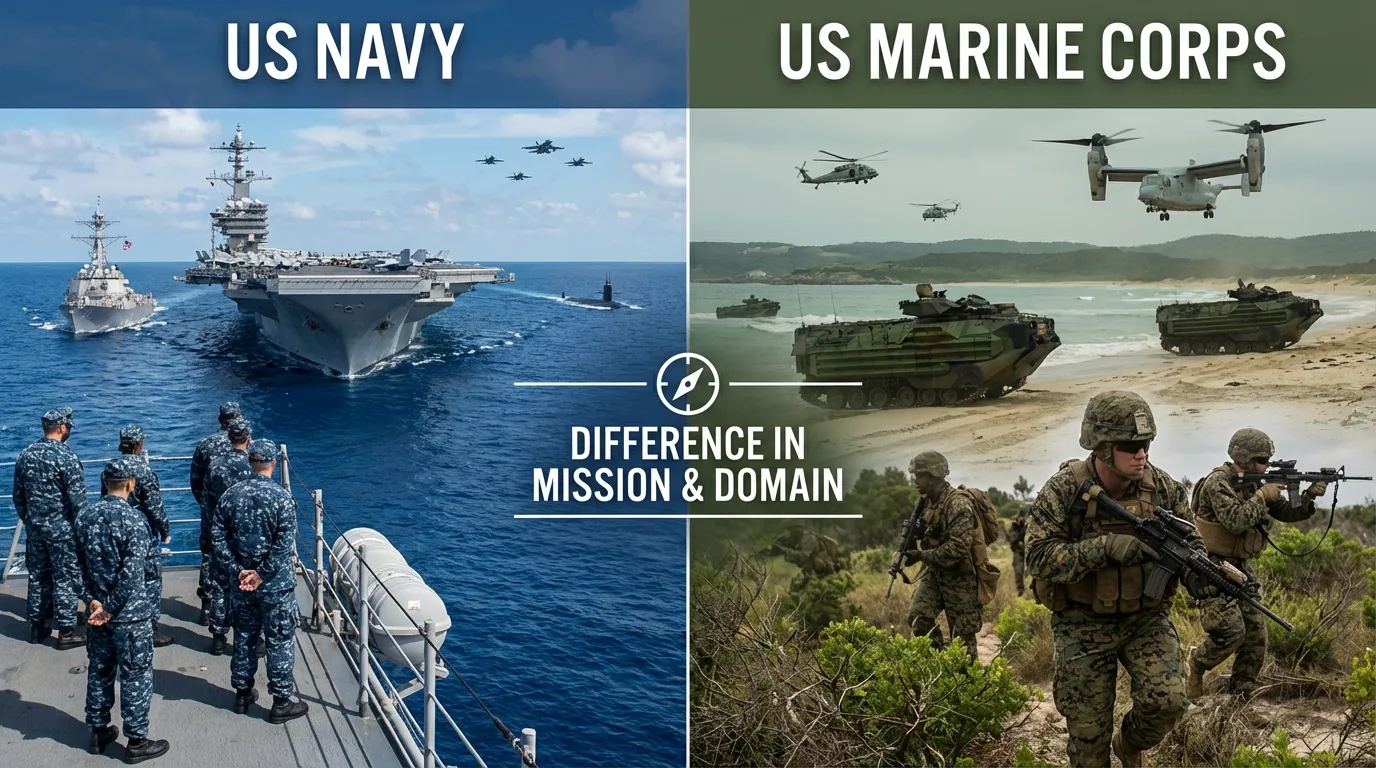
Imagine a country preparing for both sea battles and amphibious assaults. The Navy provides ships, submarines, and strategic defense at sea, while the Marines are trained to fight on land after landing from the sea. This scenario illustrates the difference between Navy and Marine.
The difference between Navy and Marine lies in roles, training, and operational focus. The Navy is primarily a maritime force, whereas Marines specialize in amphibious warfare. Many people search for Navy vs Marine to understand military structure, duties, and career opportunities.
Knowing the difference between Navy and Marine is crucial for students, military enthusiasts, and aspiring service members. Understanding Navy vs Marine ensures clarity about responsibilities, hierarchy, and skill sets in defense forces.
Key Difference Between the Both
The main difference between Navy and Marine is their operational domain.
The Navy handles maritime operations, including warships, submarines, and logistics.
The Marines specialize in amphibious operations, securing beachheads and rapid assault missions.
In short, Navy vs Marine differs in mission, training, and deployment, although they often work together in military operations.
Why Is Their Difference Necessary to Know for Learners and Experts?
Understanding the difference between Navy and Marine is vital for military enthusiasts, students, and defense strategists.
For learners, knowing the difference between Navy and Marine helps in career planning, education, and understanding military structure. Many search for Navy vs Marine to decide which branch suits them best.
For experts, understanding the difference between Navy and Marine ensures proper strategic planning and resource allocation. Awareness of Navy vs Marine is essential for defense studies, policy-making, and tactical operations.
Pronunciation of the Both (US & UK)
Navy
- US: /ˈneɪ.vi/
- UK: /ˈneɪ.vi/
Marine
- US: /məˈriːn/
- UK: /məˈriːn/
Correct pronunciation ensures clear communication in educational, military, and professional discussions about Navy vs Marine.
Difference Between the Keywords
1. Definition
Navy is a branch of a nation’s armed forces specializing in naval and maritime operations.
- Example 1: The U.S. Navy operates aircraft carriers and submarines.
- Example 2: The Navy protects sea trade routes and national waters.
Marine is a branch trained for amphibious and expeditionary operations, often deployed from ships to land.
- Example 1: Marines secure a beachhead during a military landing.
- Example 2: Marines perform rapid assault missions after arriving from Navy vessels.
2. Primary Role
Navy focuses on sea control, maritime defense, and naval strategy.
- Example 1: Patrolling international waters.
- Example 2: Protecting maritime supply lines.
Marines focus on amphibious warfare and rapid ground assault after deployment from ships.
- Example 1: Conducting coastal attacks.
- Example 2: Taking control of enemy ports or islands.
3. Training
Navy personnel train in naval operations, navigation, and ship systems.
- Example 1: Learning to operate submarines and aircraft carriers.
- Example 2: Handling naval weapons systems.
Marines undergo rigorous combat and amphibious training.
- Example 1: Boot camp with land and sea combat exercises.
- Example 2: Tactical assault training and survival skills.
4. Deployment
Navy personnel are deployed on ships, submarines, and naval bases.
- Example 1: Serving aboard a destroyer in international waters.
- Example 2: Stationed on a naval base for maintenance and operations.
Marines are deployed on ships for transit but operate on land during combat.
- Example 1: Landing on a hostile shore for assault operations.
- Example 2: Conducting reconnaissance missions after ship deployment.
5. Equipment
Navy uses ships, submarines, aircraft, and naval weapons.
- Example 1: Aircraft carriers for air operations at sea.
- Example 2: Submarines for underwater defense and attack.
Marines use light armor, artillery, and infantry weapons.
- Example 1: Tanks and amphibious vehicles for beach assaults.
- Example 2: Rifles and grenade launchers for ground combat.
6. Size and Organization
Navy is a larger branch with fleets, squadrons, and global bases.
- Example 1: Navy includes thousands of personnel worldwide.
- Example 2: Organized into specialized units like surface fleet and submarine fleet.
Marines are smaller but highly mobile and expeditionary.
- Example 1: Marine units can rapidly deploy to conflict zones.
- Example 2: Smaller, elite units trained for targeted missions.
7. Hierarchy
Navy has a structured chain of command with admirals, captains, and officers.
- Example 1: Admiral commands an aircraft carrier fleet.
- Example 2: Captain oversees ship operations.
Marines have ranks including generals, colonels, and enlisted units focused on combat.
- Example 1: Marine general plans amphibious assault.
- Example 2: Lieutenant commands a platoon during deployment.
8. International Presence
Navy often has global presence and diplomatic roles.
- Example 1: Port visits in allied countries.
- Example 2: Participating in joint naval exercises.
Marines are usually deployed in targeted operations with strategic importance.
- Example 1: Humanitarian missions in conflict zones.
- Example 2: Rapid response to emerging threats.
9. Relationship
Navy supports Marines by transporting them and providing naval artillery.
- Example 1: Aircraft carrier deploys Marines to a mission zone.
- Example 2: Naval gunfire supports marine beach landing.
Marines rely on Navy for transport and supplies during operations.
- Example 1: Amphibious landing coordinated with Navy ships.
- Example 2: Resupply missions provided by naval logistics.
10. Career Opportunities
Navy careers include navigation, engineering, medical, aviation, and intelligence.
- Example 1: Naval pilot operating from aircraft carriers.
- Example 2: Engineer maintaining ship systems.
Marine careers focus on combat leadership, tactics, and expeditionary skills.
- Example 1: Infantry officer leading assault missions.
- Example 2: Reconnaissance specialist gathering intelligence on land.
Nature and Behaviour of Both
Navy behaves as a strategic maritime force, defending seas and enabling global operations.
Marines behave as rapid-deployment, amphibious specialists trained for ground combat. Understanding their roles clarifies the difference between Navy and Marine.
Why People Are Confused About Their Use?
| Feature | Navy | Marine | Similarity |
| Domain | Sea operations | Amphibious/land operations | Both are military branches |
| Role | Defense and patrol | Assault and rapid deployment | Both protect national security |
| Training | Naval systems and ships | Combat and amphibious warfare | Both require rigorous training |
| Deployment | Ships, submarines, bases | Land missions from ships | Both may work together in operations |
Confusion arises because both are part of a country’s defense forces, often operating jointly.
Which Is Better in What Situation?
Navy is better for strategic defense, global maritime operations, and controlling sea lanes. For example, protecting trade routes or engaging in naval warfare is a Navy’s primary role.
Marines are better for rapid assault, amphibious missions, and tactical ground operations. For example, securing a hostile coastline or responding to sudden crises is ideal for Marines. The choice depends on operational needs and mission type in Navy vs Marine scenarios.
How the Keywords Are Used in Metaphors and Similes
- “The Navy is like the backbone of the seas, protecting the nation’s waters.”
- “The Marines are like a spearhead, striking quickly and decisively on land.”
These metaphors explain the difference between Navy and Marine vividly.
Connotative Meaning of Both Keywords
Navy – Positive
Example: “The Navy safeguards international waters and trade.”
Marine – Positive
Example: “The Marines are heroes in amphibious operations and combat missions.”
Idioms or Proverbs Related to the Words
“All hands on deck.” – Often used to describe Navy readiness.
Example: Navy personnel preparing for emergency maneuvers.
“Lead from the front.” – Often associated with Marines’ combat leadership.
Example: Marines spearheading assault in hostile territory.
Works in Literature Using the Keywords
- The U.S. Navy in World War II — History, John Keegan, 1989
- Marine Corps Leadership Handbook — Military Guide, Jane Smith, 2015
- Sea Power and Strategy — Nonfiction, Mark Allen, 2012
Movie Names Related to the Keywords
- Top Gun — 1986, USA
- Saving Private Ryan — 1998, USA
- American Sniper — 2014, USA
These films highlight the roles of Navy and Marines in combat and defense operations.
Frequently Asked Questions
1. What is the main difference between Navy and Marine?
Navy focuses on sea operations; Marines specialize in amphibious and ground assault.
2. Can Marines operate independently of the Navy?
Yes, but they often rely on Navy ships for deployment.
3. Which branch is larger?
The Navy is generally larger with more personnel and ships.
4. Do both branches require combat training?
Yes, but Marines receive more intensive ground combat training.
5. Which branch is better for rapid deployment?
Marines are better for quick, tactical deployments on land.
How Both Are Useful for Surroundings
Both Navy and Marines protect national security, defend borders, and ensure global peace. Understanding Navy vs Marine helps civilians, students, and strategists appreciate their complementary roles.
Final Words for the Both
Navy and Marines are indispensable for national defense. Knowing the difference between Navy and Marine and comparing Navy vs Marine helps individuals, students, and enthusiasts understand military operations and career paths.
Conclusion
The difference between Navy and Marine lies in operational domain, training, and mission focus. Navy defends seas and provides strategic control, while Marines specialize in amphibious assaults and rapid land operations.
Understanding the difference between Navy and Marine is vital for military knowledge, career decisions, and appreciating national defense strategies. Exploring Navy vs Marine ensures clarity on their unique roles and how they collaborate for national security.