🟩 Quick Answer:
OLED is a display technology with self-lighting pixels, while UHD is a resolution standard (4K) that defines picture clarity. 🟦 Simple Tip:
Choose OLED for better colors and contrast, and UHD for higher resolution and sharper images.
When I visited an electronics store, I saw two TVs side by side. One had deep blacks and bright colors, while the other showed very sharp and clear images. The labels said OLED and UHD. At first, I thought they were the same thing, but they are not.
The difference between OLED and UHD is important when buying a TV or screen. OLED is about how the screen works, while UHD is about how clear the picture looks. Both are used in modern devices, but they serve different purposes.
Understanding the difference between OLED and UHD helps you choose the right screen for your needs. Whether you love movies, games, or simple viewing, knowing the difference between OLED and UHD can make your experience much better.
Key Difference Between the Both
The main difference is simple. OLED is a type of display technology, while UHD is a resolution standard.
OLED controls light at each pixel, giving better contrast. UHD increases the number of pixels, making images sharper.
Why Is Their Difference Necessary to Know for Learners and Experts?
Knowing screen technology is useful today. Learners can make better buying decisions, and experts can design better products.
The difference between OLED and UHD helps people understand what they are paying for. It also prevents confusion when comparing products.
In society, screens are everywhere—from phones to TVs. Understanding the difference between OLED and UHD vs other display types helps users enjoy better quality and value.
Pronunciation of the Both (US & UK)
- OLED:
- US: oh-led
- UK: oh-led
- UHD:
- US: yoo-ech-dee
- UK: yoo-ech-dee
Now that you know how to say them, let’s explore their differences in detail.
Difference Between the Keywords
1. Definition
OLED is a display technology.
UHD is a resolution format.
Examples:
- OLED TVs control each pixel.
- UHD TVs show 4K resolution images.
2. Function
OLED produces light itself.
UHD defines pixel count.
Examples:
- OLED pixels turn on/off individually.
- UHD screens show more detail.
3. Picture Quality
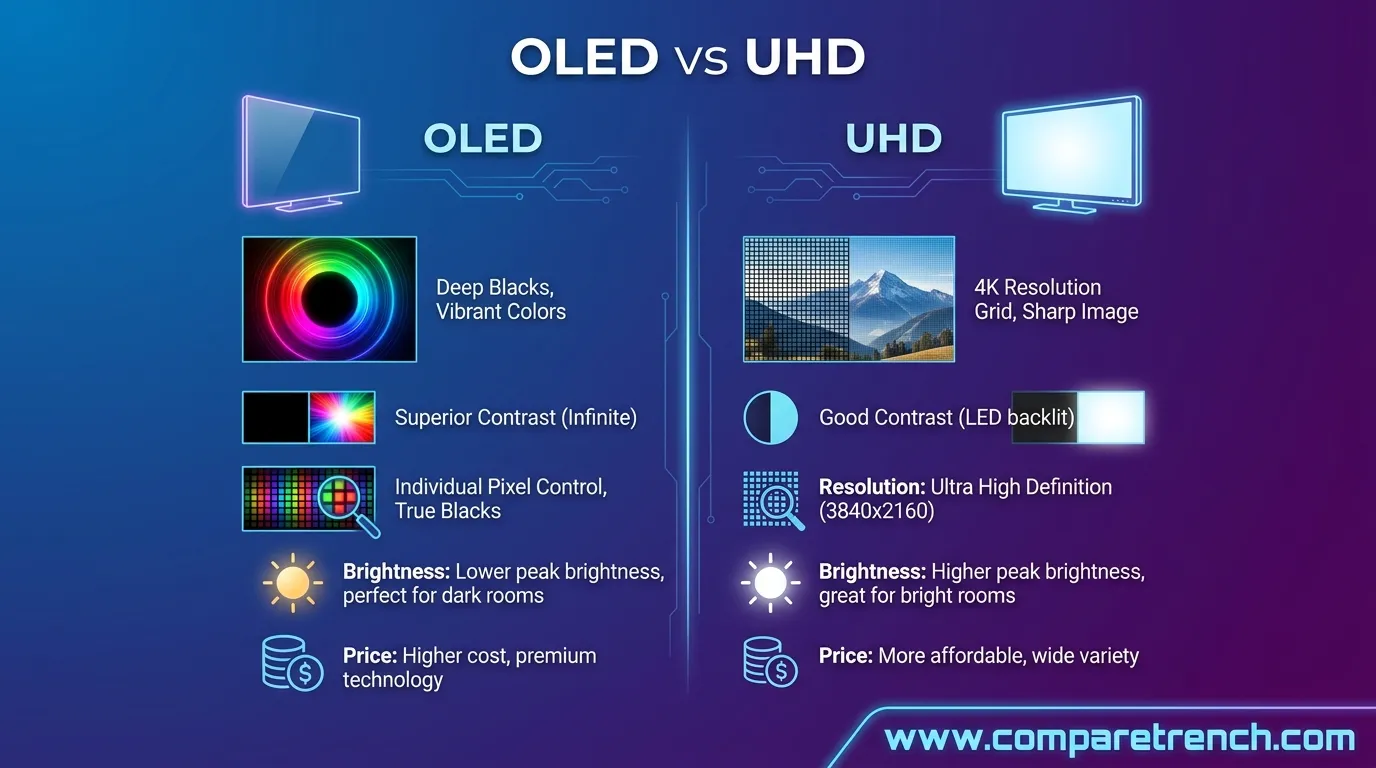
OLED offers better contrast.
UHD offers sharper images.
Examples:
- OLED shows deep blacks.
- UHD shows fine details in videos.
4. Color Performance
OLED has richer colors.
UHD depends on the panel type.
Examples:
- OLED shows vibrant reds and blues.
- UHD may vary across TVs.
5. Brightness
OLED has moderate brightness.
UHD can be very bright.
Examples:
- OLED works well in dark rooms.
- UHD TVs shine in bright rooms.
6. Viewing Angles
OLED has wide viewing angles.
UHD varies by screen type.
Examples:
- OLED looks good from the side.
- Some UHD TVs lose quality at angles.
7. Thickness
OLED screens are very thin.
UHD screens are thicker.
Examples:
- OLED TVs can be ultra-slim.
- UHD TVs are usually bulkier.
8. Energy Use
OLED uses less power for dark scenes.
UHD uses steady power.
Examples:
- OLED saves energy in movies.
- UHD uses similar power always.
9. Price
OLED is more expensive.
UHD is more affordable.
Examples:
- OLED TVs cost more.
- UHD TVs fit lower budgets.
10. Lifespan
OLED may degrade over time.
UHD depends on panel type.
Examples:
- OLED can face burn-in issues.
- UHD LED TVs last longer.
Discuss the Nature and Behaviour of the Both Separately
OLED is flexible and advanced. It gives deep blacks and high contrast. It behaves like a premium display technology for high-end users.
UHD is a standard feature. It focuses on clarity and resolution. It behaves like a universal upgrade for better picture sharpness.
Why People Are Confused About Their Use?
| Feature | OLED | UHD | Similarity |
| Type | Technology | Resolution | Both improve display |
| Focus | Contrast | Sharpness | Both enhance quality |
| Use | Premium TVs | Many TVs | Both widely used |
| Confusion | Seen together | Seen together | Sold together |
People are confused because many TVs offer OLED and UHD together. The difference between OLED and UHD vs other terms becomes unclear in marketing.
Which Is Better in What Situation?
OLED is better for movies and gaming. It gives deep blacks and rich colors. It works best in dark rooms and for high-quality viewing.
UHD is better for everyday use. It gives sharp images and works well in bright rooms. It is great for sports and general watching.
How the Keywords Used in Metaphors and Similes
- “Clear like UHD” means something is very sharp.
- “Deep like OLED” means something has strong depth.
These phrases show how technology terms enter daily speech.
Connotative Meaning of Both the Keywords
- OLED:
- Positive: premium, advanced
- Neutral: display tech
- Negative: expensive
Example:
- “His work is like OLED—deep and detailed.”
- UHD:
- Positive: clarity, sharpness
- Neutral: resolution
- Negative: common
Example:
- “Her vision is like UHD—clear and focused.”
Idioms or Proverbs Related to the Words
- “Crystal clear”
- Example: The image is UHD clear.
- “See the bigger picture”
- Example: OLED helps you see deeper details.
Works in Literature
- The Display Technology Book – Tech – 2018
- Understanding Screens – Tech Guide – 2020
Movie Names Made on Keywords
- No direct movies exist, but high-quality visuals appear in:
- Avatar – 2009 – USA
- Gravity – 2013 – USA
How Both Are Useful for Surroundings
OLED improves visual quality in premium devices. UHD improves clarity in everyday screens.
Both help in education, entertainment, and communication.
Top 10 Comparison Table
| Point | OLED | UHD |
| Type | Technology | Resolution |
| Focus | Contrast | Sharpness |
| Color | Rich | Depends |
| Brightness | Medium | High |
| Cost | High | Lower |
| Thickness | Thin | Thicker |
| Viewing | Wide | Varies |
| Power | Efficient | Stable |
| Use | Premium | General |
| Lifespan | Moderate | Long |
Final Words for the Both
OLED and UHD are different but both are important. OLED improves quality, while UHD improves clarity.
Understanding OLED vs UHD helps you choose better screens.
Conclusion
The difference between OLED and UHD is simple but important. OLED focuses on display quality, while UHD focuses on resolution.
Both technologies improve viewing, but in different ways. OLED is best for deep colors and contrast, while UHD is best for sharp images.
Knowing these differences helps you make smart choices when buying screens. Whether you choose OLED vs UHD, the right option depends on your needs and budget.
Frequently Asked Questions
1. What is the main difference between OLED and UHD?
OLED is a display technology, while UHD is a resolution standard.
2. Which is better OLED or UHD?
It depends. OLED is better for contrast, UHD is better for sharpness.
3. Can a TV be both OLED and UHD?
Yes, many TVs have both features.
4. Is OLED more expensive than UHD?
Yes, OLED TVs are usually more costly.
5. Why are people confused between OLED and UHD?
Because both terms are used together in TV marketing.