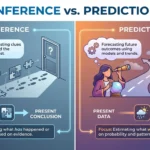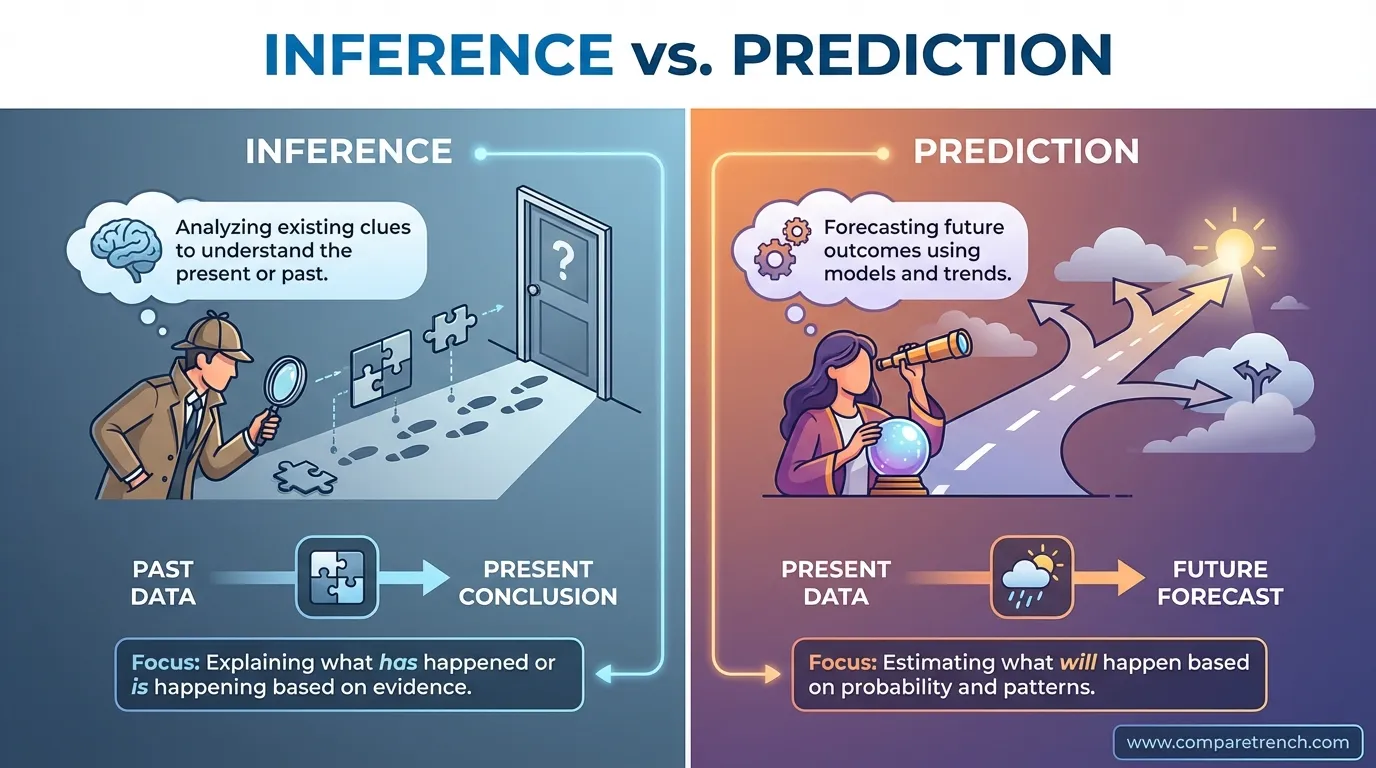
🟩 Featured Snippet: Inference means drawing a conclusion from clues or evidence. Prediction means guessing what will happen in the future based on patterns or data.
Imagine a teacher seeing dark clouds and telling students to stay inside. She is making an inference from what she observes. Later, she says, “It will rain in one hour.” That is a prediction.
The difference between inference and prediction is easy to understand when we see how we think in daily life. Inference is about explaining what is happening now using clues. Prediction is about guessing what will happen next.
When we study the difference between inference and prediction, we learn how people think, decide, and solve problems. This difference between inference and prediction helps students, scientists, and even doctors. Understanding the difference between inference and prediction can improve decision-making and critical thinking in simple ways.
Key Difference Between the Both
The main difference between inference vs prediction is time.
Inference explains the present or past using evidence. Prediction talks about the future using trends or patterns.
Both are important thinking tools, but they serve different purposes in learning and life.
Why Is Their Difference Necessary to Know for Learners and Experts?
Understanding the difference between inference and prediction helps learners think clearly. Students can read better, understand stories, and solve problems.
Experts like scientists and analysts use the difference between inference vs prediction to study data and make decisions.
In society, this knowledge helps people avoid confusion. For example, doctors infer diseases from symptoms but predict recovery time. Knowing the difference between inference and prediction improves accuracy and confidence.
Pronunciation of Both (US & UK)
- Inference:
- US: IN-fur-uhns
- UK: IN-fuh-ruhnce
- Prediction:
- US: pri-DIK-shun
- UK: pri-DIK-shuhn
Now that you know how to say them, let’s move forward to explore the difference between inference vs prediction in detail.
Difference Between the Keywords
1. Time Focus
Inference focuses on present or past. Prediction focuses on future.
- Example (Inference): The ground is wet, so it rained.
- Example (Prediction): It will rain later today.
2. Based On
Inference uses evidence. Prediction uses patterns.
- Example (Inference): He is tired because he is yawning.
- Example (Prediction): He will sleep soon.
3. Purpose
Inference explains. Prediction forecasts.
- Example (Inference): She is happy because she is smiling.
- Example (Prediction): She will celebrate tonight.
4. Certainty Level
Inference is more certain. Prediction is less certain.
- Example (Inference): Smoke means fire.
- Example (Prediction): Fire may spread.
5. Use in Reading
Inference helps understand text. Prediction helps guess story outcomes.
- Example (Inference): The character is sad.
- Example (Prediction): The story may end happily.
6. Use in Science
Inference explains data. Prediction tests future results.
- Example (Inference): Plants need sunlight.
- Example (Prediction): Plants will grow faster with more light.
7. Evidence Type
Inference uses direct clues. Prediction uses trends.
- Example (Inference): Clouds are dark.
- Example (Prediction): Storm is coming.
8. Thinking Skill
Inference is analytical. Prediction is imaginative.
- Example (Inference): He failed due to lack of study.
- Example (Prediction): He will pass next time.
9. Outcome
Inference gives explanation. Prediction gives expectation.
- Example (Inference): Food is burnt.
- Example (Prediction): Next meal will be better.
10. Learning Stage
Inference comes first. Prediction follows.
- Example (Inference): Test was hard.
- Example (Prediction): Students may score low.
Nature and Behaviour of Both
Inference is logical and evidence-based. It stays close to facts and reality.
Prediction is future-focused and sometimes uncertain. It depends on patterns and guesses.
So, in inference vs prediction, one explains while the other anticipates.
Why People Are Confused About Their Use?
| Aspect | Inference | Prediction | Similarity |
| Meaning | Explains clues | Guesses future | Both use thinking |
| Time | Present/Past | Future | Based on reasoning |
| Certainty | More sure | Less sure | Use evidence |
| Use | Analysis | Forecasting | Help decisions |
Which Is Better in What Situation?
Inference is better when you need to explain something clearly. For example, teachers use inference to explain student behavior. It helps understand facts and current situations.
Prediction is better when planning ahead. For example, weather forecasting uses prediction. It helps prepare for future events. In inference vs prediction, both are useful depending on the need.
How the Keywords Used in Metaphors and Similes
- Inference: “Her silence was a clue, like a hidden message.”
- Prediction: “His guess flew like an arrow into the future.”
Connotative Meaning
- Inference: Neutral/Positive
- Example: Her inference was accurate.
- Prediction: Neutral
- Example: His prediction was correct.
Idioms or Proverbs
- “Reading between the lines” (Inference)
- Example: She read between the lines to understand the message.
- “Crystal ball” (Prediction)
- Example: He used a crystal ball to predict the future.
Works in Literature
- Inference
- Detective Fiction – Arthur Conan Doyle – 1892
- Prediction
- Science Fiction – H.G. Wells – 1895
Movie Names
- Minority Report (2002, USA) – Prediction theme
- Sherlock Holmes (2009, UK/USA) – Inference theme
How Both Are Useful for Surroundings
Inference helps us understand people and situations.
Prediction helps us prepare for future events like weather or exams.
In daily life, inference vs prediction makes thinking smarter.
Top 10 Comparison Table
| No | Inference | Prediction |
| 1 | Present/Past | Future |
| 2 | Evidence-based | Pattern-based |
| 3 | Explanation | Forecast |
| 4 | More certain | Less certain |
| 5 | Logical | Imaginative |
| 6 | Used in reading | Used in planning |
| 7 | Based on clues | Based on trends |
| 8 | Analytical | Predictive |
| 9 | Immediate | Future-focused |
| 10 | Fact-driven | Possibility-driven |
Final Words for the Both
Inference explains what we see. Prediction tells what may happen next.
Both are powerful tools in learning and thinking.
Conclusion
The difference between inference and prediction is simple but very important. Inference helps us understand what is happening now by using clues. Prediction helps us think about the future using patterns.
In inference vs prediction, both work together to improve thinking skills. Students, teachers, and professionals all benefit from knowing this difference.
When you understand the difference between inference and prediction, you become better at reading, analyzing, and planning. It is a key skill for everyday life.
Frequently Asked Questions
1. What is the main difference between inference and prediction?
Inference explains present clues, while prediction guesses future events.
2. Which is more accurate?
Inference is usually more accurate because it uses direct evidence.
3. Can inference and prediction be used together?
Yes, inference helps build prediction.
4. Is prediction always correct?
No, prediction can be wrong because it is about the future.
5. Why is this difference important?
It improves thinking, learning, and decision-making.