In today’s fast-moving digital world, people often transfer money instantly from one bank to another. Imagine a small business owner who needs to pay a supplier urgently. At that moment, choosing the right transfer method matters. This is where understanding the difference between NEFT and RTGS becomes very important.
The difference between NEFT and RTGS is mainly related to how quickly money is transferred and the minimum transaction amount. Many people hear these terms when using online banking but are not fully aware of the NEFT vs RTGS concept and how each system works.
Knowing the difference between NEFT and RTGS helps individuals and businesses choose the correct payment method. Whether someone is sending a small amount to a friend or a large payment to a company, understanding NEFT vs RTGS ensures safer and more efficient transactions.
In simple words, learning the difference between NEFT and RTGS or understanding NEFT vs RTGS helps people avoid confusion while making online bank transfers.
Key Difference Between the Both
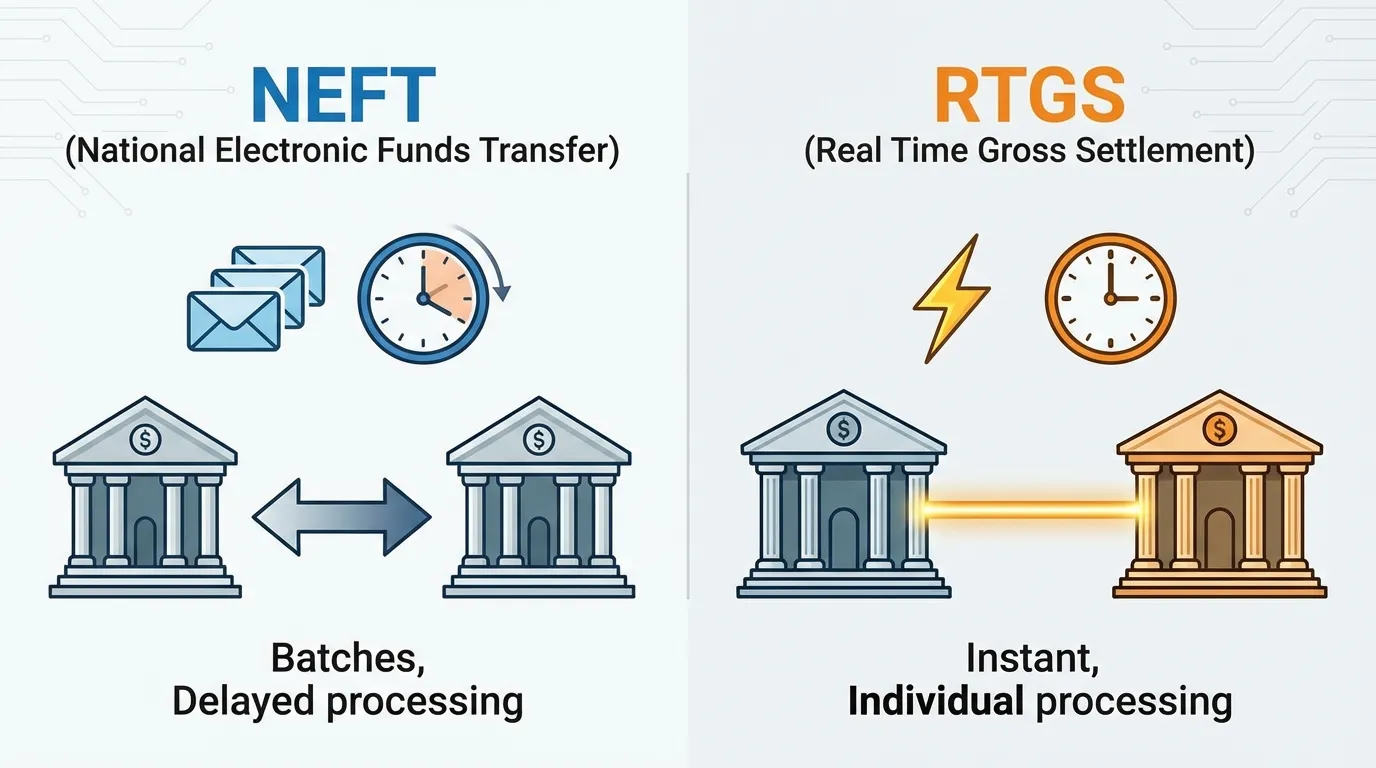
The main difference between NEFT and RTGS lies in transaction speed and settlement method.
NEFT (National Electronic Funds Transfer) processes payments in batches, meaning transactions are grouped and processed together.
RTGS (Real Time Gross Settlement) transfers money instantly and processes each transaction individually in real time.
When discussing NEFT vs RTGS, we can say that NEFT is suitable for small routine payments while RTGS is designed for urgent and high-value transactions.
Why Is Their Difference Necessary to Know for Learners and Experts?
Understanding the difference between NEFT and RTGS is important for both beginners and financial professionals.
For learners, it helps them understand how modern banking systems work. Knowing NEFT vs RTGS allows people to choose the correct method when transferring money.
For experts and professionals, the difference between NEFT and RTGS plays a major role in financial planning, business transactions, and large-scale payments. Businesses often depend on RTGS for urgent payments, while NEFT is widely used for routine transfers.
In society, digital banking is growing rapidly. Therefore, knowing the difference between NEFT and RTGS or clearly understanding NEFT vs RTGS helps improve financial literacy and promotes safer banking practices.
Pronunciation of the Both (US & UK)
NEFT
- US: /nɛft/
- UK: /nɛft/
RTGS
- US: /ɑːr tiː dʒiː ɛs/
- UK: /ɑː tiː dʒiː ɛs/
Before exploring the full difference between NEFT and RTGS, it is useful to understand how these terms are spoken in daily banking conversations when people compare NEFT vs RTGS.
Difference Between the Keywords
1. Processing Method
NEFT processes transactions in batches.
Example 1: A person sends ₹5,000 through NEFT and it is processed in the next settlement batch.
Example 2: Salary payments sent to employees through NEFT may be processed together.
RTGS processes transactions individually.
Example 1: A company sends ₹10 lakh through RTGS and it reaches instantly.
Example 2: Property payment is transferred through RTGS for immediate confirmation.
This point clearly explains the difference between NEFT and RTGS.
2. Transaction Speed
NEFT transfers may take some time depending on the batch schedule.
Example 1: A student sends money for fees and it arrives after a short wait.
Example 2: A friend sends funds that appear in the account later in the day.
RTGS transfers happen in real time.
Example 1: A business payment arrives within minutes.
Example 2: A supplier receives funds instantly for urgent delivery.
This is another key comparison in NEFT vs RTGS.
3. Minimum Transfer Amount
NEFT has no minimum limit.
Example 1: Sending ₹100 to a friend.
Example 2: Paying a small online purchase.
RTGS usually has a minimum limit.
Example 1: Businesses transferring large funds.
Example 2: Real estate payments.
This shows the practical difference between NEFT and RTGS.
4. Transaction Purpose
NEFT is commonly used for everyday payments.
Example 1: Utility bills.
Example 2: Personal transfers.
RTGS is used for high-value transfers.
Example 1: Corporate payments.
Example 2: Large business deals.
When people compare NEFT vs RTGS, purpose is an important factor.
5. Settlement Type
NEFT uses deferred settlement.
Example 1: Payment processed in the next time slot.
Example 2: Multiple payments cleared together.
RTGS uses immediate settlement.
Example 1: Payment settled instantly between banks.
Example 2: Immediate confirmation for high-value deals.
This technical feature explains the difference between NEFT and RTGS clearly.
6. Popularity of Use
NEFT is widely used by individuals.
Example 1: Family money transfers.
Example 2: Paying school fees.
RTGS is popular with businesses.
Example 1: Corporate vendor payments.
Example 2: Import-export transactions.
This comparison often appears in discussions about NEFT vs RTGS.
7. Processing Time Window
NEFT operates continuously but still follows settlement cycles.
Example 1: Transfers processed periodically during the day.
Example 2: Banks group multiple requests together.
RTGS works instantly during banking hours.
Example 1: Urgent payment processed immediately.
Example 2: Quick settlement for business transactions.
This shows the operational difference between NEFT and RTGS.
8. Risk Level
NEFT carries slightly delayed confirmation.
Example 1: Waiting for confirmation message.
Example 2: Payment showing pending status.
RTGS reduces delay risk.
Example 1: Immediate credit confirmation.
Example 2: Faster completion of deals.
Another point often discussed in NEFT vs RTGS comparisons.
9. Typical Users
NEFT users are usually individuals and small businesses.
Example 1: Freelancers receiving payments.
Example 2: Students paying fees.
RTGS users are mostly corporations.
Example 1: Banks transferring large funds.
Example 2: Government transactions.
This highlights the practical difference between NEFT and RTGS.
10. Urgency of Transfer
NEFT is used for non-urgent payments.
Example 1: Monthly rent transfers.
Example 2: Routine personal payments.
RTGS is ideal for urgent payments.
Example 1: Property deal payments.
Example 2: Emergency business transfers.
This final point summarizes the real-life NEFT vs RTGS situation.
Nature and Behaviour of Both
NEFT behaves like a scheduled payment system. Transactions are collected and processed in groups, which makes it flexible for everyday transfers.
RTGS behaves like an instant transfer system. Each transaction is processed separately without delay. This explains the operational difference between NEFT and RTGS.
Why People Are Confused About Their Use?
| Feature | NEFT | RTGS | Similarity |
| Transfer Speed | Batch processing | Real-time processing | Both transfer money electronically |
| Minimum Amount | No minimum limit | Usually higher minimum | Both used in banking |
| Usage | Small payments | Large payments | Both require bank accounts |
| Processing | Group settlement | Individual settlement | Both are secure |
People often confuse NEFT vs RTGS because both systems are used for online bank transfers and look similar in banking apps.
Which Is Better in What Situation?
NEFT is better for everyday transactions. If someone wants to send a small amount to a friend, pay bills, or transfer salary, NEFT is a convenient choice. It has no minimum limit and is commonly available through online banking.
RTGS is better for urgent and large transactions. Businesses often use RTGS when they need immediate settlement. When comparing NEFT vs RTGS, RTGS is usually preferred for property payments, large deals, or high-value transfers that require immediate confirmation.
How the Keywords Are Used in Metaphors and Similes
Sometimes these banking terms are used metaphorically.
Example metaphors:
- “His response came like an RTGS transfer, immediate and direct.”
- “Their communication works like NEFT, arriving after a delay.”
These comparisons indirectly reflect the difference between NEFT and RTGS.
Connotative Meaning of Both Keywords
NEFT – Neutral to Positive
Example:
“Using NEFT makes small transactions convenient and simple.”
RTGS – Positive (speed and reliability)
Example:
“RTGS ensures instant settlement for large payments.”
Idioms or Proverbs Related to the Words
These are technical banking terms, so traditional idioms are rare.
Related proverb:
“Time is money.”
Example sentence:
A businessman chose RTGS because in large deals time is money.
Works in Literature Using the Keywords
- Digital Banking Revolution — Genre: Finance, Writer: Chris Skinner, Year: 2014
- The Future of Money — Genre: Economics, Writer: Eswar Prasad, Year: 2021
Movie Names Made on Keywords
There are currently no mainstream movies titled NEFT or RTGS because they are technical banking terms.
However, financial systems are often shown in economic or banking-themed films.
Frequently Asked Questions
1. What is the main difference between NEFT and RTGS?
The main difference between NEFT and RTGS is that NEFT processes transactions in batches while RTGS processes them instantly.
2. Which transfer is faster in NEFT vs RTGS?
RTGS is faster because it transfers money in real time.
3. Is NEFT safe?
Yes, NEFT is a secure electronic banking system used widely for online transfers.
4. When should RTGS be used?
RTGS should be used for urgent or high-value payments.
5. Can individuals use both systems?
Yes, individuals can use both systems depending on the situation when choosing NEFT vs RTGS.
How Both Are Useful for Surroundings
NEFT and RTGS support the growth of digital banking and reduce dependence on cash transactions.
They make financial systems faster, more reliable, and accessible. Understanding the difference between NEFT and RTGS helps people make smarter financial choices in everyday life.
Final Words for the Both
Both NEFT and RTGS are essential parts of modern banking. While NEFT is suitable for daily payments, RTGS is designed for urgent and high-value transactions.
Knowing NEFT vs RTGS allows users to choose the right transfer method at the right time.
Conclusion
The difference between NEFT and RTGS mainly lies in transaction speed, settlement method, and payment size. NEFT is best for small and routine transfers, while RTGS is ideal for large and urgent payments.
As digital banking becomes more common, understanding NEFT vs RTGS becomes increasingly important for individuals and businesses. By choosing the right system, users can ensure secure, efficient, and timely financial transactions.