Imagine a student finishing a short training course in graphic design and receiving a certificate. Another student completes a two-year program in business administration and receives a diploma. At first glance, both qualifications seem similar, but there is a clear difference between certificate and diploma.
The difference between certificate and diploma mainly relates to the length of study, depth of learning, and career opportunities. Many students often search for certificate vs diploma comparisons when deciding which educational path to choose.
Understanding the difference between certificate and diploma is important for students planning their careers. Some people prefer short skill-based courses, while others want more detailed academic training. This is why discussions about certificate vs diploma are common in colleges, training institutes, and career counseling sessions. Knowing the difference between certificate and diploma helps learners choose the right qualification for their goals.
Key Difference Between the Both
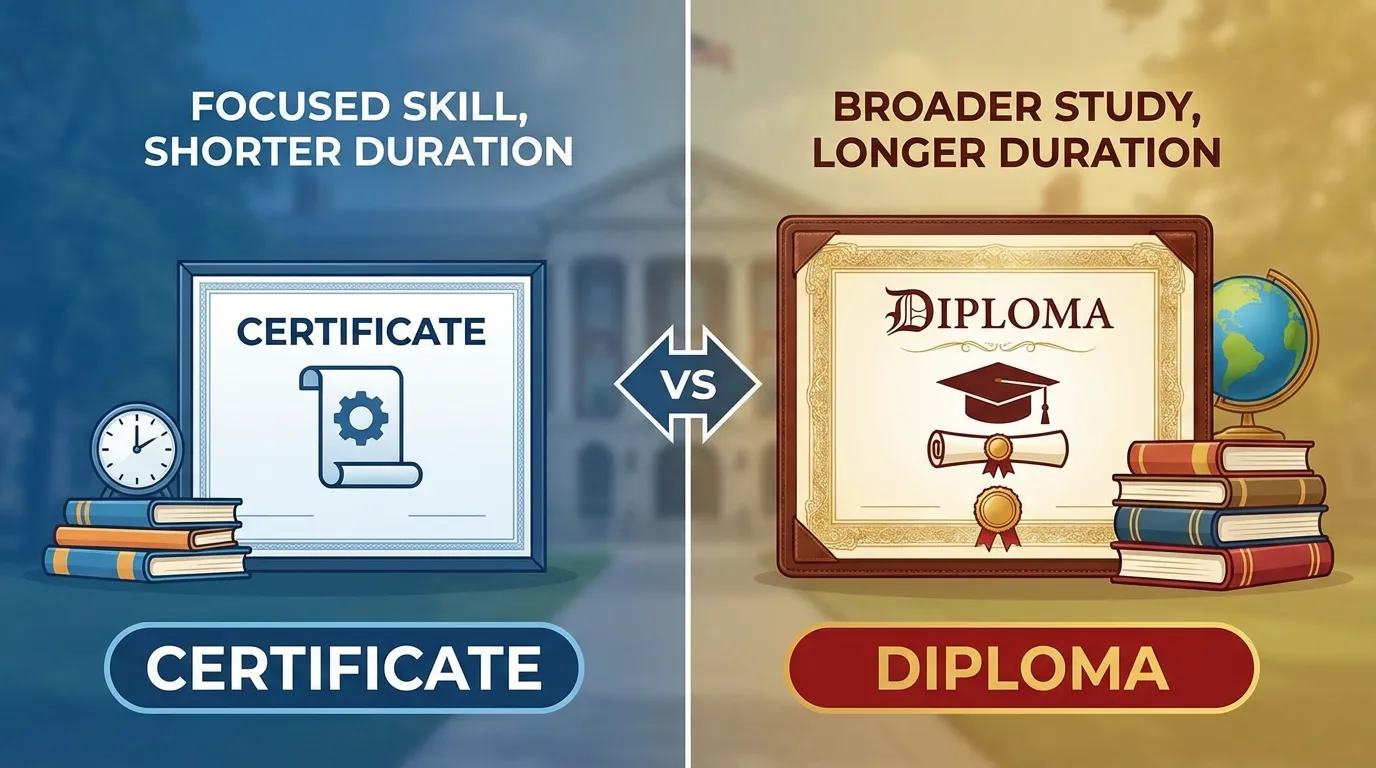
The main difference between certificate and diploma lies in the duration and level of education.
A certificate program is usually short and focuses on specific skills or training in a particular field.
A diploma program is generally longer and provides more detailed academic and practical knowledge.
In simple terms, when people compare certificate vs diploma, certificates are short-term skill programs, while diplomas offer broader and deeper education.
Why Is Their Difference Necessary to Know for Learners and Experts?
Understanding the difference between certificate and diploma is essential for both students and education professionals.
For learners, knowing the difference between certificate and diploma helps them select the right course based on their career goals and available time. Many students compare certificate vs diploma before enrolling in a program to determine which qualification suits their needs.
For educators and career counselors, the difference between certificate and diploma helps guide students toward appropriate academic paths. In society, discussions about certificate vs diploma support better educational planning and workforce development.
Overall, understanding the difference between certificate and diploma allows individuals to make smarter decisions about education and professional training.
Pronunciation of the Both (US & UK)
Certificate
- US: /sərˈtɪfɪkət/
- UK: /səˈtɪfɪkət/
Diploma
- US: /dɪˈploʊmə/
- UK: /dɪˈpləʊmə/
Before exploring the detailed difference between certificate and diploma, learning their pronunciation helps when discussing topics like certificate vs diploma in educational settings.
Difference Between the Keywords
1. Definition
A certificate is proof that a person has completed a specific course or training.
Example 1: A certificate in digital marketing after a short training program.
Example 2: A certificate in computer basics from a training institute.
A diploma is a formal qualification awarded after completing a longer educational program.
Example 1: A diploma in business administration.
Example 2: A diploma in graphic design from a college.
This highlights the basic difference between certificate and diploma.
2. Duration
Certificate programs are usually short.
Example 1: A three-month language course.
Example 2: A six-month technical training program.
Diploma programs take longer.
Example 1: A one-year hotel management diploma.
Example 2: A two-year engineering diploma.
This duration difference often appears in certificate vs diploma comparisons.
3. Depth of Study
Certificates focus on specific practical skills.
Example 1: Learning basic coding skills.
Example 2: Training in photography techniques.
Diplomas provide broader academic and practical knowledge.
Example 1: Studying business management concepts.
Example 2: Learning design theory and practice.
4. Entry Requirements
Certificate programs usually have flexible entry requirements.
Example 1: Some courses require only basic education.
Example 2: Short training programs accept beginners.
Diploma programs often require higher education levels.
Example 1: High school completion may be required.
Example 2: Some diplomas require prior qualifications.
This is another difference between certificate and diploma.
5. Career Opportunities
Certificates help people gain quick skills for specific jobs.
Example 1: A certificate in web design for freelance work.
Example 2: A certificate in computer repair for technical jobs.
Diplomas open more structured career opportunities.
Example 1: A diploma in nursing leading to healthcare careers.
Example 2: A diploma in engineering technology.
6. Academic Level
Certificates are usually considered entry-level qualifications.
Example 1: Beginner programming courses.
Example 2: Introductory business training.
Diplomas are considered higher than certificates in many education systems.
Example 1: Advanced technical diplomas.
Example 2: Professional training diplomas.
7. Learning Structure
Certificates focus mainly on skill training.
Example 1: Practical workshops.
Example 2: Hands-on learning sessions.
Diplomas include theory and practical education.
Example 1: Classroom lectures.
Example 2: Laboratory and project work.
This structural comparison appears in many certificate vs diploma discussions.
8. Recognition
Certificates may be recognized by training institutes or organizations.
Example 1: A certificate from an online course provider.
Example 2: A certificate from a vocational center.
Diplomas are often recognized by colleges or universities.
Example 1: A college diploma in information technology.
Example 2: A government-approved diploma program.
9. Cost
Certificates usually cost less.
Example 1: Short online courses with small fees.
Example 2: Affordable vocational training.
Diplomas may cost more because they last longer.
Example 1: Multi-semester diploma programs.
Example 2: Professional diploma courses.
10. Purpose
Certificates focus on upgrading skills quickly.
Example 1: Learning a new software tool.
Example 2: Improving job-related skills.
Diplomas focus on building a professional qualification.
Example 1: Preparing for a career in engineering.
Example 2: Training for management roles.
This final comparison summarizes the difference between certificate and diploma.
Nature and Behaviour of Both
Certificates behave as short educational achievements. They are designed to help individuals learn specific skills quickly and enter the workforce faster.
Diplomas behave as structured educational qualifications. They provide deeper academic knowledge and professional training. Understanding this nature shows the broader difference between certificate and diploma often discussed in certificate vs diploma comparisons.
Why People Are Confused About Their Use?
| Feature | Certificate | Diploma | Similarity |
| Study Duration | Short-term | Longer-term | Both are educational qualifications |
| Focus | Skill-based training | Detailed education | Both improve knowledge |
| Issuing Authority | Training institutes | Colleges or universities | Both provide proof of learning |
| Career Purpose | Quick skill development | Professional qualification | Both help in career growth |
People often confuse certificate vs diploma because both are academic credentials that show a person has completed a course.
Which Is Better in What Situation?
A certificate is better when someone wants to learn a new skill quickly or improve job-related abilities. For example, professionals may take certificate courses in digital marketing, programming, or language learning to upgrade their skills without spending several years in formal education.
A diploma is better for individuals who want deeper knowledge and a stronger professional qualification. Diploma programs usually provide a structured curriculum and more comprehensive training. In many certificate vs diploma comparisons, diplomas are preferred for long-term career development.
How the Keywords Are Used in Metaphors and Similes
These terms sometimes appear in symbolic comparisons.
Examples:
- “A certificate is like a quick tool that helps you start working immediately.”
- “A diploma is like a strong foundation for building a professional career.”
Such metaphors highlight the difference between certificate and diploma in educational progress.
Connotative Meaning of Both Keywords
Certificate – Neutral to Positive
Example:
“A certificate shows proof of a learned skill.”
Diploma – Positive
Example:
“A diploma represents advanced training and dedication.”
Idioms or Proverbs Related to the Words
Although these terms themselves are not idioms, related expressions about education exist.
“Knowledge is power.”
Example:
Whether someone earns a certificate or a diploma, knowledge is power.
“Practice makes perfect.”
Example:
Students with certificates improve their skills because practice makes perfect.
Works in Literature Using the Keywords
- Educated — Memoir, Tara Westover, 2018
- The School of Life — Philosophy/Self-development, Alain de Botton, 2012
- Outliers: The Story of Success — Nonfiction, Malcolm Gladwell, 2008
Movie Names Related to the Keywords
- The Social Network — 2010, USA
- Dead Poets Society — 1989, USA
- Good Will Hunting — 1997, USA
These films explore themes of education, learning, and personal growth.
Frequently Asked Questions
1. What is the main difference between certificate and diploma?
The difference between certificate and diploma is that certificates are short skill-based courses, while diplomas are longer programs providing deeper knowledge.
2. Which is better: certificate vs diploma?
It depends on career goals. Certificates are better for quick skills, while diplomas offer more detailed education.
3. Can a certificate help in getting a job?
Yes, certificates can help people gain specific skills needed for certain jobs.
4. Is a diploma higher than a certificate?
In most education systems, a diploma is considered higher than a certificate.
5. Can someone study both certificate and diploma programs?
Yes, many students start with certificates and later pursue diplomas.
How Both Are Useful for Surroundings
Certificates and diplomas both support education and professional growth in society. Certificates help individuals learn practical skills quickly, which benefits industries that require trained workers.
Diplomas help build deeper knowledge and professional expertise. Understanding the difference between certificate and diploma helps individuals contribute more effectively to education, workplaces, and communities.
Final Words for the Both
Certificates and diplomas are valuable educational achievements that support learning and career development.
By understanding the difference between certificate and diploma and comparing certificate vs diploma, students can choose the qualification that best fits their goals and future plans.
Conclusion
The difference between certificate and diploma mainly lies in their duration, depth of study, and career value. Certificates focus on short-term skill training, while diplomas provide more detailed academic and professional education.
Understanding the difference between certificate and diploma helps students make informed decisions about their educational journey. Whether someone chooses a certificate for quick skill development or a diploma for deeper learning, both qualifications play important roles in personal growth and career success. Exploring certificate vs diploma ultimately helps learners select the right path for their future.