Quick Answer: Sourcing is the strategic front end of procurement: researching the market, evaluating suppliers, negotiating terms, and signing contracts. Procurement is the entire end-to-end cycle — from identifying a need and issuing purchase orders to receiving goods and paying invoices. In short, sourcing decides who you buy from and on what terms; procurement executes every purchase from requisition to payment.
| Feature | Procurement | Sourcing |
|---|---|---|
| Definition | End-to-end acquisition of goods and services | Strategic process of finding and selecting suppliers |
| Scope | Full cycle, from need to payment | Subset: supplier search to signed contract |
| Primary focus | Efficiency, compliance, cost control | Strategy, value, supplier relationships |
| Key activities | Requisition, purchase orders, receiving, payment | Market research, RFx events, negotiation, contracting |
| Time horizon | Short-term and transactional | Long-term and relationship-based |
| Success metrics | Cycle time, purchase-price savings, compliance | Total cost of ownership, supplier performance |
| Core skills | Process management, systems, accuracy | Negotiation, analysis, market knowledge |
| Frequency | Continuous, with every purchase | Periodic, per category or contract renewal |
| Main output | Goods and services received and paid for | Signed supplier agreements |
| Risk handled | Transactional risk and fraud prevention | Supply continuity and supplier risk |
| Typical tools | E-procurement, purchase orders, AP automation | E-sourcing, spend analysis, supplier management |
| Team | Buyers and procurement operations | Category managers and sourcing analysts |
What Is Procurement?
Procurement is the end-to-end process a company uses to acquire the goods and services it needs to operate — everything from raw materials and software licenses to office supplies and consulting hours. It starts the moment a need is identified and ends only when the supplier has been paid and the transaction is recorded.
The full journey is often called procure-to-pay: an employee raises a purchase requisition, it gets approved, a purchase order goes to the supplier, the goods are received and inspected, the invoice is matched against the order, and payment is released. Each step has controls to prevent errors, fraud, and off-contract buying.
Procurement’s job is to make sure the right things arrive at the right time, at the right price, from approved suppliers, with a clean audit trail. It is the operational backbone of spending — less glamorous than deal-making, but it is where budgets are actually enforced. In large organizations procurement is a formal function with its own leadership and systems; in small ones it may be one person with a spreadsheet — but the cycle is the same.
What Is Sourcing?
Sourcing is the strategic work of finding, evaluating, and selecting suppliers — and negotiating the agreements a company will buy against. Where procurement executes purchases, sourcing decides who the company buys from and on what terms.
A typical sourcing effort starts with market research: who supplies this category, what do they charge, how reliable are they? It continues through RFx events — requests for information, proposals, or quotations — where suppliers compete for the business. Then comes evaluation, negotiation, and finally a signed contract locking in pricing, service levels, and terms.
Strategic sourcing takes this further. It is the ongoing, disciplined practice of optimizing the supply base: consolidating spend with fewer, better suppliers, standardizing specifications, and revisiting categories on a cycle to keep terms competitive.
Sourcing ends where the contract is signed. Everything after that — placing orders, receiving goods, paying invoices — belongs to procurement. Done well, sourcing lowers total cost of ownership, reduces supply risk, and builds supplier relationships that survive disruptions.
Scope: Subset vs Whole
Picture two circles, one inside the other. The outer circle is procurement: the complete process of obtaining goods and services. The inner circle is sourcing: the strategic subset concerned with choosing suppliers and striking deals.
Sourcing covers the front end: identifying needs at a category level, researching the market, running competitive bids, negotiating, and contracting. Its question is who should supply us, and on what terms, for the next few years?
Procurement picks up where sourcing leaves off and keeps going. It handles the day-to-day: requisitions, approvals, purchase orders, delivery tracking, receiving, invoice matching, and payment. Its question is how do we get this order placed, received, and paid correctly this week?
A concrete example helps. Sourcing selects the office-supply vendor and negotiates a 15 percent discount across 200 items. Procurement places the weekly orders against that contract, checks deliveries, and pays the invoices. Without sourcing, procurement buys at whatever price is quoted; without procurement, the negotiated contract never turns into delivered goods.
The confusion is not just academic — it costs money. Companies that treat sourcing as just buying skip competitive bidding and overpay for years; companies that treat procurement as just paperwork underinvest in controls and leak spend through off-contract purchases. Naming the two functions correctly is the first step to staffing and measuring them correctly.
The Sourcing Process Step by Step
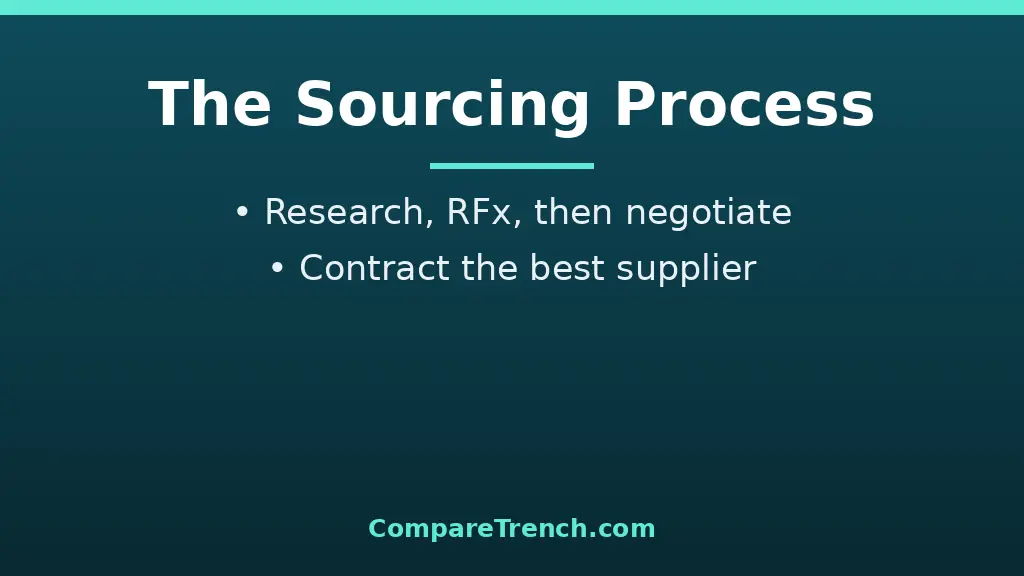
A professional sourcing project follows a repeatable sequence. Skipped steps are where bad contracts come from.
- Define requirements — state what the business needs in measurable terms: specifications, volumes, and service levels.
- Research the market — identify potential suppliers, benchmark pricing, and check financial health and references.
- Run the RFx — issue a request for information, proposal, or quotation so suppliers bid on equal terms.
- Evaluate proposals — score bids against weighted criteria: price, quality, capacity, risk, and sustainability.
- Negotiate — push beyond the opening bid on price, payment terms, service levels, and exit clauses.
- Award and contract — select the winner and sign an agreement that captures everything negotiated.
- Onboard and manage — introduce the supplier to operations and track performance against the contract.
Each step feeds the next: weak requirements produce incomparable bids, and skipped reference checks produce nasty surprises mid-contract.
The Procurement Cycle Step by Step
While sourcing is periodic, the procurement cycle runs continuously — every purchase travels it.
- Purchase requisition — an employee formally requests goods or services, stating what, why, and at what cost.
- Approval — the request is reviewed against budget and policy; unauthorized spend stops here.
- Purchase order — an approved PO goes to the supplier, creating a binding commitment.
- Receiving — goods arrive, are inspected, and quantities are confirmed against the PO.
- Invoice matching — the invoice is matched to the PO and the receipt (the three-way match) before anything is paid.
- Payment — the approved invoice is paid on agreed terms, capturing early-payment discounts where offered.
- Record and audit — the transaction is logged, creating the spend data that future sourcing projects depend on.
Payments usually move by bank transfer. If your suppliers or operations are in India, our NEFT vs RTGS comparison explains the two domestic transfer systems and when each fits.
Strategic vs Operational Mindset
The deepest difference is mindset. Sourcing thinks in years: which suppliers should we partner with, how should categories be structured, where is the market heading? Its wins are measured in total cost of ownership and risk avoided — savings that compound over a contract’s life.
Procurement thinks in days and weeks: is this requisition approved, did the delivery arrive complete, does the invoice match? Its wins are speed, accuracy, and compliance — thousands of small correct decisions that keep operations running.
Both mindsets are necessary, and confusing them causes real damage. Asking buyers to be strategic while drowning them in purchase orders fails; asking category managers to chase late invoices wastes their skill. Strategy questions ultimately escalate to senior leadership — our CFO vs CEO comparison explains how those top roles divide financial ownership.
The two mindsets also use different scorecards. Sourcing is judged on total cost of ownership, contracted savings versus the market, and supplier performance ratings. Procurement operations is judged on purchase-order cycle time, invoice accuracy, and the share of spend flowing through approved contracts. When leadership reviews the wrong metrics for the wrong team, both underperform.
Roles and Team Structure
In a mature organization, sourcing and procurement are staffed differently. Strategic sourcing teams employ category managers — each owning a spend category like IT hardware or logistics — supported by sourcing analysts who crunch spend data and run RFx events. Their currency is negotiation skill, market knowledge, and analytics.
Procurement operations employ buyers, procurement specialists, and purchasing coordinators who process requisitions and purchase orders, plus accounts-payable staff who handle invoice matching and payment. Their currency is process discipline, systems expertise, and accuracy.
Both teams work closely with finance, legal, and the business units they serve. Professional standards for the field are set by bodies such as the Chartered Institute of Procurement & Supply, whose frameworks many employers use for training and certification.
Smaller companies rarely split the roles: one person often sources the supplier, places the orders, and pays the bills. If your business needs outside tax or accounting help as it grows, our CPA vs EA guide explains which credential to hire.
Which One Should You Choose?
You do not choose between them — you need both, in the right proportion. The question is where to invest next.
Invest in sourcing when spend is unmanaged: maverick buying off-contract, no competitive bidding, the same category bought from twelve vendors at twelve prices. A single strategic sourcing project routinely cuts a meaningful share of a category’s total cost.
Invest in procurement operations when the buying machine itself is broken: slow approvals, lost purchase orders, invoice mismatches, frustrated suppliers. Automation and process discipline pay back in speed and control.
A practical starting point is a spend analysis: pull twelve months of purchases, sort by category and supplier, and look for fragmentation. The messiest categories are your sourcing backlog; the slowest approvals are your procurement backlog.
Procurement professionals weigh present costs against future value every day — the same habit that pays off in personal finance, as our Roth IRA vs Traditional IRA comparison shows.
Frequently Asked Questions
Is sourcing part of procurement?
Yes. Sourcing is the strategic subset of procurement — the front-end work of selecting suppliers and negotiating contracts. All sourcing is procurement, but procurement also includes the operational buying cycle that sourcing does not touch.
Which comes first, sourcing or procurement?
Sourcing comes first logically: you select and contract suppliers, then procurement buys against those contracts. In practice the cycle loops — a purchase need with no contracted supplier triggers a new sourcing project, and contract renewals send categories back through sourcing periodically.
What is strategic sourcing?
It is the disciplined, ongoing practice of optimizing how a company buys each category: analyzing spend, researching markets, running competitive bids, negotiating, and managing supplier performance on a cycle. Tactical sourcing just finds a supplier; strategic sourcing continuously improves cost, quality, and risk.
Do small businesses need both functions?
Yes, but rarely as separate teams. In a small business one person often does both: negotiating with a key supplier one day and raising purchase orders the next. Start with procurement basics — approved suppliers, purchase orders, invoice matching — and add structured sourcing as spend grows.
What is the difference between procurement and purchasing?
Purchasing is the narrower, transactional subset: raising requisitions, issuing purchase orders, and paying suppliers. Procurement is the wider discipline that includes purchasing plus sourcing, contract management, supplier relationships, and spend strategy. People often say purchasing when they mean the whole of procurement.
Conclusion
The difference between procurement and sourcing is scope: sourcing is the strategic work of choosing suppliers and striking deals; procurement is the full cycle that turns those deals into delivered goods and paid invoices. Companies that do both well buy smarter and operate smoother.
Start by mapping where your buying process breaks down — unmanaged supplier choices point to sourcing, chaotic ordering points to procurement operations — and fix the weakest link first. Mastery of both is what separates companies that merely buy things from companies that buy well. If you are structuring the business that houses these functions, our LLC vs S Corp comparison is a useful next read.