Quick Answer: Artificial intelligence is the broad field of building computer systems that perform tasks requiring human-like intelligence, such as understanding language, recognizing images, or making decisions. Machine learning is a subset of AI: the technique of teaching systems to learn patterns from data instead of following hand-written rules. In short, every machine learning model is AI, but not every AI system uses machine learning — classic chess engines and expert systems run on rules, not data.
| Feature | AI | Machine Learning |
|---|---|---|
| Scope | The entire field of intelligent systems | One technique within the AI field |
| How it works | Can run on hand-coded rules and logic | Learns patterns from training data |
| Data needs | Rule-based AI needs no training data | Needs large, high-quality datasets |
| Core techniques | Expert systems, search algorithms, logic | Supervised, unsupervised, and reinforcement learning |
| Examples | Chess engines, voice assistants, chatbots | Spam filters, recommendations, image recognition |
| Human involvement | Programmers define the decision logic | Data scientists curate data; models learn the logic |
| Adaptability | Rigid unless reprogrammed by hand | Improves as it sees more data |
| Hardware needs | Runs on standard computers | Training often requires GPUs or cloud compute |
| Typical cost | Lower for simple rule-based systems | Higher: data collection, compute, and expertise |
| Output style | Decisions based on defined rules | Predictions based on learned patterns |
| Relationship | The parent field | A subset of AI; deep learning sits inside it |
| Best suited for | Well-defined, stable problems | Fuzzy problems with plenty of data |
What Is AI?
Artificial intelligence is the science and engineering of making machines behave intelligently. The term covers any system that perceives its environment and takes actions to achieve goals — from a thermostat that adjusts heating, to a chess engine that plans moves, to a chatbot that answers questions. What unites these systems is not how they are built, but what they do: they automate tasks we would normally associate with human thinking.
The idea is older than most people assume. In the 1950s, researchers defined AI as building machines that could reason, and early programs played checkers and proved mathematical theorems using hand-coded logic. These rule-based systems are still AI, even though no learning is involved: a programmer writes the rules, and the machine follows them exactly.
Modern AI also includes systems that learn, but learning is only one way to be intelligent. A spam filter that learns from millions of emails and a factory robot that follows fixed motion instructions are both AI applications. For a deeper technical overview, see IBM’s explainer on AI vs machine learning, which maps how these terms fit together.
What Is Machine Learning?
Machine learning is the subfield of AI concerned with building systems that improve automatically through experience. Instead of a programmer writing explicit rules, an ML model is fed large amounts of data and finds patterns on its own. A spam filter, for example, is trained on thousands of labeled emails until it can reliably separate junk from legitimate mail — nobody wrote a rule saying a specific phrase means spam; the model discovered the pattern.
ML is usually divided into three approaches. Supervised learning trains on labeled examples, like photos tagged with what they show. Unsupervised learning finds structure in unlabeled data, such as grouping customers by purchasing habits. Reinforcement learning trains an agent through trial and error, rewarding good outcomes — this is how programs learned to master games like Go and chess at superhuman levels.
The defining trait of machine learning is data dependence: more high-quality data generally means a better model. That is why ML powers the recommendation engines behind streaming services and online stores — the more you watch or buy, the better the suggestions get. If you are watching those recommendations on a new screen, our OLED vs UHD comparison explains the display technology behind it. Where AI is the broad goal of intelligent behavior, machine learning is one concrete, data-driven way to get there.
Scope: A Field vs a Technique
Think of AI as a discipline, like medicine, and machine learning as a specialty within it, like cardiology. AI asks the big question: how can machines perform tasks that require intelligence? Machine learning answers a narrower one: how can machines learn those abilities from data?
This is why saying “AI” can mean so many different things. A rule-based expert system that diagnoses car faults from a decision tree is AI. A neural network that translates languages is also AI. Both qualify because both behave intelligently — but only the second uses machine learning.
The distinction matters in everyday conversation. When a company announces an “AI feature,” it might be a simple rules engine or a sophisticated learning model, and the label alone tells you nothing about which. Marketing often uses “AI” loosely while the engineering reality is machine learning underneath — or sometimes just basic automation. Knowing that AI is the field and ML is a technique lets you ask the sharper question: is this system actually learning, or just following rules?
How They Work: Rules vs Data
The core technical difference comes down to where the “intelligence” lives. In traditional, rule-based AI, it lives in code written by people. Developers study a problem, extract the decision logic, and encode it as if-then rules, search algorithms, or knowledge graphs. A chess engine evaluates millions of positions using hand-tuned scoring functions; a tax calculator applies legal rules step by step. These systems are precise, predictable, and easy to audit — but they are brittle. If a situation falls outside the programmed rules, the system fails.
In machine learning, the intelligence lives in the data. Developers choose a model architecture and a training process, but the specific decision logic emerges from patterns in the training data. A fraud-detection model was never told which transactions are suspicious; it inferred the signals from historical examples.
Neither approach is universally better. Rules win when the logic is well understood and must be exact, like flight-control software or legal compliance checks. Data wins when the rules are unknown or too complex to write by hand, like recognizing faces or predicting demand. Many production systems blend both: rules for safety boundaries, learning for the fuzzy parts.
Real-World Examples of AI vs Machine Learning
Concrete examples make the boundary clear. Pure rule-based AI — no learning involved — includes chess and checkers engines, expert systems used in medicine and equipment diagnosis, automated theorem provers, and the pathfinding algorithms that route characters through video game levels. Even much of the logic in popular game modifications is scripted rather than learned; players choosing a mod loader often read a Fabric vs Forge comparison, and both frameworks run deterministic code, not ML models.
Machine learning examples are the ones most people meet daily: spam filters, product recommendations, speech recognition in voice assistants, autocorrect and predictive text, photo face-tagging, fraud alerts from your bank, and language translation. None of these were programmed with explicit rules for every case; each learned from data.
Then there are hybrids. A modern voice assistant combines ML (to transcribe your speech) with rules (to execute a command like setting a timer). A self-driving car uses ML to perceive the road and hand-coded logic for safety constraints.
Deep Learning’s Place in the Picture
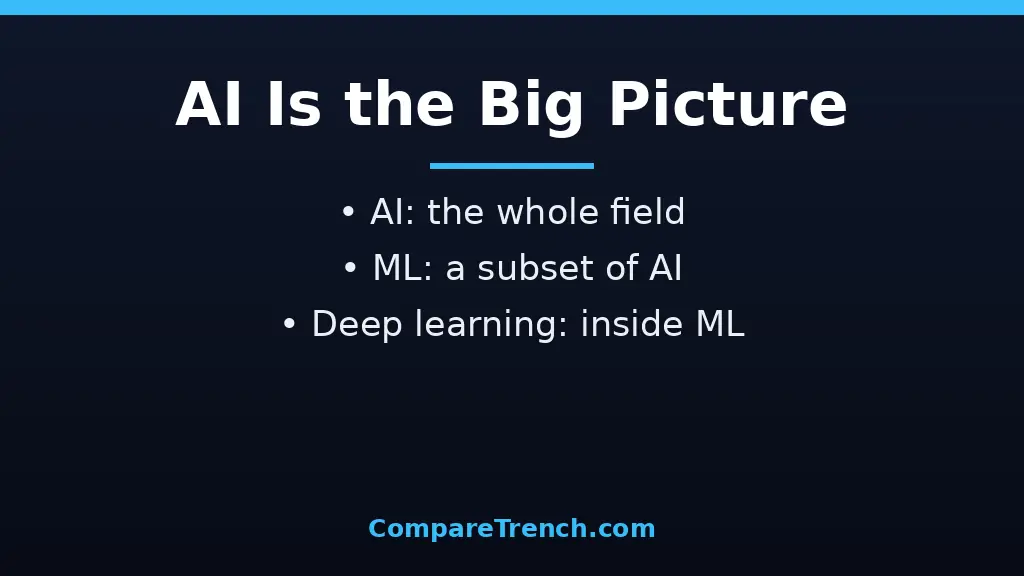
Deep learning is a subset of machine learning, which is itself a subset of AI — three nested circles. It refers to ML models built from artificial neural networks with many layers, loosely inspired by the structure of the brain. The “deep” simply means many layers of processing sit between input and output.
Deep learning earned its reputation by conquering problems where older ML struggled: image recognition, speech recognition, and natural language processing. Today’s large language models, image generators, and advanced translation tools are all deep learning systems, trained on enormous datasets with powerful GPUs.
Not all machine learning is deep learning, though. Simpler ML methods — decision trees, linear regression, random forests — remain the workhorses of business analytics because they train quickly, need less data, and are easier to interpret. A bank predicting loan defaults or a retailer forecasting inventory usually reaches for these classic methods first. One useful piece of vocabulary: once a trained model is deployed, using it on new data is called inference. The inference vs prediction distinction trips up many beginners, but the two terms describe two sides of the same step — the model takes input and produces an output.
Skills, Data, and Cost to Build
Building rule-based AI and building ML demand different resources. A rule-based system needs domain experts and programmers who can translate knowledge into logic. The cost is mostly engineering time, and once built, the system is cheap to run on ordinary hardware. The catch is maintenance: every change in the real world means someone must update the rules by hand.
Machine learning flips the cost structure. You still need engineers, but you also need data scientists who can clean datasets, select models, and evaluate results — distinct roles with distinct skill sets, much like the difference an author vs writer comparison draws between two easily confused job titles. You need large volumes of quality data, which can be expensive to collect and label. And training modern models often requires GPUs or cloud compute, which adds a significant bill before the system ever ships.
This is why ML projects fail more often than expected: companies underestimate the data work. Industry experience suggests most of an ML project’s effort goes into gathering, cleaning, and labeling data — not into the model itself. Rule-based AI avoids that entirely but cannot learn or adapt.
Which One Should You Choose?
For a business decision-maker, the question is rarely “AI or ML?” in the abstract — it is “which approach solves my problem at a cost I can justify?” Start with the problem, not the technology.
Choose rule-based AI when the logic is stable and well understood: eligibility checks, pricing rules, compliance workflows, scheduling constraints, and diagnostic decision trees. These systems are cheaper to build, easier to explain to regulators, and behave predictably. If your process can be written as a flowchart, you probably do not need machine learning.
Choose machine learning when you have abundant data and a fuzzy problem: forecasting demand, personalizing content, detecting fraud, understanding customer messages, or recognizing images. ML shines where human experts cannot write the rules because the patterns are too subtle or too numerous.
Many projects need both, with rules guarding the ML model’s outputs. And getting any of this funded means convincing leadership — our CFO vs CEO comparison explains how financial and executive decision-makers divide responsibilities, which helps you pitch the right benefits to the right person.
Frequently Asked Questions
Is machine learning the same as AI?
No. Machine learning is a subset of AI. AI is the broad field of building intelligent systems; machine learning is one technique within that field — teaching systems to learn from data. All ML is AI, but rule-based systems like chess engines are AI without being ML.
Is deep learning part of machine learning?
Yes. Deep learning is a subset of machine learning that uses multi-layered neural networks. So the nesting is: AI contains machine learning, and machine learning contains deep learning. Large language models and image generators are deep learning systems.
Can AI exist without machine learning?
Yes. Before machine learning became dominant, most AI was rule-based: expert systems, chess engines, and logic programs that follow hand-written rules. These systems behave intelligently without learning anything from data, and rule-based AI is still widely used where precision and auditability matter.
Which should I learn first, AI or machine learning?
Start with machine learning fundamentals — Python, statistics, and core algorithms — because ML is the most employable and practical entry point. Once you can train and evaluate models, broaden into the wider AI field: search, logic, planning, and how ML systems are deployed in products.
Does my business need AI or machine learning?
It depends on the problem. If your process follows clear, stable rules, simple automation or rule-based AI is cheaper and more reliable. If you have large amounts of data and need to find subtle patterns — in customer behavior, demand, or risk — machine learning is worth the investment.
Conclusion
The difference between AI and machine learning is ultimately about scope: AI is the entire field of intelligent machines, and machine learning is the data-driven technique inside it. Rule-based systems still count as AI, deep learning is ML’s most powerful branch, and the right choice for any project depends on your data, your problem, and your budget.