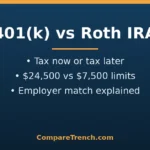
Quick Answer: A 401(k) is an employer-sponsored plan funded mostly with pre-tax dollars that lower this year’s tax bill, while a Roth IRA is an individual account you open yourself and fund with after-tax dollars that grow and withdraw tax-free in retirement. The core difference is tax timing: a 401(k) defers taxes until withdrawal, while a Roth IRA forgoes the deduction now for tax-free withdrawals later. A 401(k) also allows much higher contributions and may include an employer match; a Roth IRA offers broader investment choice and penalty-free access to contributions.
| Feature | 401(k) | Roth IRA |
|---|---|---|
| What it is | An employer-sponsored retirement plan | An individual account you open yourself |
| How you join | Through your employer; contributions come out of your paycheck | At a bank or brokerage; you fund it on your own |
| Tax timing | Pre-tax contributions lower today’s taxable income; withdrawals are taxed | After-tax contributions; qualified withdrawals are tax-free |
| 2026 contribution limit | $24,500 for employees ($32,500 if age 50 or older) | $7,500 ($8,600 if age 50 or older) |
| Income limits | None for contributing | Phase-out begins at $153,000 single / $242,000 joint MAGI |
| Employer match | Often available; essentially free money | Not available; no employer is involved |
| Investment choices | Limited to your plan’s menu, usually mutual funds | Nearly anything: stocks, bonds, mutual funds, ETFs |
| Early access | 10% penalty before 59 and a half, with limited exceptions | Contributions can be withdrawn anytime, penalty-free |
| Loans | Many plans let you borrow from your balance | No loans; withdrawals only |
| Required withdrawals | Required minimum distributions start at age 73 | None during the owner’s lifetime |
| Best for | Higher earners wanting maximum savings plus a match | Younger savers expecting higher tax rates in retirement |
What Is a 401(k)?
A 401(k) is a retirement savings plan offered by an employer, named after the section of the U.S. tax code that created it. You sign up through your workplace, choose a percentage of your paycheck to save, and the money flows automatically into an investment account before you ever see it. That automation is one of its biggest strengths: saving happens by default, not by willpower.
Most 401(k) contributions are pre-tax: the money goes in before income tax is calculated, lowering your taxable income for the year. Earn $70,000 and contribute $10,000, and you are taxed as if you earned $60,000. Investments grow tax-deferred, and you pay ordinary income tax on withdrawals in retirement.
The defining perk is the employer match: many companies add 50 cents or a dollar per dollar you contribute, up to a set percentage of salary. That instant return is why planners say to contribute at least enough to capture the full match before funding anything else.
What Is a Roth IRA?
A Roth IRA is an Individual Retirement Arrangement that you open and fund yourself at a bank, brokerage, or robo-advisor. No employer is involved, which makes it ideal for freelancers, part-time workers, and anyone whose job does not offer a 401(k). You can open one in minutes online and set up automatic monthly transfers.
The tax treatment is the mirror image of a traditional 401(k). Contributions are made with after-tax dollars, so you get no deduction today, but the money grows tax-free and qualified withdrawals in retirement are completely tax-free. If you contribute $7,000 at age 30 and it grows to $50,000 by retirement, that entire $50,000 comes out with zero tax owed, provided you follow the withdrawal rules.
The catch is eligibility. For 2026, full Roth IRA contributions require modified adjusted gross income below $153,000 single or $242,000 joint, with a phase-out range above that. Higher earners often use a backdoor Roth conversion instead, with a tax professional’s help.
Tax Treatment: Pay Now or Pay Later
With a traditional 401(k), you get the tax benefit now: contributions reduce taxable income, which matters most in peak earning years. A worker in the 32 percent bracket who contributes $10,000 saves $3,200 in federal tax that year.
With a Roth IRA, you pay the tax now and never again. That trade favors people early in their careers who are in a low bracket today but expect to earn more later. A 25-year-old in the 12 percent bracket pays only $840 of tax on a $7,000 contribution, and decades of growth plus all withdrawals come out tax-free. If tax rates rise broadly in the future, the Roth’s locked-in tax-free status becomes even more valuable.
If you are self-employed, a solo 401(k) is one of the best perks of working for yourself, and the choice between an LLC vs S corp structure affects how much you can contribute.
Contribution Limits and Income Rules
The 401(k) wins on sheer capacity. For 2026, employees can contribute up to $24,500 of their own money, plus another $8,000 in catch-up contributions if they are 50 or older. Employer matching contributions sit on top of that employee limit, and total contributions from all sources can reach $72,000. The IRS publishes the current 401(k) contribution limits each year with cost-of-living adjustments, so these figures creep upward over time.
The Roth IRA limit is far smaller: $7,500 for 2026, or $8,600 with the age-50 catch-up, and the income phase-out can block high earners from contributing directly at all. For aggressive savers, the 401(k)’s higher ceiling makes it the main savings engine, with the Roth IRA in a supporting role.
One more nuance: the $7,500 IRA limit is shared across all your IRAs combined. If you fund both a Roth and a traditional IRA in the same year, total contributions to both cannot exceed the limit. The 401(k) limit, by contrast, is separate, so you can max out both a 401(k) and a Roth IRA in the same year if your income allows.
The Employer Match: Free Money
Only the 401(k) side of this comparison comes with an employer match, and it is the single most compelling reason to prioritize a 401(k) first. A common formula is a 100 percent match on the first 3 percent of salary plus 50 percent on the next 2 percent. On a $100,000 salary, contributing 5 percent ($5,000) earns you $4,000 of employer money, an instant 80 percent return before any market growth.
Matching contributions usually vest over two to six years: leave early and you may forfeit some of the employer’s money, though your own contributions are always 100 percent yours.
No match exists for a Roth IRA because no employer is involved. That asymmetry drives the standard advice: fund the 401(k) to the full match, then a Roth IRA, then add more to the 401(k). In large companies, plan decisions sit with senior leadership, which is one reason the CFO vs CEO split matters to employees more than they might expect.
Investment Choices and Control
A Roth IRA offers far more investment freedom. Because you open the account yourself at the brokerage of your choice, you can buy individual stocks, bonds, ETFs, mutual funds, and sometimes even real estate or other alternatives. Fees tend to be lower because you shop in a competitive open market rather than accepting a captive menu.
A 401(k) restricts you to the investment lineup your employer selected, typically 15 to 25 mutual funds covering broad categories like large-cap stocks, bonds, and target-date funds. Some plans are excellent, with low-cost index funds; others carry higher fees that quietly drag on returns. You cannot move the money elsewhere while you are still employed there, though you can usually roll it into an IRA when you leave.
Limited choice is not always a disadvantage: a curated menu with a solid target-date fund protects beginners from chasing hot stocks or panic-selling. For hands-off savers, the 401(k)’s guardrails are a feature, not a bug.
Withdrawals, Loans, and Early Access
The Roth IRA is far more flexible before retirement. You can withdraw your contributions, though not the earnings, at any time for any reason with no taxes or penalties. That makes a Roth IRA double as a backup emergency fund: the money is invested for retirement, but your original contributions remain reachable if life goes sideways.
A 401(k) locks money up more tightly. Withdrawals before age 59 and a half generally trigger income tax plus a 10 percent early-withdrawal penalty, with narrow exceptions for hardship, disability, or medical expenses. One useful exception: if you leave your employer in or after the year you turn 55, you can tap that employer’s 401(k) penalty-free, a rule that does not apply to IRAs.
Many 401(k) plans allow loans of up to 50 percent of your vested balance (capped at $50,000), repaid with interest to yourself. But a loan can become due immediately if you change jobs, and unpaid balances turn into taxable distributions. Roth IRAs offer no loans, though free access to contributions means you rarely need one.
Required Minimum Distributions
In retirement, the accounts diverge again. A traditional 401(k) forces you to start taking required minimum distributions at age 73, whether you need the money or not, and each distribution is taxed as income. The government gave you a tax break upfront and eventually wants its share.
A Roth IRA has no required minimum distributions during the owner’s lifetime. You can leave the money untouched for decades, letting it compound tax-free, and pass it to heirs, which also makes it a powerful estate-planning tool.
Because retirement accounts pass directly to named beneficiaries outside of probate, keeping your beneficiary designations current is as important as the account choice itself. Related planning documents matter too, and understanding the difference between POA vs guardianship helps you cover incapacity planning alongside inheritance planning.
Which One Should You Choose?
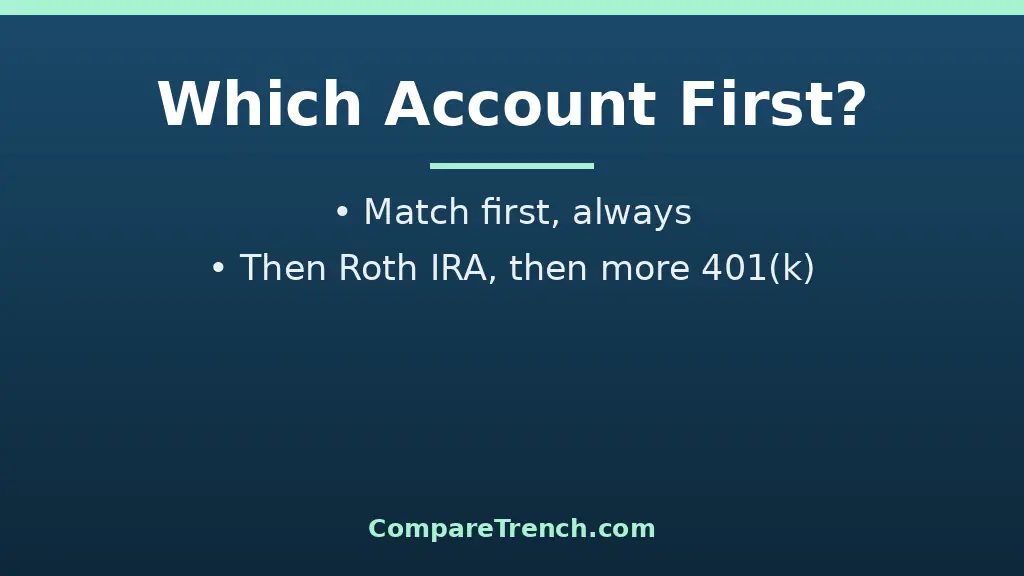
If your employer offers a 401(k) match, start there: contribute enough to capture every dollar of the match. That is free money with an immediate return no other account can match. Skipping it to fund a Roth IRA first is one of the most common and costly retirement mistakes.
Next, fund a Roth IRA if you are eligible, especially if you are early in your career or in a lower tax bracket than you expect in retirement. The combination of tax-free growth, flexible access to contributions, and no lifetime RMDs makes it the most versatile account in the retirement toolkit.
Then, with leftover capacity, increase 401(k) contributions toward the $24,500 limit. High earners in peak tax years may prefer stuffing the pre-tax 401(k) first; young workers often favor the Roth. Employer vendor selection for 401(k) providers mirrors any corporate purchase, and the procurement vs sourcing distinction shows up in how plan fees get negotiated. Getting the strategy right is worth professional input, and knowing whether you need a CPA vs EA helps you hire the right tax professional.
Frequently Asked Questions
Can I have both a 401(k) and a Roth IRA?
Yes, and many people do. The contribution limits are separate, so you can max out a 401(k) at $24,500 and still contribute up to $7,500 to a Roth IRA in the same year, as long as you are under the Roth income limits and have enough earned income to cover both.
Is it better to max out a 401(k) or a Roth IRA first?
Contribute to the 401(k) up to the employer match first, since the match is an instant return. After that, a Roth IRA usually comes next for its tax-free growth and flexibility, and then additional 401(k) contributions beyond the match if you can save more.
What happens to my 401(k) if I leave my job?
Your contributions and their earnings are always yours. You can leave the money in the old plan, roll it into your new employer’s 401(k), or roll it into an IRA. A direct rollover to a Roth IRA is allowed but triggers income tax on any pre-tax amounts converted.
Can high earners contribute to a Roth IRA?
Not directly once income exceeds the phase-out range, which for 2026 starts at $153,000 for single filers and $242,000 for joint filers. Many high earners use a backdoor Roth: contribute to a traditional IRA with after-tax dollars, then convert it to a Roth, paying tax only on any earnings.
Do Roth IRAs have required minimum distributions?
No. Unlike a traditional 401(k), which forces withdrawals starting at age 73, a Roth IRA has no required minimum distributions during the owner’s lifetime, so the money can keep growing tax-free as long as you live.
Conclusion
The difference between 401(k) and Roth IRA comes down to who sponsors the account and when you pay tax. A 401(k) is your employer’s plan with pre-tax contributions, higher limits, and often a match; a Roth IRA is your own account with after-tax contributions, tax-free withdrawals, and total flexibility.
For most savers the winning order is simple: capture the full 401(k) match, fund a Roth IRA, then add more to the 401(k). Tune that order to your tax bracket and income, revisit it as your career progresses, and you will have both tax diversification and maximum savings working in your favor.