Quick Answer: Bacteria are living, single-celled organisms that can survive and reproduce on their own, while viruses are non-living particles that can only replicate by hijacking a host cell. Bacteria are much larger, have their own cellular machinery, and many are harmless or even helpful; viruses are tiny packets of genetic material wrapped in protein. The most practical difference: bacterial infections can be treated with antibiotics, while viral infections cannot, which is why knowing which one is making you sick determines the treatment.
| Feature | Virus | Bacteria |
|---|---|---|
| What it is | A non-living infectious particle | A living, single-celled organism |
| Size | Extremely small: 20 to 300 nanometers | Larger: 0.5 to 5 micrometers (up to 100x bigger) |
| Cell structure | No cells; genetic material in a protein coat (capsid) | Prokaryotic cell with wall, membrane, cytoplasm, ribosomes |
| Genetic material | DNA or RNA, never both | DNA, usually a single circular chromosome |
| Reproduction | Only inside a host cell, using the cell’s machinery | Independently, by binary fission |
| Metabolism | None; no energy production of its own | Full metabolism; generates its own energy |
| Response to antibiotics | Not affected; antibiotics are useless against viruses | Susceptible; antibiotics kill or stop them |
| Role in nature | Almost always parasitic; a few used in gene therapy | Many beneficial: gut microbiome, digestion, soil health |
| Example diseases | Flu, common cold, COVID-19, HIV | Strep throat, UTIs, tuberculosis, food poisoning |
| Prevention | Vaccines for some; hygiene and distancing | Vaccines for some; hygiene and food safety |
What Is a Virus?
A virus is a microscopic infectious agent that sits in a strange gray zone between living and non-living. Structurally, it is remarkably simple: a snippet of genetic material, either DNA or RNA but never both, wrapped in a protective protein shell called a capsid. Some viruses add an outer lipid envelope stolen from the host cell they last infected. That is essentially the whole package.
Outside a host, a virus does absolutely nothing. It has no metabolism, produces no energy, and cannot move or reproduce on its own. It is inert, more like a chemical than a creature. Its only trick is what happens when it meets a susceptible cell: it attaches, injects or delivers its genetic instructions, and forces the cell’s own machinery to manufacture new virus particles. This hijacking often damages or destroys the host cell, which is what causes disease symptoms.
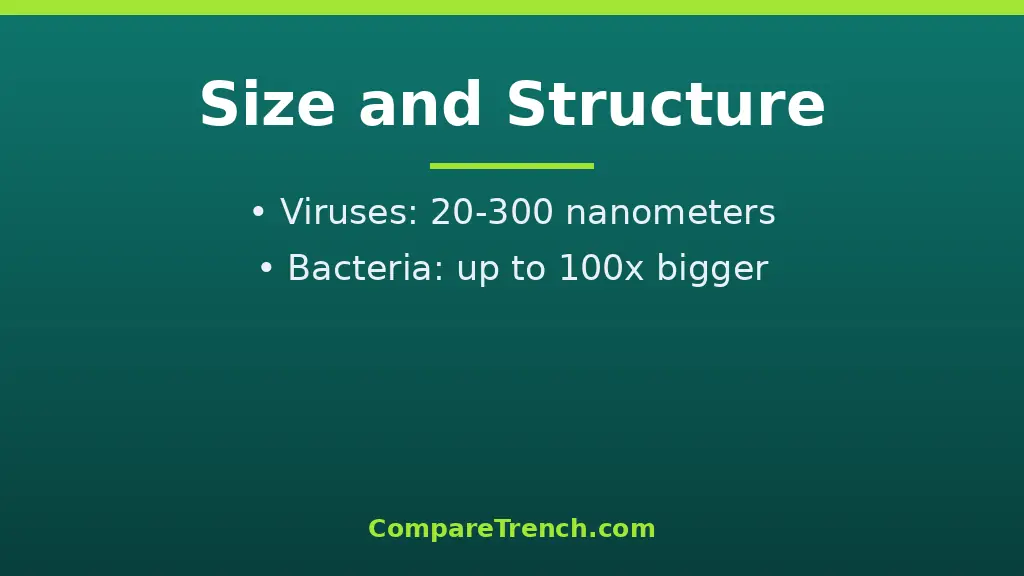
Viruses are astonishingly small, typically 20 to 300 nanometers across, which is why they were discovered through filters fine enough to trap bacteria but not viruses. Familiar examples include the influenza virus, rhinoviruses that cause the common cold, SARS-CoV-2, and HIV. Many viruses store their genetic code as RNA rather than DNA, which is why understanding the difference between RNA vs mRNA helps explain how viral vaccines and treatments are designed.
What Are Bacteria?
Bacteria are single-celled living organisms and among the oldest life forms on Earth, with fossils dating back billions of years. Each bacterium is a complete, self-contained cell: it has a cell wall, a plasma membrane, cytoplasm, ribosomes for building proteins, and its own DNA, usually arranged as a single circular chromosome floating in the cell.
Because bacteria are alive, they carry out all the basic functions of life independently. They consume nutrients, generate energy through metabolism, respond to their environment, and reproduce by binary fission, a process in which one cell splits into two identical copies roughly every 20 minutes under ideal conditions. A single bacterium can theoretically become millions overnight, which is why bacterial infections can escalate so quickly.
Crucially, most bacteria are not enemies. Trillions of them live in and on the human body, especially in the gut, where they aid digestion, produce vitamins, and crowd out harmful microbes. Only a small minority, roughly one percent of known species, cause human disease. Examples of pathogenic bacteria include Streptococcus pyogenes, which causes strep throat, Escherichia coli strains behind many UTIs, and Mycobacterium tuberculosis.
Size and Structure Compared
The size gap is dramatic. A typical bacterium measures 0.5 to 5 micrometers, while a virus measures 20 to 300 nanometers. Since one micrometer equals 1,000 nanometers, even a large virus is dwarfed by a small bacterium; the difference is roughly the scale of a person standing next to a skyscraper. Under a standard light microscope you can see bacteria, but viruses require an electron microscope.
Structurally, bacteria are complete cells with layered defenses: a rigid cell wall that maintains shape, a membrane controlling what enters, and internal machinery for every life process. Viruses have none of this. A virus is essentially a delivery vehicle for genetic code, a capsid shell protecting nucleic acid, sometimes with spike proteins that act like keys fitting the locks on target cells.
This structural difference explains treatment. Antibiotics work by attacking features only bacteria have: penicillin weakens bacterial cell walls, others jam bacterial ribosomes or block bacterial DNA copying. A virus has no cell wall, no ribosomes of its own, and no independent metabolism, so antibiotics have literally nothing to attack. Prescribing them for a viral illness does not help the patient and contributes to antibiotic resistance.
Living vs Non-Living: Why It Matters
Biologists generally classify bacteria as living and viruses as non-living, and the distinction rests on the classic criteria for life: metabolism, growth, reproduction, and response to stimuli performed independently. Bacteria meet all of them. Viruses meet none of them outside a host cell, which is why textbooks often describe viruses as existing at the edge of life.
This is not just philosophy; it shapes medicine. Because bacteria are alive with their own biochemistry, drugs can target bacterial processes without harming human cells too much, the principle behind selective toxicity that makes antibiotics possible. Viruses, having borrowed nearly everything from the host, offer few unique targets, which is why antiviral drugs are harder to develop and often only slow viruses rather than killing them outright.
The living-or-not question also explains survival. Bacteria can persist in soil, water, and on surfaces for long periods, feeding and multiplying. A virus outside a host is on a countdown: without a cell to infect, it gradually degrades, though some survive on surfaces for hours or days. Good hygiene interrupts both, but for different reasons.
How They Make You Sick
Bacterial and viral infections tend to produce different illness patterns, though symptoms often overlap enough that testing matters. Bacterial infections frequently stay localized: strep throat centers on the throat, a UTI on the urinary tract, an ear infection on the ear. They often produce pus, a visible sign of the immune system battling bacteria, and they can often be confirmed with a culture or rapid test.
Viral infections more often cause systemic symptoms: fever, body aches, fatigue, and headache accompanying respiratory viruses like flu, or the widespread rash of chickenpox. Viruses damage host cells directly as they replicate, and much of what you feel is your immune system’s inflammatory response to infected cells.
Some illnesses blur the line. Pneumonia and bronchitis can be either viral or bacterial, and a viral cold can damage airways enough to invite a secondary bacterial infection, which is why a lingering cold sometimes turns into a sinus infection needing antibiotics. Respiratory illnesses also connect to how the body moves air, and the distinction between ventilation vs respiration explains what is happening in the lungs during these infections.
Treatment: Antibiotics vs Antivirals
Bacterial infections are treated with antibiotics, drugs that either kill bacteria outright or stop them from multiplying so the immune system can finish the job. Different classes target different bacterial weak points, and doctors choose based on the likely organism, the infection site, and local resistance patterns. Finishing the full prescribed course matters: stopping early can leave the hardiest bacteria alive to multiply and spread resistance.
Viral infections require a different playbook. Most are managed with rest, fluids, and symptom relief while the immune system clears the virus. Specific antivirals exist for some viruses, such as influenza, COVID-19, HIV, and herpesviruses, but they work by interfering with viral replication steps rather than by killing, and they are far fewer in number than antibiotics. Vaccines are the most powerful tool against viruses, training the immune system before exposure.
The CDC’s overview of group A strep infections, a classic bacterial illness, illustrates the contrast well: strep throat is diagnosed with a test and cured with antibiotics, while a sore throat from a cold virus would not benefit from the same prescription. This is also why the sexually transmitted infections syphilis vs herpes are treated so differently: syphilis is bacterial and curable with penicillin, while herpes is viral and manageable but lifelong.
Prevention and the Role of Hygiene
Prevention overlaps more than treatment does. Handwashing, safe food handling, clean water, and disinfecting surfaces reduce transmission of both bacteria and viruses. Respiratory hygiene, covering coughs and improving ventilation, matters especially for airborne pathogens of both kinds.
Vaccines exist for major threats on both sides: measles, flu, and COVID-19 vaccines target viruses, while tetanus, pertussis, and pneumococcal vaccines target bacteria. Staying current on vaccinations is the single highest-leverage prevention step for both categories.
One caution: antibacterial soaps and overuse of antibiotics do not help against viruses and can backfire by breeding resistant bacteria. The rise of drug-resistant bacteria is considered one of the major public health threats of this century, and every unnecessary antibiotic prescription makes it marginally worse. When a doctor says an illness is viral and antibiotics will not help, that restraint is protecting both you and the community.
Why the Difference Matters for Treatment
For a patient, the practical question is never academic: the same fever and sore throat could be strep throat, cured in days with antibiotics, or a viral pharyngitis that simply needs time. Guessing wrong in either direction has costs. Unnecessary antibiotics cause side effects like diarrhea and yeast infections, wipe out beneficial gut bacteria, and fuel resistance. Missing a bacterial infection, meanwhile, lets it worsen or spread.
That is why rapid tests exist for strep, flu, and COVID-19, and why doctors sometimes order cultures before prescribing. The test result, not the symptom list, determines the drug. Understanding the difference between virus and bacteria turns you from a passive patient into an informed one who can ask the right question: is this bacterial, viral, or do we need a test to tell?
The distinction even reaches anatomy and imaging. When doctors locate an infection or describe where it sits in the body, they use standardized anatomical planes, which is where terminology like sagittal vs midsagittal comes from. And because some infections carry extra risk during pregnancy, the difference between implantation vs period timing can matter for testing and treatment decisions in early pregnancy.
Frequently Asked Questions
Can antibiotics kill viruses?
No. Antibiotics target structures and processes that exist only in bacteria, such as cell walls and bacterial ribosomes. Viruses have none of these, so antibiotics cannot harm them. Taking antibiotics for a viral infection will not shorten the illness and can cause side effects and contribute to antibiotic resistance.
How do doctors tell a viral infection from a bacterial one?
Through a combination of symptoms, physical examination, and testing. Rapid tests exist for strep throat, influenza, and COVID-19, while bacterial cultures can identify the specific organism and which antibiotics it responds to. Blood markers like procalcitonin can also hint at bacterial involvement.
Are all bacteria harmful?
Far from it. The vast majority of bacteria are harmless or beneficial. Your gut microbiome helps digest food, produces vitamins, and protects against pathogens, and bacteria in soil and water drive the nutrient cycles all life depends on. Only about one percent of known bacterial species cause human disease.
Can you be infected by a virus and bacteria at the same time?
Yes. A viral infection can damage tissues and weaken defenses, opening the door to a secondary bacterial infection. This is common with the flu leading to bacterial pneumonia or a cold leading to a bacterial sinus infection, which is why an illness that suddenly worsens after improving deserves a second medical look.
Do vaccines work against both viruses and bacteria?
Yes. Vaccines train your immune system against specific pathogens regardless of type. Viral vaccines include those for measles, polio, flu, and COVID-19, while bacterial vaccines include those for tetanus, diphtheria, pertussis, and pneumococcal disease. Both kinds have saved hundreds of millions of lives.
Conclusion
The difference between virus and bacteria is fundamental: bacteria are living cells that can survive on their own, while viruses are non-living particles that must hijack a host cell to replicate. That single distinction cascades into differences in size, structure, reproduction, and, most importantly for patients, treatment.
Remember the practical rule: antibiotics fight bacteria, not viruses. Knowing which type of germ is responsible for an illness is what lets doctors choose the right treatment, and it is what lets you understand why sometimes the best prescription is rest, fluids, and time.