Quick Answer: The difference between physical therapy and occupational therapy is their goal: physical therapy (PT) restores how the body moves — strength, mobility, balance, and pain relief — while occupational therapy (OT) restores the ability to perform daily life activities like dressing, eating, working, and writing. PT asks “can the body move again?”; OT asks “what is that movement for?” They are distinct professions that frequently work together on the same patients.
After an injury, surgery, stroke, or a new diagnosis, a doctor’s referral might read “PT” or “OT” — and many patients have no idea which one they are getting or why. Physical therapy and occupational therapy sound similar, often happen in the same clinics, and sometimes even treat the same person in the same week. But they are built around different questions, different skills, and different definitions of recovery.
Understanding the difference between physical therapy and occupational therapy matters for two audiences: patients who want the right care, and students choosing between two rewarding healthcare careers. This guide explains what each therapy does, how a typical session looks, where each is practiced, what education each requires, and how the two professions collaborate instead of competing.
| Feature | Physical Therapy (PT) | Occupational Therapy (OT) |
|---|---|---|
| Primary goal | Restore movement, strength, and physical function | Restore independence in daily activities |
| Core question | Can the body move safely and well? | Can the person live their daily life? |
| Typical focus areas | Gross motor skills, gait, balance, pain, joint mobility | Fine motor skills, self-care, cognition, sensory processing |
| Example session | Strengthening exercises after knee surgery | Relearning dressing and cooking after a stroke |
| Common settings | Outpatient clinics, hospitals, sports facilities | Hospitals, schools, home health, workplaces |
| Degree required | Doctor of Physical Therapy (DPT) | Master’s or doctorate in occupational therapy |
| Licensing exam | National Physical Therapy Examination (NPTE) | NBCOT certification exam |

What Is Physical Therapy?
Physical therapy is rehabilitative care focused on the body’s ability to move. Physical therapists evaluate posture, strength, range of motion, balance, and pain, then design treatment plans built on exercise, manual techniques, and patient education. A typical PT plan after an ACL repair, for example, progresses from reducing swelling and regaining knee bend, to rebuilding quadriceps strength, to retraining running and cutting movements.
PT is also preventive. Therapists teach body mechanics, design fall-prevention programs for older adults, and help athletes correct movement patterns that invite injury. The American Physical Therapy Association describes physical therapists as movement experts — and that framing is precise. If the problem is fundamentally about how the body moves through space, PT is the discipline built to fix it.
Common PT tools include therapeutic exercise, gait training, balance work, joint mobilization, dry needling (where permitted), ultrasound, and heat or cold therapy. Sessions are active: the patient works, sweats, and practices. Progress is measured in concrete terms — degrees of motion, pounds lifted, distance walked, pain scores.
What Is Occupational Therapy?
Occupational therapy is rehabilitative care focused on participation in the activities that make up a person’s life. Here “occupation” does not mean a job — it means anything a person does that occupies their time and gives it meaning: getting dressed, preparing a meal, typing, driving, parenting, returning to work or school. An occupational therapist’s job is to make those activities possible again after illness, injury, or disability.
OT works through two main strategies: rebuilding the underlying skills (hand strength, coordination, visual-motor integration, cognitive sequencing) and adapting the task or environment (recommending adaptive utensils, rearranging a kitchen, teaching energy-conservation techniques, fitting a splint). After a stroke, for instance, an OT might help a patient relearn buttoning a shirt with one functional hand while also installing grab bars at home.
OT’s scope is notably broad across the lifespan. Pediatric OTs help children with developmental delays master handwriting and play skills; school-based OTs support classroom participation; hand therapists (a specialty) rehabilitate complex upper-extremity injuries; and OTs in mental health settings build routines and coping strategies. It is a profession organized around independence, not just movement.
Key Differences Between Physical Therapy and Occupational Therapy
1. Goal: Movement vs. Participation
This is the central difference between physical therapy and occupational therapy. PT’s endpoint is physical capacity: the knee bends fully, the back lifts safely, the balance holds. OT’s endpoint is life participation: the patient dresses independently, cooks safely, returns to work. A patient can succeed at PT (full shoulder motion restored) yet still need OT (cannot yet manage the buttons, zippers, and hair-washing of a morning routine). Recovery is only complete when both capacities are in place.
2. What a Session Looks Like
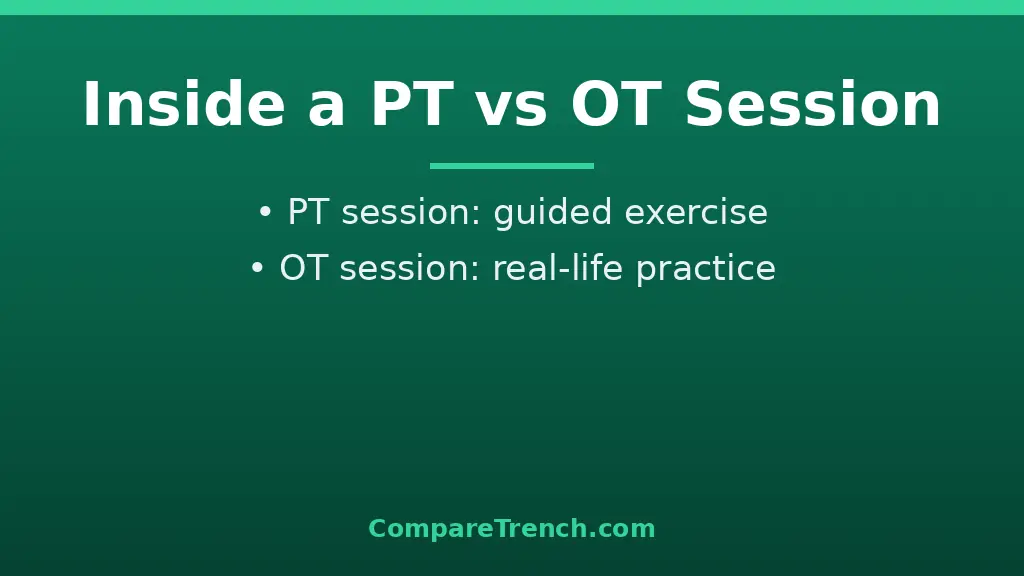
A PT session typically looks like guided athletic training: warm-up, targeted strengthening, balance drills, treadmill or gait work, stretching, and homework exercises. An OT session looks like real life rehearsed: practicing transfers from bed to chair, cooking a simple meal with adaptive tools, handwriting drills, simulated work tasks, or cognitive exercises like planning a grocery trip. Both are evidence-based and progressive; the scenery is simply different.
3. Body Areas and Skills Emphasized
PT emphasizes gross motor function — large muscle groups, whole-body movement, walking, posture, and endurance. OT emphasizes fine motor function and the integration of skills — hand dexterity, coordination, visual perception, sensory processing, and the cognitive sequencing behind multi-step tasks. There is overlap (both care about strength and range of motion), but the lens differs: PT views the shoulder as a joint to rehabilitate; OT views it as the joint that lets you reach the top shelf.
4. Settings and Populations
Both professions work in hospitals, rehabilitation centers, outpatient clinics, and home health. Beyond that, they diverge: PTs cluster in sports medicine facilities, orthopedic clinics, and skilled nursing; OTs are prominent in schools, early intervention, workplace ergonomics, and community mental health. If you meet a therapist in an elementary school or fitting office workstations, that therapist is almost certainly an OT.
5. Education and Licensing
Both are doctoral- or graduate-level professions, but the paths differ. Physical therapists earn a Doctor of Physical Therapy (DPT), typically a three-year graduate program after a bachelor’s degree, then pass the National Physical Therapy Examination (NPTE). Occupational therapists earn a master’s or doctoral degree in occupational therapy, then pass the NBCOT certification exam. Both require state licensure, continuing education, and supervised clinical rotations — neither is a short certificate program.
6. When Each Is Prescribed
Doctors refer to PT for musculoskeletal injuries, post-surgical rehabilitation, back and neck pain, sports injuries, balance disorders, and neurological conditions affecting movement (Parkinson’s, multiple sclerosis). They refer to OT after stroke, hand injuries, developmental delays, traumatic brain injury, arthritis affecting hand function, and conditions where daily independence is the main casualty. Baptist Health’s guide to occupational therapy vs physical therapy puts it simply: OT targets the ability to perform specific tasks; PT targets recovery of movement itself.
How Physical Therapy and Occupational Therapy Work Together
In practice, the two professions are teammates far more often than alternatives. Consider a hip replacement: the PT rebuilds walking, stair climbing, and leg strength, while the OT teaches safe dressing techniques, bathroom transfers, and home modifications for the first weeks. After a stroke, PT works on standing balance and walking while OT works on feeding, grooming, and cognitive strategies for daily routines.
Clinicians describe the relationship as sequential and complementary: PT often restores the raw physical capacity, and OT converts that capacity into independent living. Many rehabilitation teams hold joint sessions where both therapists treat the patient together — the PT guarding a transfer while the OT coaches the patient through the task. Choosing “which one” is usually the wrong question; the right question is which goals need which expertise, and the answer is frequently both.

PT vs OT as a Career: Which Should You Choose?
Choose physical therapy if you are drawn to biomechanics, sports, and hands-on movement science — if the idea of analyzing a runner’s gait or progressing an athlete back to competition excites you. PT offers strong demand in orthopedics, sports medicine, and geriatrics, with a clear doctoral path.
Choose occupational therapy if you are drawn to creativity, problem-solving, and the whole person — if adapting a child’s classroom, redesigning a kitchen for a wheelchair user, or helping someone return to meaningful work sounds fulfilling. OT offers remarkable variety across the lifespan and settings, from neonatal intensive care to workplace consulting.
Both careers share strong job outlooks, meaningful patient relationships, and comparable graduate-level investment. Shadow both professions before deciding: a day in a PT sports clinic feels nothing like a day in a pediatric OT session, and the right fit is usually obvious after watching.

Frequently Asked Questions
Can I do physical therapy and occupational therapy at the same time?
Yes — and it is common. Many patients receive both concurrently because the therapies target different goals: PT rebuilds movement capacity while OT rebuilds daily-life independence. Your care team coordinates the plans so the two reinforce each other rather than duplicating effort.
Which is better for back pain, PT or OT?
Physical therapy is the usual first referral for back pain, since it directly addresses strength, flexibility, posture, and movement patterns. Occupational therapy becomes relevant when back pain interferes with specific daily tasks or work duties — an OT can redesign workstations, teach safe lifting strategies, and adapt routines to protect the back long term.
Do occupational therapists only work with hands?
No. Hand therapy is one OT specialty, but the profession spans pediatrics, stroke rehabilitation, mental health, school-based practice, home modifications, driving rehabilitation, and workplace ergonomics. The unifying thread is enabling daily activities, not any single body part.
Is a referral needed for physical or occupational therapy?
It depends on your location and insurance. Many places allow direct access to physical therapy without a physician referral, though some insurers still require one for coverage. Occupational therapy referrals more often come through a physician. Check your insurance policy and local regulations before booking.
How long does therapy usually last?
It varies widely by condition. A straightforward orthopedic issue might resolve in 6–12 PT sessions over two months; stroke rehabilitation involving both PT and OT can continue for many months. Your therapist sets measurable goals and re-evaluates regularly, discharging you when you meet them — not on a fixed calendar.
Conclusion
The difference between physical therapy and occupational therapy is ultimately a difference in mission: PT restores the body’s ability to move, and OT restores the person’s ability to live. One rebuilds capacity; the other puts that capacity to work in the kitchen, the classroom, and the workplace. They are distinct professions with different training, tools, and measures of success — and they are at their best when working as a team. Whether you are a patient reading a referral or a student choosing a career, knowing which question each therapy answers makes the choice clear. To explore more health science comparisons, see our guides on the difference between arteries and veins, the difference between systolic and diastolic, the difference between virus and bacteria, the difference between ventilation and respiration, and the difference between DNA and RNA.