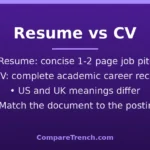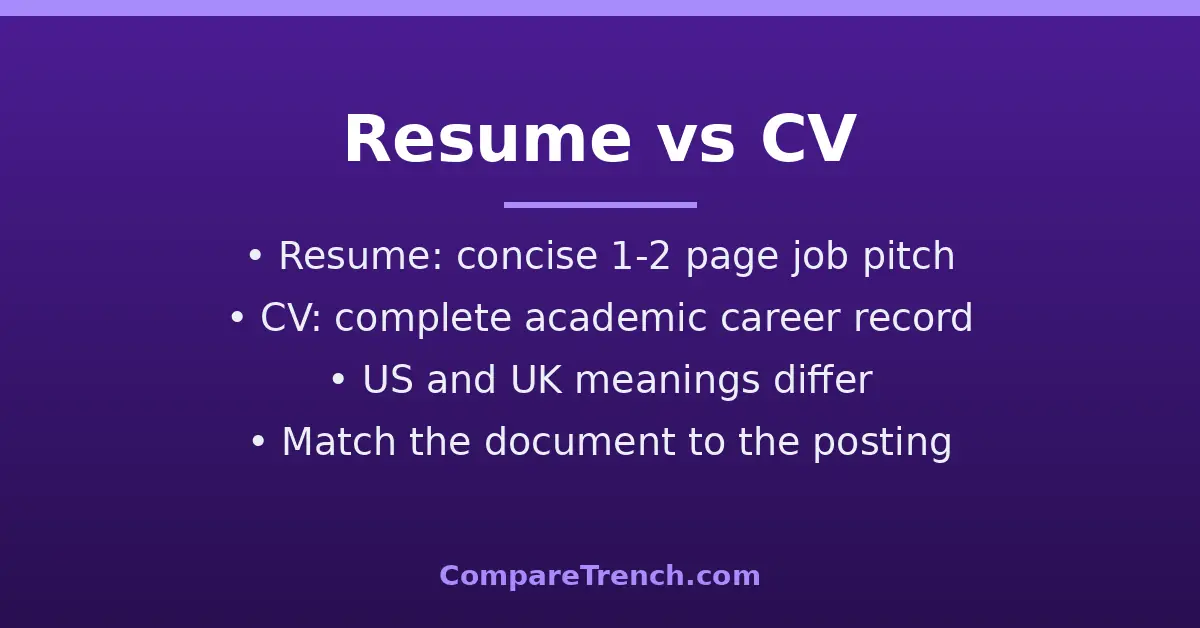
Quick Answer: A resume is a concise 1–2 page summary of your skills and experience, tailored to a specific job — the standard for most US job applications. A CV (curriculum vitae, Latin for “course of life”) is a comprehensive, multi-page record of your full academic and professional history, used for academic, research, and medical roles in the US and as the standard job-application document in the UK and Europe.
Applying for a job starts with a document — but which one? Job postings ask for a resume, a CV, or sometimes either, and the terms are used loosely enough to confuse even experienced applicants. The difference between a resume and a CV matters because sending the wrong document can make you look unprepared. This guide breaks down how they differ in length, content, purpose, and geography so you always send the right one.
Resume vs CV: Side-by-Side Comparison
| Feature | Resume | CV (Academic) |
|---|---|---|
| Full meaning | French for “summary” | Latin for “course of life” |
| Length | 1–2 pages, concise | No fixed limit; grows with your career |
| Content focus | Skills and achievements relevant to one specific job | Complete academic and professional history |
| Tailoring | Rewritten or adjusted for every application | Generally one comprehensive master document |
| Typical sections | Summary, work experience, skills, education | Education, publications, research, teaching, grants, presentations, awards |
| Used for (US) | Most private-sector and non-academic jobs | Faculty, research, medical, and fellowship positions |
| Used for (UK/Europe) | Term rarely used | “CV” is the standard word for what Americans call a resume |
| Personal details | Minimal: name, contact, LinkedIn | May include fuller background, references, professional memberships |
What Is a Resume?
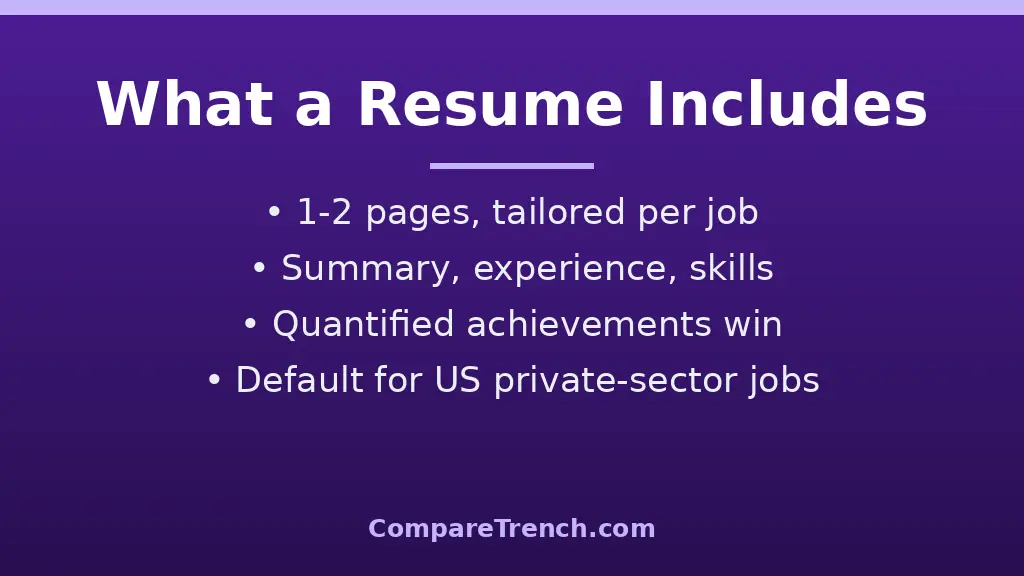
A resume is a targeted marketing document — a tight, 1–2 page summary designed to convince a specific employer you fit a specific role. Every line earns its place by answering one question: does this help me get this job? Irrelevant experience gets cut, achievements get quantified (“increased sales 23%”), and the whole document is often rewritten for each application.
The standard US resume structure includes a brief professional summary, reverse-chronological work experience with bullet-point accomplishments, a skills section, and education. Hiring managers often spend under 30 seconds on a first scan, so clarity and relevance beat completeness. In the United States, the resume is the default document for corporate, nonprofit, government, and private-sector hiring outside academia.
What Is a CV?
A CV (curriculum vitae) is a comprehensive record of your entire academic and professional life. Unlike a resume, it is not tailored down — it grows longer as your career grows, documenting every degree, publication, presentation, research project, teaching role, grant, award, and professional affiliation. A mid-career academic’s CV can easily run 5–10 pages or more.
In the United States, CVs are expected for academic, scientific, medical, and research positions: faculty jobs, postdoctoral roles, grants, and fellowships. Hiring committees want the full scholarly record, not a highlights reel. UCLA’s career center offers a clear CV vs resume comparison chart showing exactly which sections belong in each document.
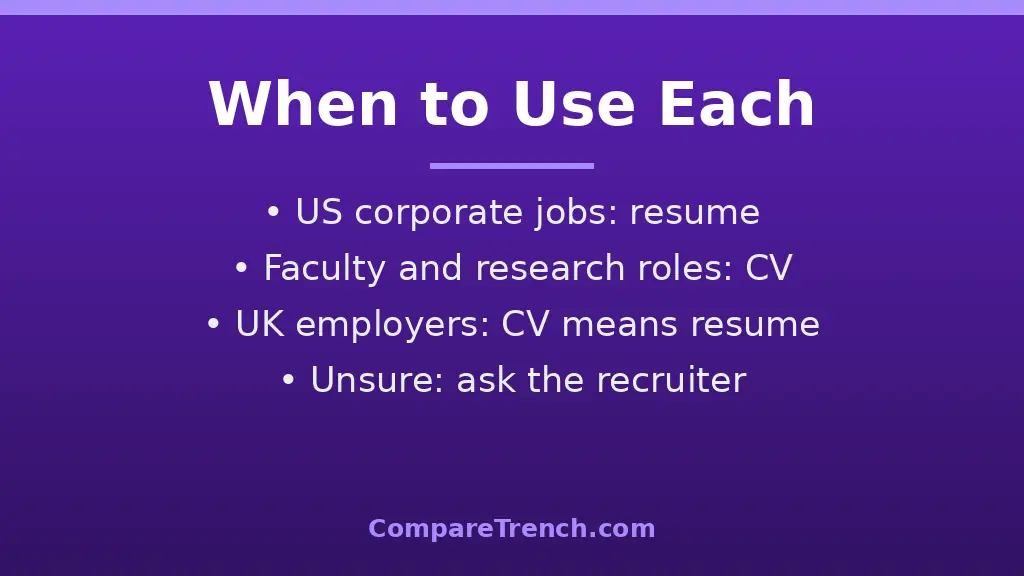
There is an important geographic twist: in the UK, Ireland, and much of Europe, “CV” is simply the normal word for a job-application document — equivalent to the American resume, usually 1–2 pages. So a “CV” requested by a London employer is not the multi-page academic document at all. Always read the employer’s context.
Length: The Most Obvious Difference
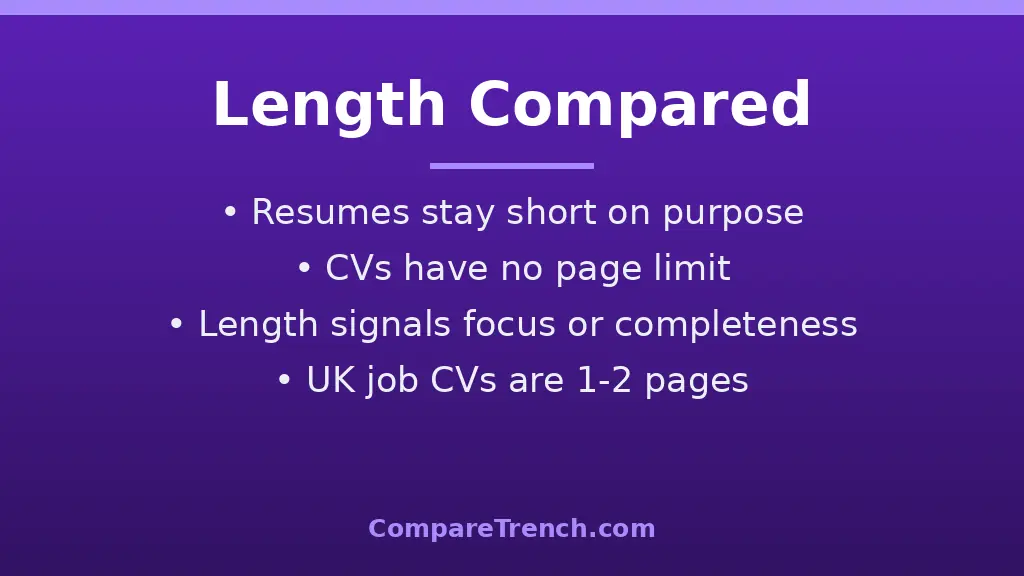
Resumes stay short on purpose. One page is ideal for early-career applicants; two pages is the accepted maximum for experienced professionals. Anything longer signals you have not prioritized — and risks the hiring manager never reaching page three. Recruiters consistently report that shorter, focused resumes get read far more carefully.
CVs have no page limit. Because their job is completeness, length is a feature: every publication, conference talk, and course taught belongs there. Academics maintain a single master CV for years, adding to it continuously, and submit it in full when applying for positions or grants.
Content and Structure Compared
A resume is selective: professional summary, work experience (newest first, with quantified achievements), key skills, education, and optionally certifications or volunteer work. Personal details stay minimal — name, phone, email, city, LinkedIn. Photos, date of birth, and marital status do not belong on a US resume.
An academic CV is exhaustive and follows a fairly fixed scholarly order: education, academic appointments, publications (often split into peer-reviewed articles, books, chapters), presentations, research experience, teaching experience, grants and funding, awards and honors, professional service, and references. Nothing relevant is left out, because committees evaluate the whole record.
A UK/European job CV looks much like a US resume — 1–2 pages with a personal statement instead of a summary — but local norms differ: photos and date of birth are more common in some countries, paper size is A4 rather than US Letter, and spellings follow British English.
Purpose: Marketing vs Record-Keeping
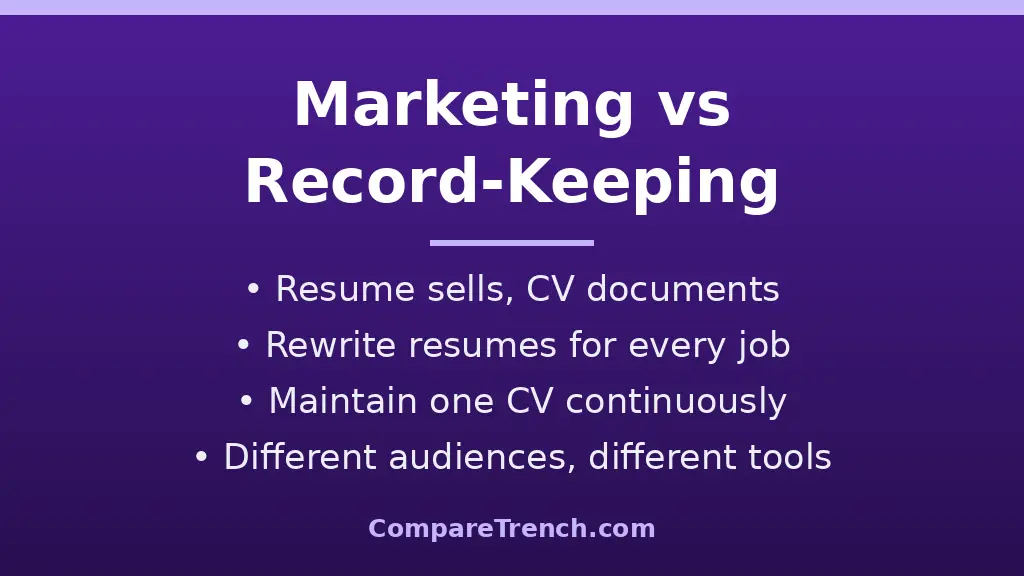
Think of it this way: a resume sells, a CV documents. The resume is a persuasive pitch customized for each audience — you emphasize different skills for a marketing role than for a data analyst role, even with the same work history. The CV is an archive: the same document goes to every academic search committee, because the facts of your scholarly record do not change with the audience.
This is why career advisors tell you to rewrite your resume for every job but maintain one CV continuously. The resume is disposable and tactical; the CV is cumulative and permanent.
When to Use a Resume
- Applying for most jobs in the US private sector: corporate, tech, retail, healthcare (non-academic), nonprofits
- Government and administrative positions that ask for a resume
- Internships and entry-level roles
- Networking — a one-page resume is the standard leave-behind
- Any posting that says “resume” without mentioning academic credentials
When to Use a CV
- Faculty, lecturer, and researcher positions at universities
- Postdoctoral fellowships and research scientist roles
- Grant, fellowship, and award applications
- Medical and clinical academic positions
- Jobs in the UK, EU, and many other regions where “CV” means the standard application document
- International organizations (UN, NGOs) that request a CV-format history
Resume Formats: Chronological, Functional, and Combination
Within the resume world, three formats dominate — and picking the right one is part of sending the right document:
- Chronological: work history in reverse date order, with achievements under each role. The default choice and the one recruiters prefer, because career progression is easy to follow. Best when your recent experience directly supports the job you want.
- Functional: organized around skill groups rather than job titles and dates. Useful for career changers, people with employment gaps, or freelancers with project-based work — but some recruiters view it with suspicion since it can hide work history.
- Combination (hybrid): a skills summary up top followed by a concise chronological work history. The best of both worlds for experienced professionals who want to highlight capabilities without burying their track record.
Academic CVs rarely vary in format — the scholarly section order (education, publications, teaching, grants) is conventional worldwide, and deviating from it confuses committees. Where CV writers do make choices is in emphasis: a teaching-focused CV leads with pedagogy and courses taught, while a research-focused CV leads with publications and funding. For the UK/European job CV, the combination format translates well: a short personal statement, key skills, then employment history.
Whichever format you choose, keep design clean and ATS-friendly: standard fonts, no graphics or tables carrying critical information, and clear section headings. Fancy templates may look good to humans but get mangled by the applicant tracking systems that screen most resumes before a person ever sees them.
Common Mistakes to Avoid
- Sending a 5-page “resume” to a US company. Trim it to 1–2 pages of relevant highlights — length reads as unfocused.
- Sending a 1-page summary for a faculty job. Search committees expect the full CV with publications and teaching history.
- Using one generic resume everywhere. Mirror the job description’s keywords and prioritize matching experience; applicant tracking systems filter on relevance.
- Mixing up the UK and US meanings. A London “CV” is a 2-page resume equivalent — do not send a 10-page academic CV unless the role is academic.
- Including photos or personal data on a US resume. It looks unprofessional and can trigger bias concerns; keep it to contact details.
Which One Should You Send?
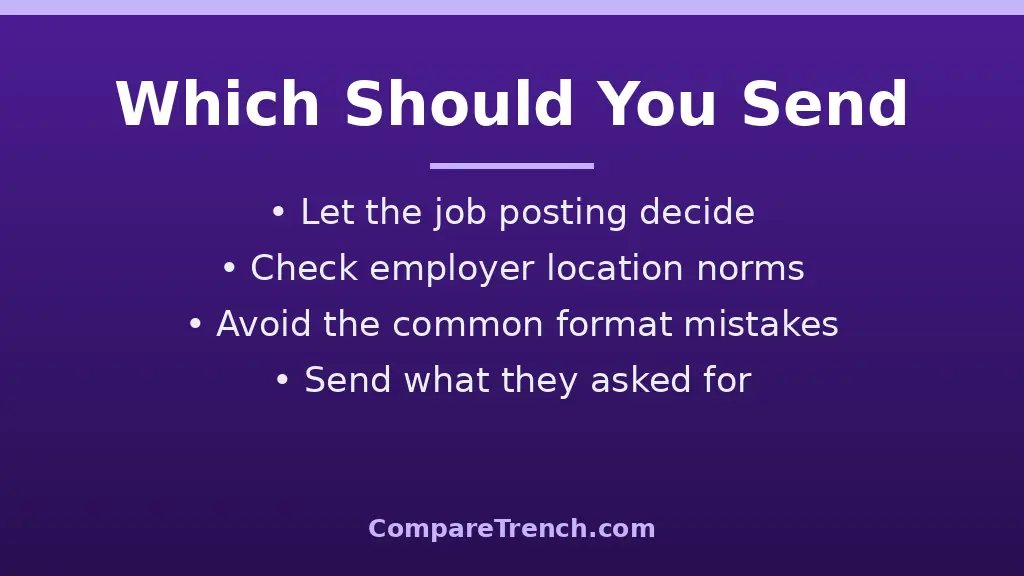
Let the posting decide. If it says resume, send a tailored 1–2 page resume. If it says CV for an academic, research, medical, or fellowship role, send your full academic CV. If a UK or European employer asks for a CV, send your 2-page resume equivalent (calling it a CV). When genuinely unsure, check the employer’s location and industry — or simply ask the recruiter which format they expect. Sending the document they asked for, in the format they recognize, is the easiest win in any application.
Frequently Asked Questions
Is a CV longer than a resume?
An academic CV is much longer — it has no page limit and grows throughout your career. But note the exception: in the UK and Europe, a “CV” is usually 1–2 pages, equivalent to a US resume.
Can I use a resume and a CV interchangeably?
In the US, no — they serve different purposes and audiences, so check each posting carefully. In the UK and much of Europe, the words overlap because “CV” is the standard term for the resume-style document.
Do employers prefer a resume or CV?
US private-sector employers overwhelmingly prefer resumes: concise, tailored, and scannable. Academic and research employers require CVs because they need your complete scholarly record.
Should a resume be one page or two?
One page for students and early-career applicants; up to two pages once you have substantial relevant experience. Never exceed two pages for a standard US resume.
What does CV stand for?
Curriculum vitae, Latin for “course of life” — a fitting name for a document that records the full course of your academic and professional career.
Career documents are just one part of professional growth — related comparisons include the difference between a certificate and a diploma for your education section, the difference between an author and a writer if you publish, the difference between a CFO and a CEO and the difference between an LLC and an S corp for business roles, and the difference between procurement and sourcing for supply-chain careers.
Conclusion
The difference between a resume and a CV is breadth versus focus: a resume is a concise, tailored 1–2 page pitch for a specific job, while a CV is a complete, ever-growing record of your academic and professional life. Use a resume for most US jobs, an academic CV for faculty, research, and medical roles, and remember that in the UK and Europe “CV” usually means the resume-style document. Keep a master file of your full history so you can build either document quickly, tailor the resume to each posting, and match the document to the audience — your application starts on the right foot.