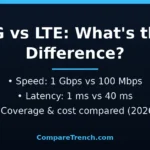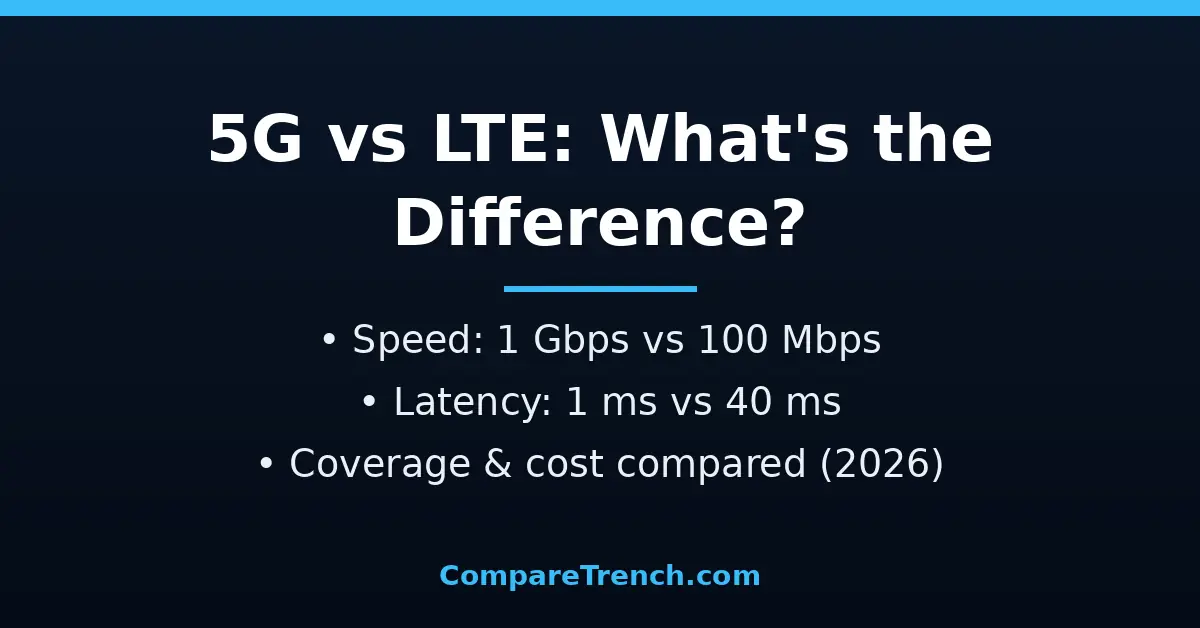
Quick Answer: LTE is the fourth-generation standard powering most of the world’s phones, while 5G is the newer fifth generation with far higher peak speeds, lower latency, and greater device capacity. In practice, mid-band 5G typically delivers several times the real-world speed of LTE, but LTE still wins on rural coverage, battery efficiency, and device compatibility. The difference between 5G and LTE matters most in dense cities, for gaming and video, and for industrial uses like IoT and fixed wireless.
Should you stay on LTE or move to 5G? The difference between 5G and LTE runs deeper than a single speed number. LTE — what most carriers market as “4G” — remains the backbone of mobile connectivity across most of the world. 5G is the fifth generation of mobile technology, rolling out since 2019 with a new radio interface, new spectrum, and capabilities designed for far more than faster downloads.
The two technologies differ in radio design, latency, capacity, spectrum use, and coverage maturity — and the practical winner depends on where you live, what your phone supports, and what you do with your connection. This guide breaks down every meaningful difference between 5G and LTE so you can make the right call for your next phone, plan, or IoT deployment.
5G vs LTE: At a Glance
| Feature | 5G | LTE |
|---|---|---|
| Generation | 5th generation (5G NR) | 4th generation (LTE / LTE-Advanced) |
| Radio interface | 5G New Radio (NR) | LTE air interface (E-UTRA) |
| Peak download speed | Up to 10–20 Gbps (theoretical); 1+ Gbps on mmWave | Up to 1 Gbps (LTE-Advanced, theoretical) |
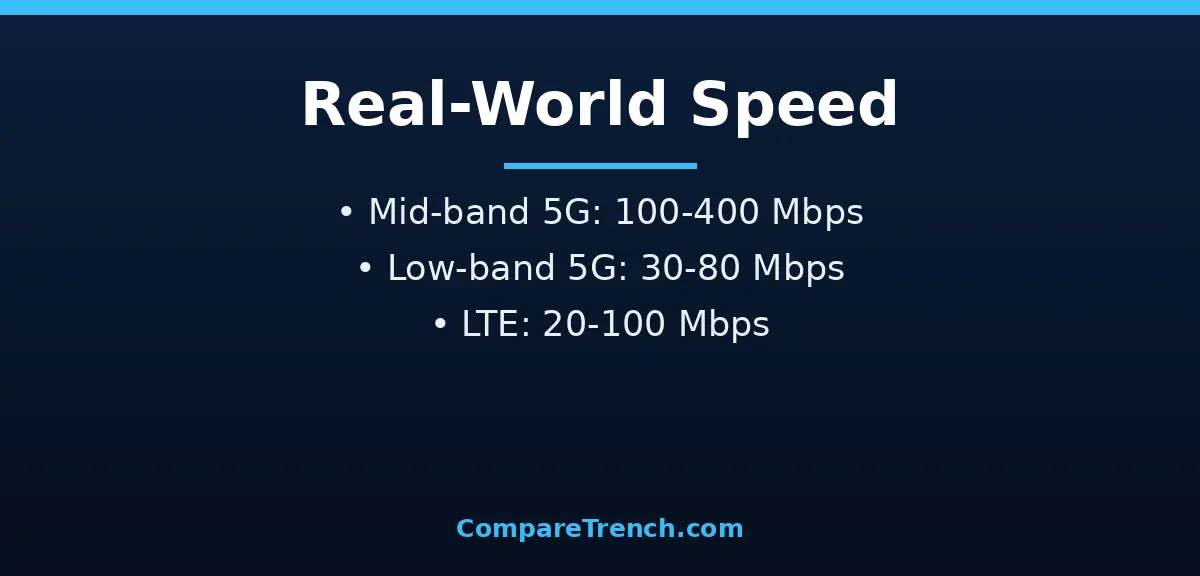
| Typical real-world speed | 100–400 Mbps on mid-band; far less on low-band | 20–100 Mbps on LTE-Advanced |
| Latency | 1–10 ms (standalone 5G) | 30–50 ms |
| Spectrum | Low-band, mid-band (sub-6 GHz), and high-band mmWave | Low-band and mid-band only |
| Connection density | Up to 1 million devices per km² | Around 2,000 devices per km² |
| Deployment modes | Non-standalone (NSA) or standalone (SA) | Standalone; anchors NSA 5G |
| Battery impact | Higher drain, especially on mmWave | Lower, more efficient power draw |
| Coverage | Strong in cities; patchy in rural areas | Near-universal, including rural areas |
| Special features | Network slicing, RedCap, edge computing | VoLTE, carrier aggregation, NB-IoT/LTE-M |
| Best for | Gaming, 4K streaming, IoT at scale, fixed wireless | Everyday reliability, rural use, battery life |
What Is LTE?
LTE stands for Long-Term Evolution — the standard behind what most carriers call “4G,” first deployed commercially around 2009–2010. It replaced the circuit-switched voice model of 3G with an all-IP, packet-switched network, making mobile data efficient enough for HD streaming, video calls, and the smartphone app era. Variants like LTE-Advanced added carrier aggregation (bonding spectrum channels into one wider pipe), 4×4 MIMO, and 256-QAM, pushing theoretical peaks toward 1 Gbps. By 2026, LTE had near-universal population coverage in most countries, plus VoLTE voice and low-power IoT variants (NB-IoT and LTE-M) — and it remains the fallback layer under early 5G: when your 5G signal drops, your phone almost certainly falls back to LTE.
What Is 5G?
5G is the fifth generation of mobile networks, built around a new radio interface called 5G NR (New Radio) and, in its full form, a new cloud-native core. The ITU’s IMT-2020 requirements set the bar: peak rates up to 20 Gbps, user-experienced rates of at least 100 Mbps, latency as low as 1 ms, and up to one million connected devices per square kilometer. One distinction matters most in 2026: non-standalone (NSA) 5G pairs a 5G radio with the existing LTE core, so the phone still depends on LTE for signaling; standalone (SA) 5G deploys a full 5G core with no LTE dependency, unlocking network slicing, ~1 ms latency, better battery behavior, and 5G RedCap for simpler IoT devices. As SA coverage expands, the gap between 5G and LTE keeps widening.
Speed: The Most Visible Difference
Real-world LTE delivers 20–100 Mbps — enough for 1080p streaming, video calls, and social media. 5G changes the ceiling: mid-band 5G typically gives 100–400 Mbps, while mmWave hotspots in dense urban areas can exceed 1 Gbps. A 4K movie or large game update that takes minutes on LTE can take seconds on 5G. But low-band 5G — the wide-coverage flavor behind “nationwide 5G” maps — is often only marginally faster than good LTE at 30–80 Mbps. The “5G” icon does not guarantee a boost; the band you are connected to matters enormously, and in cities with mid-band coverage the upgrade is dramatic.
Latency: The Difference You Feel in Real Time
Latency — the delay between sending a request and getting a response — is the second major divide. LTE typically delivers 30–50 ms round-trip, fine for browsing and streaming where a few dozen milliseconds are imperceptible. Standalone 5G targets as low as 1 ms, with real-world deployments commonly at 10–20 ms. That gap is what makes cloud gaming playable, competitive mobile gaming responsive, and video calls feel face-to-face. It also underpins AR and VR, where lag between head movement and image rendering breaks the experience. Where speed determines how much data moves, latency determines how quickly the connection reacts — and there, the difference between 5G and LTE is closer to a generational leap than an incremental gain.
Spectrum and Capacity: Three Bands vs Two
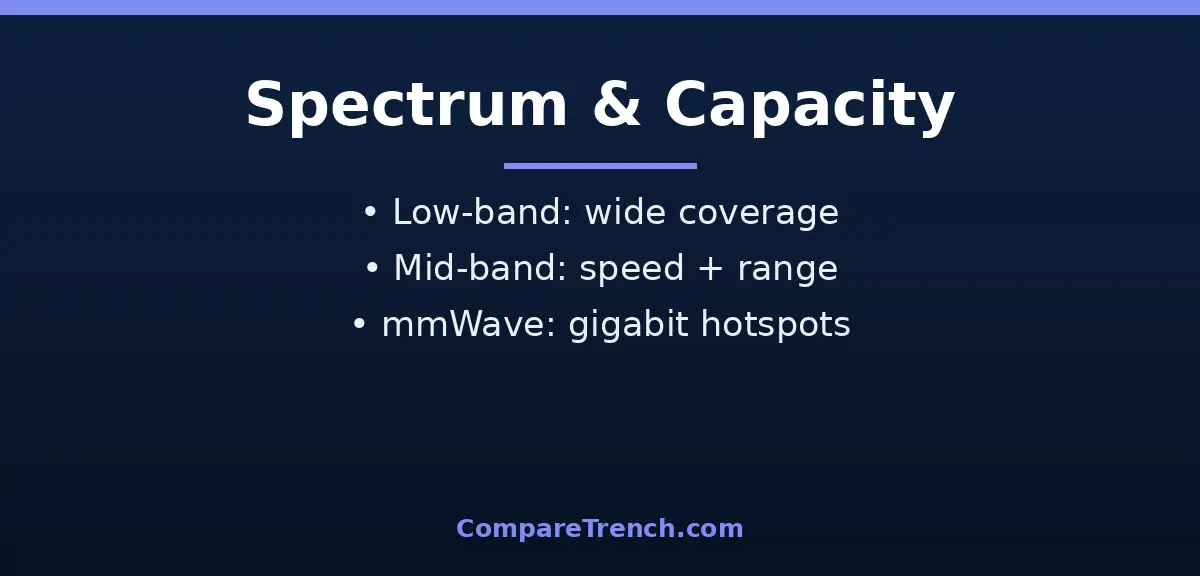
LTE operates in low-band and mid-band spectrum, roughly 600 MHz to 3.5 GHz — frequencies that travel far and penetrate buildings well, but the supply is finite and increasingly crowded. 5G adds high-band millimeter wave (mmWave) at 24 GHz and above, with enormous channel widths that enable multi-gigabit speeds. Between low-band for coverage, mid-band as the balanced workhorse, and mmWave for capacity hotspots, 5G can be tuned per location in ways LTE never could. That means capacity: LTE slows in crowded stadiums and downtown cores, while 5G’s wider channels, massive MIMO arrays, and beamforming — steering radio energy toward individual devices — serve far more simultaneous connections without the same congestion collapse.
Coverage and Rollout Status in 2026
Coverage is where LTE holds an unambiguous lead. After a decade of build-out, LTE reaches virtually the entire populated world, including rural areas and indoor spaces where low frequencies penetrate easily. 5G was still mid-rollout in 2026: low-band 5G covered most urban and suburban areas in developed markets, but mid-band — the flavor behind the headline speeds — had gaps outside major cities, and mmWave stayed limited to dense downtowns, stadiums, airports, and campuses. Several hundred operators worldwide had launched commercial 5G by 2026, with standalone deployments growing fast, while rural areas and many developing markets remain LTE-first. Carriers have no announced plans to shut down LTE — it anchors NSA 5G and carries fallback voice — so LTE coverage is not going anywhere.
Use Cases: IoT, AR/VR, and Fixed Wireless
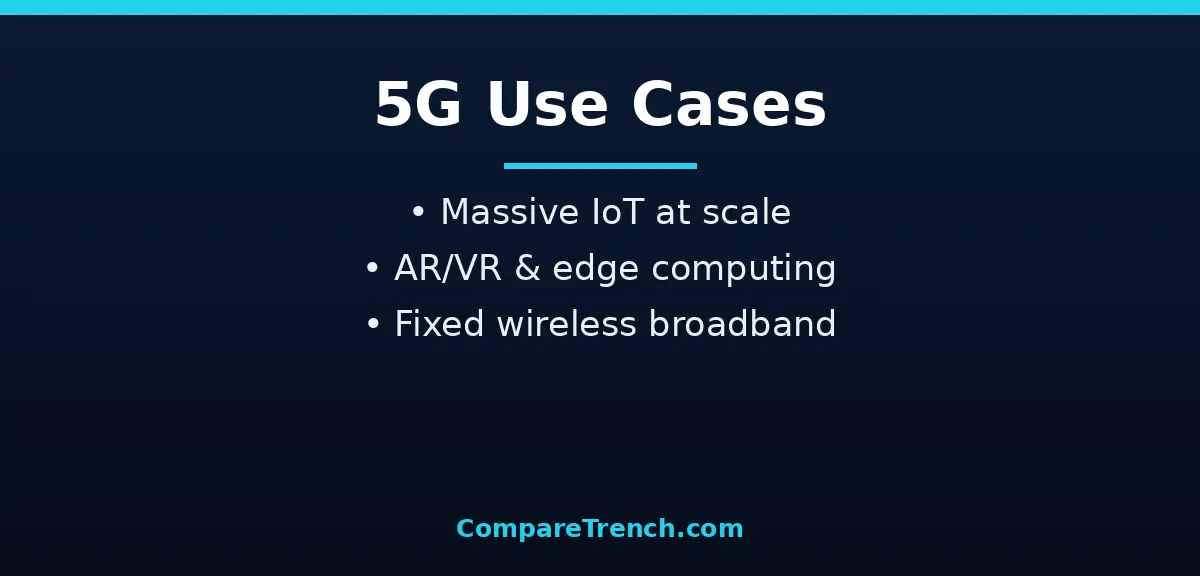
The most consequential difference between 5G and LTE is not on your phone — it is in the industries each enables. LTE supports IoT through NB-IoT and LTE-M, excellent for low-bandwidth sensors that report occasionally and sip battery. But massive machine-type communication — factories with thousands of wireless sensors, smart-city grids, supply-chain tracking — was designed into 5G from the start, alongside 5G RedCap for wearables and industrial sensors. Immersion is the second frontier: AR/VR, remote-controlled machinery, and autonomous vehicles demand the high-throughput, sub-10 ms latency combination only standalone 5G delivers. Edge computing pairs naturally with 5G to run inference workloads close to the user, powering real-time AI-assisted applications. The most visible consumer 5G use case is fixed wireless access (FWA): 5G home routers that rival cable broadband in many neighborhoods.
Battery Life, Data Plans, and Cost
5G’s performance costs power: scanning for 5G signals, maintaining multi-band connections, and especially operating on mmWave drain more battery than a settled LTE link. Modern modems and “5G Auto” modes that drop to LTE when idle have narrowed the gap, but LTE remains the more efficient choice for battery-focused users. On pricing, the 5G premium has largely evaporated: most carriers include 5G on standard plans at no extra charge, and 5G phones span every price tier. The real cost differences are indirect — a 5G phone is newer and pricier than an equivalent older LTE model, and faster speeds encourage heavier data use, so a generous data allowance matters more on 5G.
When LTE Still Wins
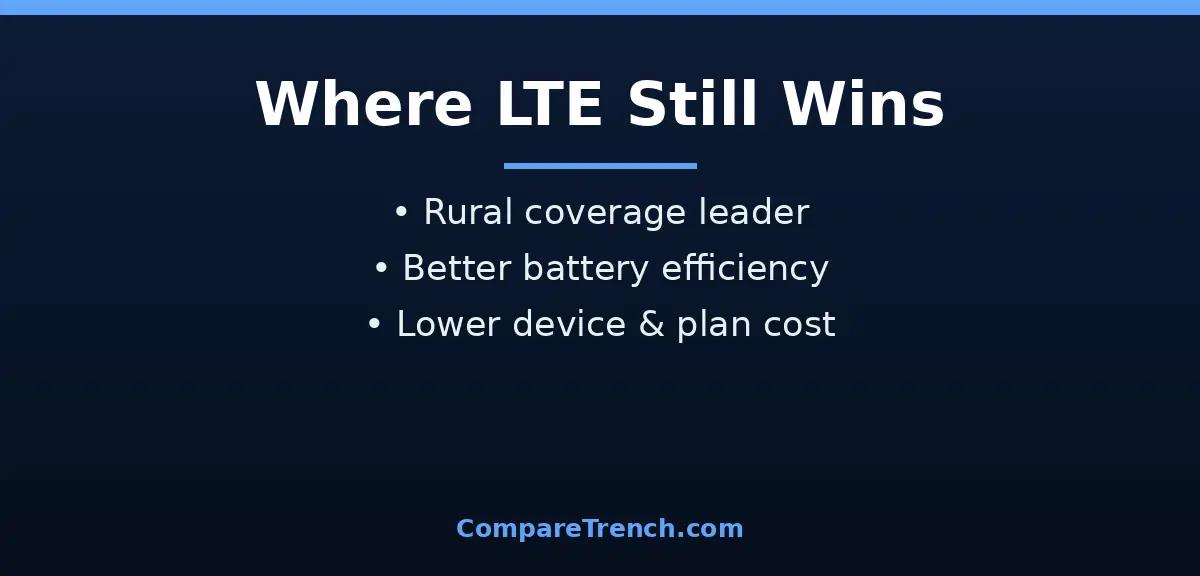
Despite 5G’s momentum, LTE is the better choice in clear situations. Rural users outside mid-band coverage usually get more consistent speeds on LTE than on a weak low-band 5G signal — carriers design networks this way, with LTE as the continuity layer. International travelers benefit from LTE’s universality, while 5G band compatibility varies by country and device. IoT deployments on NB-IoT or LTE-M offer decade-scale battery life and mature ecosystems that 5G RedCap is still building. Budget buyers get a straightforward deal: a good LTE phone on a cheap plan handles streaming, messaging, navigation, and video calls without compromise.
Which One Should You Choose?
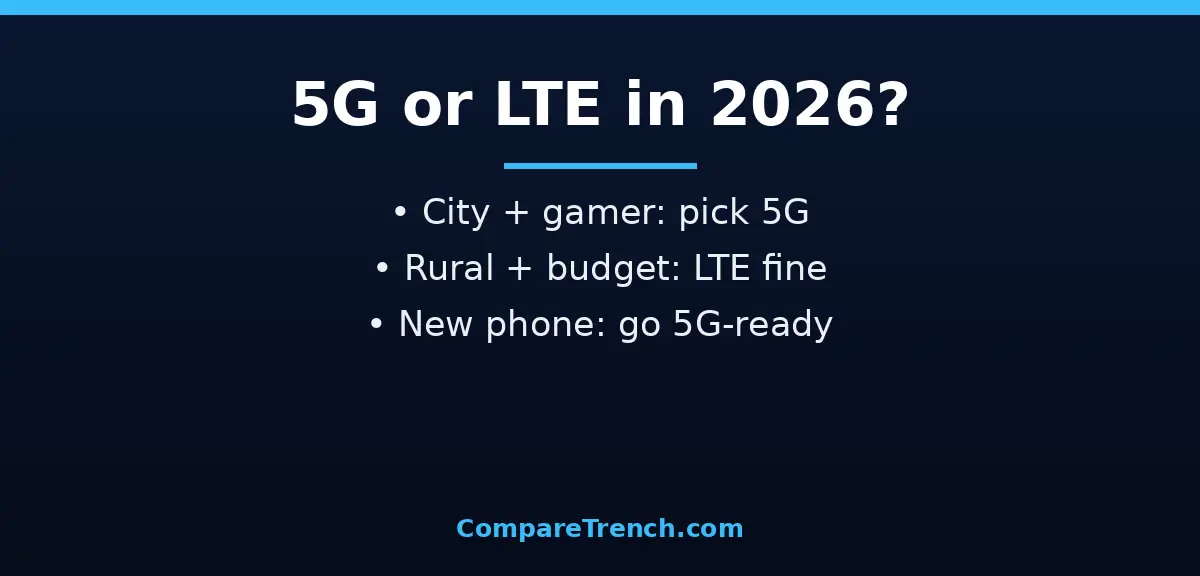
The choice comes down to where you live, what your device supports, and what you do with your phone. Buying a new phone in 2026 with solid mid-band 5G coverage? Choose 5G — virtually every new phone includes it anyway. Gamers, tethering travelers, creators uploading 4K video, and anyone in a congested city will feel the difference most.
Choose 5G if…
You have strong mid-band 5G where you live and work, play cloud or competitive mobile games, stream in 4K, or want a phone that stays relevant for three to five years. Businesses deploying IoT at scale, fixed wireless broadband, or edge-dependent applications should build on standalone 5G, where network slicing and guaranteed latency are available. For high-resolution media, the leap is tangible: a fast 5G link with a modern display makes the OLED vs UHD screen comparison genuinely visible in streamed content.
Choose LTE if…
You live rurally or travel internationally, battery life matters more than peak speed, you are buying on a budget, or your usage is mostly messaging, social media, and HD streaming — all of which LTE handles comfortably. LTE is also the pragmatic pick for simple IoT devices on established NB-IoT/LTE-M networks, and keeping an LTE phone is not a dead end: networks are not retiring LTE.
The hybrid reality
In practice, every 5G phone already lives in a hybrid world — grabbing 5G where it is strong, falling back to LTE where it is not, with handoffs increasingly managed by machine learning systems inside the network. So the question is less “which network” than “which device and plan”: buy 5G-capable hardware and let the network pick the best available link.
Frequently Asked Questions
Is 5G actually faster than LTE in real-world use?
Yes — on mid-band or mmWave 5G, real-world speeds of 100 Mbps to over 1 Gbps are common, versus LTE’s typical 20–100 Mbps. But low-band 5G is often only slightly faster than LTE, so the “5G” icon alone guarantees nothing; the band and your distance from the tower matter more than the label.
Will my LTE phone stop working when 5G expands?
No. LTE is not being shut down — it anchors non-standalone 5G and serves as the fallback network, with no carrier LTE sunset announced. Your LTE phone will keep working for years; it simply cannot connect to 5G networks. A future 5G phone will use both automatically.
Does 5G use more battery than LTE?
Generally yes. Maintaining 5G connections — especially mmWave — draws more power than LTE, though modern “5G Auto” modes that drop to LTE when idle have narrowed the gap. If battery life is the priority, LTE-only mode remains effective.
What is the difference between standalone and non-standalone 5G?
Non-standalone (NSA) 5G pairs a 5G radio with the existing LTE core, so the phone still depends on LTE for control signaling. Standalone (SA) 5G uses a full 5G core with no LTE dependency, unlocking ~1 ms latency, network slicing, and better efficiency. Carriers are progressively migrating from NSA to SA through 2026.
Does 5G use more data, and is it safe?
Faster speeds encourage heavier use — 4K streaming and large downloads become frictionless — so a generous data allowance pairs naturally with 5G. On safety, 5G uses the same radio principles as earlier generations and operates within international exposure guidelines, which regulators have found carry no established health risk. Reliable low-latency links also help clinicians with remote care, such as distinguishing a virus from a bacteria infection during a teleconsultation.
Conclusion
The difference between 5G and LTE is a genuine generational shift — new radio technology, new spectrum, lower latency, and capacity for a million devices per square kilometer — even if the everyday “5G” icon varies wildly by band and location. 5G wins on speed, responsiveness, and future-facing applications from cloud gaming to industrial IoT; LTE wins on coverage maturity, battery efficiency, and cost. Neither is going away: they are designed to coexist, with LTE as the reliable foundation and 5G as the growing layer on top.
For most people buying a phone in 2026, the advice is straightforward: get a 5G-capable device if your budget allows, check your carrier’s mid-band coverage where you live, and let the phone switch between the two networks automatically. You get 5G’s advantages where they exist and LTE’s reliability everywhere else — the best of both generations.