Quick Answer: Machine learning is the broader field of teaching computers to learn patterns from data instead of following hand-written rules, while deep learning is a specialized subset of machine learning that uses multi-layered artificial neural networks. The practical difference is that traditional machine learning needs humans to select and engineer the important features from structured data, whereas deep learning automatically discovers features from massive amounts of raw, unstructured data like images, audio, and text. Deep learning is more powerful but demands far more data, computing power, and expertise.
| Feature | Machine Learning | Deep Learning |
|---|---|---|
| What it is | The broad field of learning patterns from data | A specialized subset using multi-layer neural networks |
| Relationship | The parent category | Lives inside machine learning, which lives inside AI |
| How features are found | Humans manually select and engineer features | Neural networks learn features automatically from raw data |
| Data needed | Works well with small to medium datasets | Needs very large datasets, often millions of examples |
| Data type | Excels with structured data like tables and spreadsheets | Excels with unstructured data like images, video, and text |
| Computing power | Moderate; runs on standard CPUs | High; typically requires GPUs or specialized chips |
| Training time | Minutes to hours | Hours to weeks on powerful hardware |
| Interpretability | Often explainable; you can see which features mattered | Black box; hard to explain why it decided something |
| Typical algorithms | Decision trees, random forests, SVMs, linear regression | CNNs, RNNs, transformers, GANs |
| Classic use cases | Fraud detection, churn prediction, recommendations | Image recognition, speech, language models, self-driving |
What Is Machine Learning?
Machine learning is a branch of artificial intelligence in which computers learn to make predictions or decisions by finding patterns in data, rather than by following rules a programmer wrote explicitly. Instead of coding “if the email contains these words, mark it spam,” you feed the system thousands of labeled emails and let it discover the patterns itself.
Traditional machine learning covers a wide toolkit of algorithms: linear and logistic regression, decision trees, random forests, support vector machines, and k-nearest neighbors, among others. What they share is a reliance on structured data, information organized in rows and columns like a spreadsheet, and on feature engineering, the human-driven process of deciding which measurements the algorithm should pay attention to.
A classic example is credit scoring. A data scientist decides the relevant features might be income, debt ratio, and payment history, transforms the raw records into those features, and trains a model on them. The model’s quality depends heavily on the quality of that human feature work. Machine learning shines at forecasting, classification, and ranking tasks on business data, and it remains the workhorse of most real-world AI deployments because it is fast, economical, and explainable.
What Is Deep Learning?
Deep learning is a specialized form of machine learning built on artificial neural networks with many layers, hence “deep.” Each layer is a set of simple mathematical units inspired loosely by neurons in the brain, and data flows through layer after layer, with each layer learning progressively more abstract representations of the input.
The breakthrough idea is automatic feature learning. Show a deep network millions of raw images and it will learn on its own that edges matter in early layers, textures in middle layers, and whole objects like faces or cars in deeper layers, with no human telling it what an edge is. That ability to ingest raw, unstructured data and discover its own features is what separates deep learning from everything that came before.
This power comes at a steep price. Deep models need enormous datasets, often millions or billions of examples, and serious computing hardware, typically GPUs, to train. IBM’s deep learning guide explains how these layered networks adjust millions of weighted connections during training. The result powers the most visible AI breakthroughs of the last decade: image recognition, speech assistants, machine translation, and large language models.
The Hierarchy: AI, Machine Learning, and Deep Learning
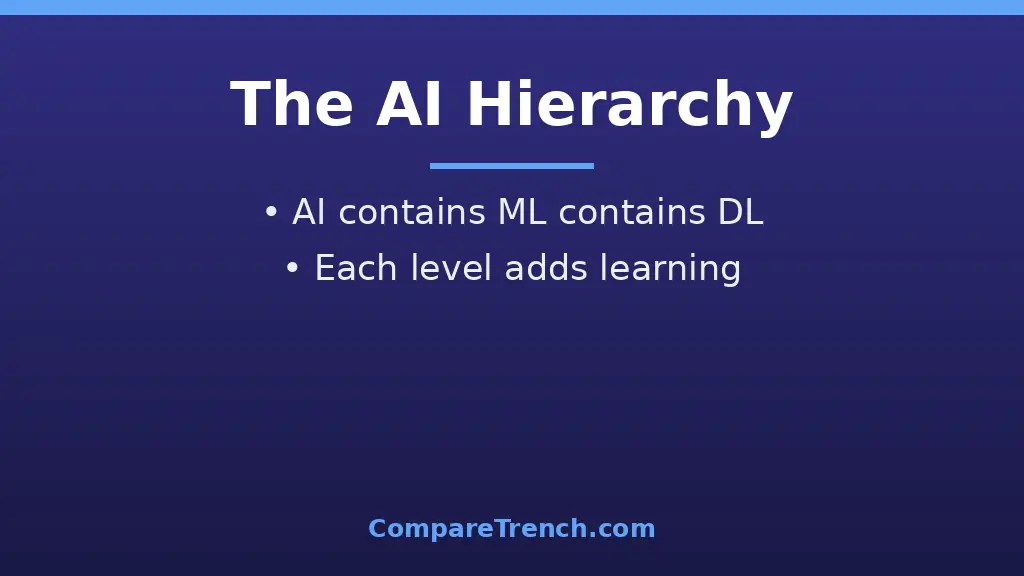
The three terms nest inside each other like Russian dolls. Artificial intelligence is the outermost and broadest: any technique that lets machines perform tasks requiring human-like intelligence, including old-school rule-based systems like chess engines that search millions of positions using hand-coded logic. No learning is required for something to count as AI.
Machine learning sits inside AI as the approach where systems improve with experience instead of explicit programming. A spam filter that updates its judgments as it sees more email is machine learning; a spam filter running on a fixed list of banned words is AI but not machine learning.
Deep learning sits inside machine learning as the neural-network-based approach to learning. So every deep learning system is a machine learning system, and every machine learning system is an AI system, but the reverse is not true. Mixing the terms up is the most common confusion in tech journalism, and keeping the hierarchy straight instantly clarifies most discussions.
Feature Engineering vs Automatic Learning
The single most practical difference between the two is who does the feature work. In traditional machine learning, domain experts study the problem, hypothesize which signals matter, and hand-craft features: for house-price prediction, features like square footage, bedroom count, and neighborhood crime rate. Model performance often hinges more on this human craftsmanship than on the choice of algorithm.
Deep learning automates that labor away. Feed raw pixels, waveforms, or text into a deep network and its layers discover useful representations by themselves during training. This is why deep learning conquered domains where humans could not hand-design good features: nobody could write down the features that distinguish a cat from a dog in a photograph, but a convolutional neural network learns them from millions of examples.
The trade-off is control and understanding. A hand-engineered feature like “debt-to-income ratio” is interpretable to a loan officer and a regulator. A feature learned by layer 47 of a neural network is a pattern of numbers with no human-readable meaning, which creates the famous black-box problem discussed below.
Data and Compute Requirements
Traditional machine learning is remarkably data-efficient. A few thousand well-chosen examples are often enough to train a strong classifier on structured data, and training typically finishes in minutes on an ordinary laptop or server CPU. This makes it accessible to small teams and modest budgets.
Deep learning is ravenous by comparison. State-of-the-art models train on datasets of millions to billions of examples and require clusters of GPUs running for days or weeks, with electricity and hardware bills to match. Training a frontier language model can cost millions of dollars. Even fine-tuning an existing model demands far more resources than training a random forest.
This resource gap drives real decisions. A startup with 10,000 customer records and a single server should reach for traditional machine learning every time; deep learning would be overkill that performs worse. A tech giant with a billion photos and a GPU farm has the opposite calculus. Matching the method to the resources is more important than chasing the trendier label.
Accuracy vs Interpretability
On complex perception tasks, deep learning wins on raw accuracy by wide margins. It recognizes images, transcribes speech, and translates languages better than any hand-engineered system ever did. For unstructured data, there is simply no contest.
But accuracy is not the only virtue. Traditional models like decision trees and linear regression are interpretable: you can inspect exactly which features drove a prediction and by how much. In regulated domains like lending, hiring, and medicine, that transparency is often legally required. A bank must be able to explain why a loan was denied, and “the neural network said so” does not satisfy regulators.
Deep networks, by contrast, are black boxes. Researchers can probe them with explanation tools, but there is rarely a clean human-readable reason for any single decision. Organizations must therefore weigh performance against accountability: the best model is not always the most accurate one, but the most accurate one you can defend, audit, and explain.
Real-World Applications
Traditional machine learning quietly runs much of the digital economy. It scores credit applications, detects fraudulent transactions, predicts which customers will cancel, forecasts inventory demand, and powers the recommendation engines behind shopping and streaming. These are structured-data problems where interpretability and cost-efficiency matter, and classic ML dominates them.
Deep learning owns the perception frontier. It enables face unlock on phones, real-time translation earbuds, voice assistants that understand natural speech, medical imaging systems that spot tumors, and self-driving cars that parse road scenes. It also powers generative AI: the large language models behind chatbots and the diffusion models behind image generators are deep neural networks at enormous scale.
The two increasingly collaborate. A self-driving stack might use deep learning to perceive pedestrians and traditional ML to decide maintenance schedules. Even consumer tech blends them: the AI upscaling that sharpens video on modern displays uses deep learning, which is part of why the distinction between OLED vs UHD matters less than the processing behind the panel. And when a trained model makes a live decision, engineers call that step inference, a concept worth separating from training-time forecasting in the inference vs prediction distinction.
Which One Should You Choose?
Choose traditional machine learning when your data is structured and modest in size, when you need results fast and cheap, when stakeholders must understand the model’s reasoning, or when you are solving a classic prediction problem like churn, fraud, or forecasting. For most business analytics tasks, this is the right answer, and it will remain so.
Choose deep learning when your data is unstructured and abundant: images, video, audio, or natural language at scale. Choose it when the problem resists hand-engineered features, when you have the data and compute budget to feed it, and when accuracy outweighs interpretability. Perception problems and generative AI live here.
For learners and builders, the pragmatic path is sequential: master traditional ML first, since its concepts of training, validation, and overfitting underpin everything, then move to neural networks once you have real unstructured-data problems. Business leaders weighing AI investments face a similar sequencing question at the organizational level, and clarity about the CFO vs CEO split helps determine who owns that technology bet. The hardware side matters too: the GPUs that train deep models are fabricated in cutting-edge semiconductor plants, a world away from how server chassis get forged from steel, which is the industrial contrast behind fabric vs forge. And as generative models start drafting articles and code, the line between author vs writer is getting blurrier in exactly the way deep learning made possible.
Frequently Asked Questions
Is deep learning better than machine learning?
Neither is universally better. Deep learning wins on unstructured data like images and text when massive datasets and compute are available. Traditional machine learning wins on structured business data, small datasets, tight budgets, and anywhere interpretability is required. The right choice depends on the problem, the data, and the constraints.
Do I need deep learning for my business data?
Almost certainly not. If your data lives in spreadsheets and databases, traditional machine learning algorithms like gradient boosting and random forests will be faster, cheaper, more explainable, and often more accurate than a neural network. Deep learning earns its keep on images, audio, video, and text.
What is an example of deep learning vs machine learning in everyday life?
Your phone’s face unlock and voice assistant use deep learning on images and audio. Your bank’s fraud alert on an unusual purchase and Netflix’s recommendations use traditional machine learning on structured transaction and viewing data. Both run constantly in the background of modern life.
How much data does deep learning need?
There is no fixed threshold, but deep learning typically needs orders of magnitude more data than traditional ML: tens of thousands of examples at minimum for simple tasks, and millions to billions for state-of-the-art vision and language models. With only a few thousand rows of tabular data, classic algorithms will outperform neural networks.
Can deep learning work without big data?
Partly, through transfer learning: take a model pre-trained on massive data and fine-tune it on your smaller dataset. This works well for images and text and is how small teams use deep learning practically. But training a deep network from scratch on a small dataset will overfit badly, memorizing the training data instead of learning general patterns.
Conclusion
The difference between machine learning and deep learning is the difference between a broad discipline and its most powerful specialty. Machine learning teaches computers to learn from data; deep learning does it with multi-layered neural networks that discover their own features from massive, unstructured datasets.
Use traditional machine learning for structured business problems where speed, cost, and explainability matter. Reach for deep learning when you face images, language, or perception at scale and have the data and compute to support it. Understanding which tool fits which job is the real skill, whatever the buzzwords say.