Quick Answer: A king bed is 76 inches wide and a queen bed is 60 inches wide — both are 80 inches long, so the entire difference between a king bed and a queen bed is 16 inches of width. That extra width gives each sleeper roughly 38 inches of personal space on a king versus 30 inches on a queen, but it demands a larger bedroom, costs more for the mattress, bedding, and frame, and is harder to move through tight spaces.
The difference between king bed and queen bed sizes is one of the most common questions shoppers ask when buying a mattress, and the answer sounds deceptively simple: the king is wider. In US sizing, a standard queen measures 60 by 80 inches and a standard (Eastern) king measures 76 by 80 inches. The length is identical, so the whole decision comes down to 16 inches of width.
But those 16 inches ripple through the whole purchase: the minimum bedroom size, the price of the mattress and every sheet set you will ever buy, whether the bed fits through your stairwell, and how much personal space you get every night for the next decade.
King Bed vs Queen Bed: At a Glance
| Feature | King Bed | Queen Bed |
|---|---|---|
| Mattress dimensions (US) | 76 × 80 inches | 60 × 80 inches |
| Total sleeping surface | 6,080 sq inches (about 27% more) | 4,800 sq inches |
| Width per person (two sleepers) | ~38 inches each | ~30 inches each |
| California King alternative | 72 × 84 inches (narrower, longer) | No equivalent |
| Minimum bedroom size | 12 × 12 ft or larger | 10 × 10 ft comfortably |
| Average mattress price | $200–$400 more than a queen | Most competitive pricing |
| Bedding cost | 20–35% higher for sheets and duvets | Lower; widest selection |
| Weight and moving | Heavier, harder through doors/stairs | Manageable for two people |
| Couples, kids, and pets | Excellent with children or pets | Comfortable for two adults |
| Bedding availability | Good, less variety than queen | Every brand carries it |
Exact Dimensions: US Standard Sizes
The standard queen mattress is 60 inches wide and 80 inches long (about 152 × 203 cm). It is 5 inches wider and 7 inches longer than a full-size bed, and it remains the most popular mattress size in the United States. The standard king — technically the Eastern king — is 76 inches wide and 80 inches long (about 193 × 203 cm). Because both share the same length, a taller sleeper gains nothing from switching to a king; the only question is how much side-to-side room you want.
Two king variants matter. The California king is 72 inches wide and 84 inches long and suits taller sleepers in rooms where a full 76-inch width is too much. The split king is two twin XL mattresses (each 38 × 80 inches) placed side by side on a king frame: together they equal the standard king’s footprint, but each side can have its own firmness and adjustable-base setting, which matters when partners have very different comfort needs.
These numbers are US standards and vary abroad. In the UK, what Americans call a queen is close to a UK king (150 × 200 cm), and a US king has no exact UK equivalent. If you are importing bedding or a frame, measure in the units of the market you are buying from.
Room Size Requirements
A bedroom must hold more than the mattress. The frame, headboard, nightstands, and walking space all add to the footprint. A good rule is to leave at least 24 inches of clear walking space on each side of the bed and about 36 inches at the foot. With a king frame typically measuring around 78 × 86 inches including the headboard, you need a room roughly 12 feet wide for the bed to feel comfortable rather than cramped. Also check that doors, closet openings, and windows will still work once the larger bed is in place — a king pushed under a window can block natural light and make the room feel smaller.
A queen is far more forgiving. Its framed footprint of about 62 × 84 inches fits comfortably in a 10 × 10-foot room and leaves a 10 × 12-foot room feeling spacious, with room for a dresser and proper walkways. This flexibility is why queens dominate guest rooms and secondary bedrooms. Before buying either size, tape the frame dimensions out on your bedroom floor with painter’s tape — standing in the outlined rectangle tells you more in thirty seconds than any chart can.
Cost Differences: Mattress, Bedding, and Frame
A king mattress typically costs $200 to $400 more than the same model in queen, and the gap widens on premium lines. Because the queen is the best-selling size, it attracts the most promotions and the deepest clearance discounts. If you are comparing prices across currencies, our guide to the difference between pounds and quid is a useful reference — but whichever currency you use, always compare the same brand and model to see the true size premium.
Bedding is where the ongoing cost gap lives. King sheet sets, duvet covers, and mattress protectors run roughly 20 to 35 percent higher than queen equivalents, with a thinner selection. Over a ten-year mattress life, replacing sheets twice and a comforter once can add several hundred dollars to the king’s lifetime cost. Frames and foundations follow the same pattern: king frames cost more, and some require a center support leg or a split box spring.
Delivery can differ too. Many retailers deliver a queen with standard service, while a king’s weight may push you into white-glove delivery. When budgeting, price the full package — mattress, frame, bedding, protector, and delivery — for both sizes; the mattress sticker price alone hides the real gap.
Comfort and Sleep Quality
The comfort argument for a king is personal space. On a queen, two sleepers get about 30 inches of width each — roughly the width of a crib. On a king, each gets about 38 inches, close to a twin bed per person. If your partner tosses and turns, runs hot, or sprawls, those extra 8 inches per person reduce sleep disturbance noticeably.
Edge support matters more on a queen because each sleeper sits closer to the edge — a queen with weak edges effectively shrinks to a full-size bed for two adults. Tall sleepers should note that both sizes are 80 inches long, so anyone over about 6’2″ should consider a California king rather than assuming a standard king solves length problems.
Temperature is a hidden factor: two people on a queen share a smaller air pocket, so heat builds up faster. Couples who sleep hot often rest better on a king simply because there is more surface to dissipate warmth. If you sleep alone, a queen already gives you abundant room — a king adds little except cost.

Couples, Kids, and Pets
Sharing a bed is its own daily negotiation — much like the difference between friendship and relationship, the difference between king bed and queen bed comes down to how much space two people need to stay comfortable together. For most couples without children or pets, a queen is enough: 30 inches each is workable when both sleepers stay roughly in place, and many couples prefer the closeness. The king becomes the clear winner when sleep habits clash — different bedtimes, restless legs, or a partner who migrates to the middle of the mattress.
Children change the math quickly. A toddler who climbs in at 3 a.m. consumes far more than their share of a queen, and families with young kids overwhelmingly prefer a king. Pets have the same effect: a medium or large dog on a queen pushes at least one human to the edge, while a king lets the dog take its corner without a turf war.
The split king deserves special mention for couples with very different preferences. Because it is two twin XL mattresses, one side can be firm while the other is soft, with independently adjustable bases. It costs more and needs special split bedding, but it solves the comfort conflict that no amount of extra width can fix.

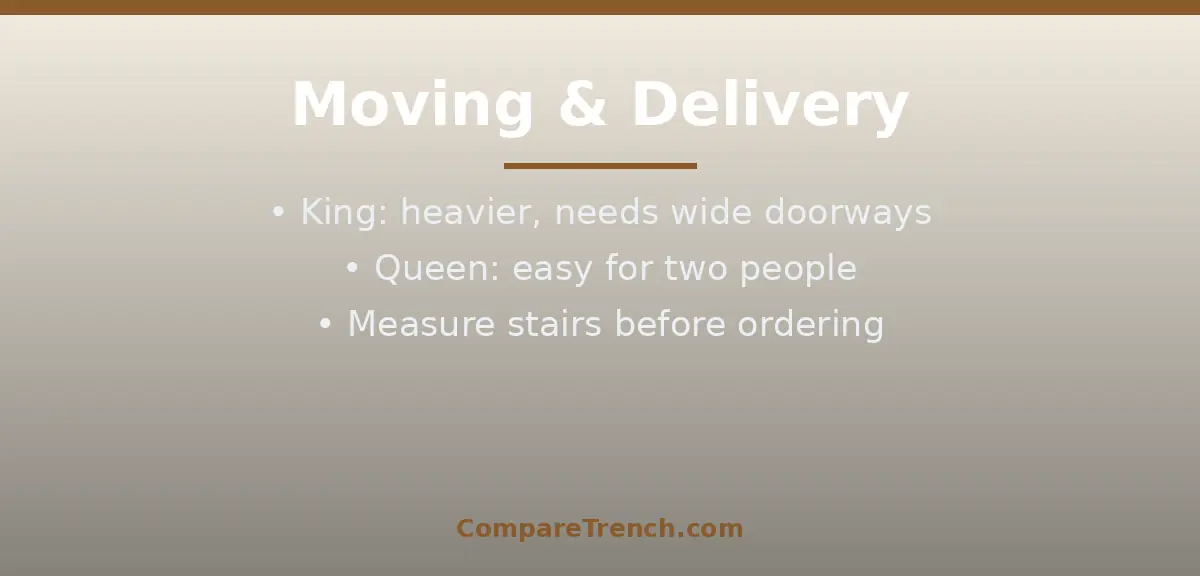
Moving and Delivery Logistics
A king mattress weighs roughly 20 to 40 pounds more than the same model in queen, and ships in a correspondingly larger box. A queen in a box usually fits through any standard 30-to-36-inch interior doorway with one turn; a king often needs to be flexed around corners, which memory foam tolerates but traditional innersprings do not. Stairwells and elevators are the real constraint — measure the tightest point on the delivery path before ordering.
Headboards add another wrinkle: solid king headboards can be wider than a standard doorway, so flat-pack or split designs are worth choosing in apartments and older homes. For upstairs bedrooms, white-glove delivery is usually money well spent — two professionals with straps move a king faster and more safely than most households can manage alone.
Renters should think about the future, too. A queen moves between apartments with minimal drama, while a king can complicate a move to a smaller place or a building with a narrow stairwell. Larger headboards in finishes from matte black to warm brass tones can dominate a room, and if you are weighing metal finishes, our comparison of brass and gold can help.
Which One Should You Choose?
Choose a king if your bedroom is at least 12 × 12 feet, you share the bed with a partner whose sleep habits disturb you, children or pets regularly join you, or you simply want maximum personal space and can absorb the higher mattress, bedding, and delivery costs. The king is the right pick for couples who value undisturbed sleep over floor space, and for families where the bed doubles as a gathering place.
Choose a queen if your bedroom is 10 × 12 feet or smaller, you sleep alone or with a partner who sleeps quietly, you want the widest bedding selection at the lowest prices, or you move frequently and need a bed that travels easily. If you mostly watch shows in bed before sleeping, screen quality matters more than bed size — our guide to OLED and UHD explains what to look for in a bedroom TV. And for your morning routine after a good night’s sleep, the difference between espresso and latte may be the next comparison worth making.
Frequently Asked Questions
Is a king bed twice as big as a queen?
No. A king is about 27 percent larger in total sleeping surface (6,080 vs 4,800 square inches), not double. The length is identical at 80 inches; the king is simply 16 inches wider.
Can I use queen sheets on a king bed?
No — queen fitted sheets will not stretch over a king mattress. A king is 16 inches wider, so queen sheets pop off the corners or tear. You need king-size fitted sheets, and usually king pillowcases and a king duvet cover as well. Mixing sizes is a common and costly mistake for first-time king buyers.
What room size do I need for a king bed?
A 12 × 12-foot bedroom is the practical minimum for a king, allowing roughly 24 inches of walking space on each side and room for nightstands. Smaller rooms can technically hold a king, but dressers, doors, and walkways become compromises. A queen works comfortably from 10 × 10 feet upward.
Is a king bed worth the extra money?
It is worth it if the extra width solves a real problem: a restless partner, kids or pets in the bed, or a large bedroom that would make a queen look lost. If none of those apply, the queen’s lower mattress price, cheaper bedding, and wider selection make it the better value — the comfort gain for a solo sleeper is minimal.
What is the difference between a standard king and a California king?
A standard (Eastern) king is 76 inches wide and 80 inches long; a California king is 72 inches wide and 84 inches long. The Cal King trades 4 inches of width for 4 inches of length, suiting taller sleepers. Bedding is not interchangeable between them, so choose before you shop for sheets.
Conclusion
The difference between king bed and queen bed sizes comes down to 16 inches of width and everything those inches demand: a bigger room, a bigger budget, and more muscle on moving day. A king rewards couples, families, and pet owners with genuinely better sleep through extra personal space, while a queen wins on price, flexibility, and ease — and remains the right answer for most bedrooms. Measure your room, price the full package including bedding, and pick the size that fits your space and your sleep. For authoritative mattress size details beyond this guide, see the Sleep Foundation’s mattress size guide.