Quick Answer: Revenue is the total money a business earns from selling its products or services before any expenses are subtracted. Profit is what remains after all expenses — production costs, operating costs, interest, and taxes — are deducted from revenue. A company can post record revenue and still report a loss, which is why investors watch profit, not just sales.
Two businesses can report identical sales and end up in completely different positions — one keeps forty cents of every dollar, the other three. That gap is the difference between revenue and profit: money flowing through a business versus money staying in it. Confusing the two is one of the costliest mistakes a founder, freelancer, or investor can make.
Revenue measures customer demand; profit measures how well purchases turn into earnings. They usually move together — but expenses can grow faster than sales, wiping out profit while revenue climbs. This guide breaks down what each one includes, how they appear on financial statements, the margins professionals track, and which number to trust when.
Revenue vs Profit: At a Glance
| Feature | Revenue | Profit |
|---|---|---|
| Definition | Total income from selling goods or services, before any costs | Income left over after subtracting all costs from revenue |
| Also called | Sales, turnover, the top line | Net income, earnings, the bottom line |
| Formula | Price × units sold (minus discounts and returns for net revenue) | Revenue − cost of goods sold − operating expenses − interest − taxes |
| Expenses included? | No — expenses are not deducted | Yes — every cost is deducted step by step |
| Income statement position | Near the top | At the bottom, after all deductions |
| What it tells you | How much demand exists for the business’s offering | How efficiently the business converts sales into earnings |
| Can it be negative? | No — revenue cannot fall below zero | Yes — when expenses exceed revenue, the result is a net loss |
| Used for | Setting sales targets and forecasting production | Valuing companies, deciding dividends, reinvesting |
| Key weakness | Ignores every cost — high revenue can hide big losses | Can be shaped by accounting choices and one-time items |
| Simple example | $50,000 in product sales | $50,000 − $42,000 in costs = $8,000 profit |

What Is Revenue?
Revenue is the money a business earns from its normal operations — selling products, delivering services, or collecting subscriptions — before any expense is taken out. It’s called the top line because it sits at the very top of the income statement, and every other figure is calculated downward from it.
The basic formula is straightforward: revenue = price × number of units sold. If an online store sells 2,000 lamps at $40 each, its revenue is $80,000. That figure says nothing about rent, staff, or shipping — it only measures the inflow from selling.
Gross Revenue vs Net Revenue
Gross revenue is total sales before adjustments; net revenue subtracts returns, refunds, and discounts. If the lamp store sold $80,000 in lamps but customers returned $4,000 and used $2,000 in discount codes, net revenue is $74,000. Most financial statements report net revenue, since it reflects the income the business actually kept.
Operating vs Non-Operating Revenue
Operating revenue comes from the core business — the lamps, the consulting hours, the subscriptions. Non-operating revenue comes from side sources like interest or asset-sale gains. Investors focus on operating revenue, because it shows whether the actual business is growing; a one-time asset sale says nothing about future sales.
Revenue matters because it is the fuel every other number depends on. Without revenue, there is no profit to calculate. It also influences how the business is structured: high-revenue ventures weigh decisions like LLC vs S corp differently than low-revenue ones, since entity choice affects how profits are taxed once they are earned.
What Is Profit?
Profit is what remains after a business deducts its expenses from revenue. In accounting it’s called net income, and it’s the bottom line because it appears at the end of the income statement. If revenue measures what a business brings in, profit measures what it keeps.
Profit is calculated in layers, and each layer answers a different question about the business.
Gross Profit
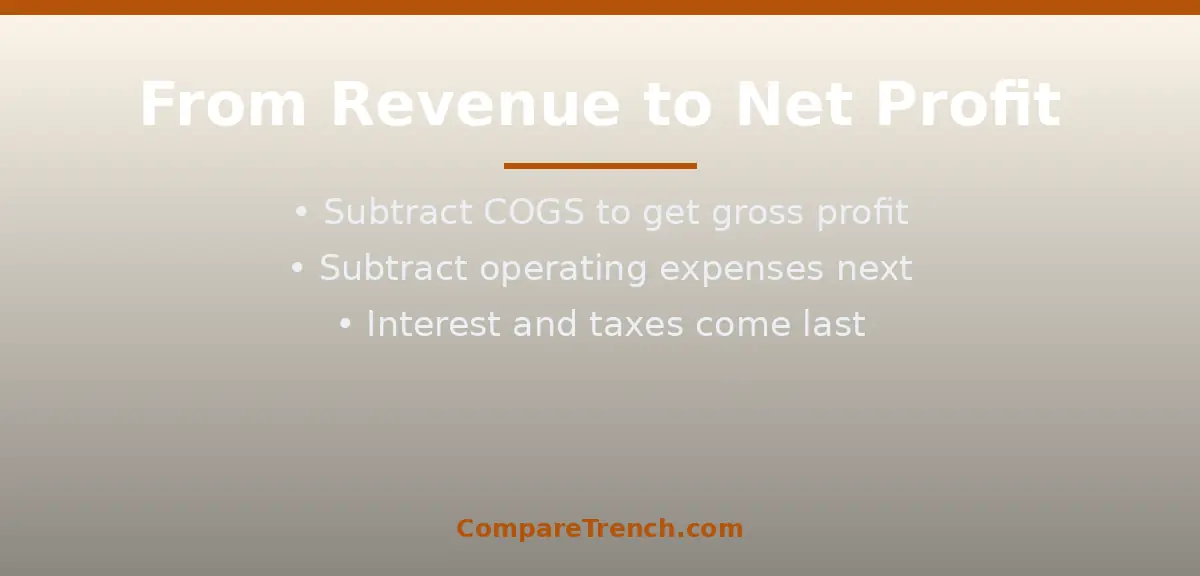
Gross profit is revenue minus the cost of goods sold (COGS) — the direct costs of producing what was sold, such as materials and labor. If the lamp store’s net revenue is $74,000 and 2,000 lamps cost $18 each to make, COGS is $36,000 and gross profit is $38,000. Gross profit shows whether the product is priced and produced sustainably, before rent and salaries enter the picture — which is why smart procurement and sourcing decisions matter.
Operating Profit
Operating profit is gross profit minus operating expenses — rent, utilities, payroll, marketing, software, insurance — the costs of running the business day to day. With $24,000 in operating expenses, the lamp store’s operating profit is $14,000. This figure shows how well management runs the company itself, apart from financing and tax choices.
Net Profit
Net profit is operating profit minus interest payments and taxes. If the lamp store pays $1,500 in loan interest and $2,500 in taxes, its net profit is $10,000. This is the final number — the money the business truly earned in the period. Net profit can be reinvested, saved, or paid out to owners.
The full chain, in one formula: Net profit = revenue − COGS − operating expenses − interest − taxes. Every step down the income statement adds a layer of cost, which is why the difference between revenue and profit widens as a business gets more complex.
How Revenue and Profit Appear on an Income Statement
An income statement reads like a staircase from revenue down to profit. Here is a simplified example for a small clothing brand in 2026:
| Income Statement Line | Amount | Running Result |
|---|---|---|
| Revenue (net sales) | $240,000 | Starting point |
| Minus cost of goods sold | ($120,000) | $120,000 gross profit |
| Minus operating expenses | ($75,000) | $45,000 operating profit |
| Minus interest | ($6,000) | $39,000 pre-tax profit |
| Minus taxes | ($9,000) | $30,000 net profit |
The brand earned $240,000 but kept only $30,000 — a 12.5% net margin. Revenue is shaped mostly by market performance: how many customers buy, at what price. Profit is also shaped by management’s cost decisions and accounting rules, making revenue the purer number and profit the more complete one. Day-to-day ownership of this staircase usually sits with finance leadership, which is why the CFO vs CEO split clarifies who owns revenue growth and who owns profitability.
Profit Margins Investors Watch
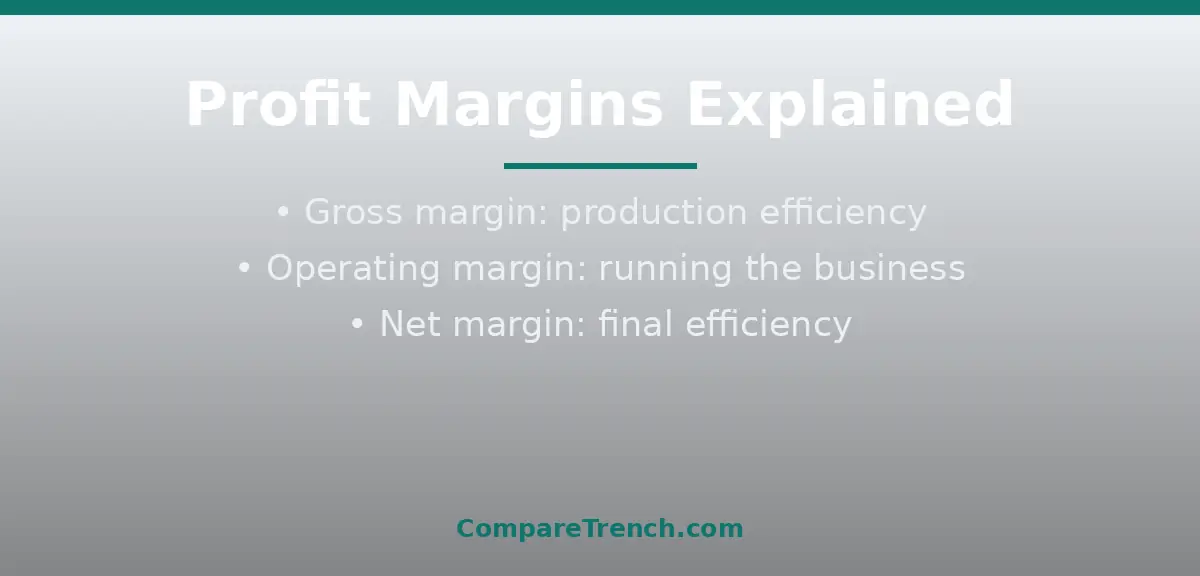
Margins express each profit layer as a percentage of revenue, which makes businesses of different sizes easy to compare. The three that matter most:
- Gross margin = gross profit ÷ revenue. It measures production efficiency. A gross margin of 50% means the company keeps 50 cents per revenue dollar before operating costs. Software companies often run above 70%; grocery stores run near 25%.
- Operating margin = operating profit ÷ revenue. It measures how efficiently the company is run. A rising operating margin means management is controlling costs while sales grow.
- Net margin = net profit ÷ revenue. It measures the final efficiency after everything. This is the margin most often quoted in the news: “a 12% net margin” means twelve cents kept per dollar sold.
Margins also show whether revenue growth is healthy: if revenue doubles but net margin falls from 15% to 5%, costs are growing faster than sales. Financing costs play a role too — heavy borrowing at high rates eats into the gap between operating and net profit, which is one reason founders track APR vs APY on business loans.
Revenue vs Profit: Examples From 2026
The difference between revenue and profit is easiest to see in real-scale numbers. According to Investopedia’s breakdown of Amazon’s 2024 annual results, the company reported roughly $638 billion in total net revenue — but its profit was about $59 billion. Enormous sales, single-digit net margin. Nothing was wrong with the business; it simply spends hundreds of billions on fulfillment, logistics, and labor before a dollar of profit remains. That is normal for a high-volume retailer.
At the other end, an illustrative 2026 example: a freelance designer bills $120,000 in project fees, spends $15,000 on software, subcontractors, and insurance, and pays no interest — net profit of about $105,000, an 87.5% margin, from revenue a fraction of Amazon’s. High revenue signals scale; high margin signals efficiency. Healthy businesses eventually need both.
Common Mistakes People Make About Revenue and Profit
Several persistent errors cause people to mix the two up — some of them costly:
- “High revenue means a healthy business.” It doesn’t. A company can double revenue and still lose money if costs rise faster. Startups commonly do this for years, funded by investors betting on future profit.
- “Money in the bank is profit.” Cash is not profit. A bank balance includes unpaid bills, loan proceeds, and customer prepayments. Profit is an accounting measure of what was earned, not a measure of cash on hand.
- “Sales and revenue are different things.” For most purposes, sales revenue is revenue — the terms are interchangeable unless a statement specifies non-operating revenue.
- “Profit means cash you can spend.” A business can be profitable on paper yet short on cash if customers haven’t paid their invoices — that is the separate concept of cash flow.
- “Revenue growth always raises profit.” Growth can destroy profit. Expanding into a low-margin product line, discounting aggressively, or hiring ahead of demand can all raise revenue while shrinking the bottom line.
Revenue vs Profit: Which Metric Matters When?
The right number depends on the decision. Judging demand and growth? Watch revenue: rising sales mean customers want the product, marketing works, and the market is expanding. Founders setting sales targets and production plans live in revenue-land.
When you are judging financial health, profit is the metric that counts. Investors deciding where to put money, owners deciding whether the business can survive a downturn, and lenders assessing repayment ability all look at profit — because profit, not revenue, pays bills, funds reinvestment, and builds reserves. For long-term wealth decisions such as retirement planning, this same earnings-after-costs logic applies: investors routinely compare options like Roth IRA vs Traditional IRA based on what they will actually keep after taxes, not on headline returns.
The practical habit: track both, and the margin between them. Revenue says the business is moving; profit says it’s moving in the right direction. When revenue rises but profit doesn’t, costs need attention before growth does.
Frequently Asked Questions
Can a company have revenue but no profit?
Yes. Any business whose total expenses exceed its sales reports a net loss despite positive revenue. Many startups operate this way for years — growing revenue rapidly while spending more than they earn — until they reach profitability or run out of funding.
Can profit ever be higher than revenue?
In normal operations, no. Net profit is revenue minus expenses, so it cannot exceed the revenue it is calculated from. A one-time asset sale can inflate net income, but the gain is part of revenue too, so the math still holds.
Is revenue the same as income?
Not exactly. In finance, “revenue” means top-line income from sales, while “income” usually refers to net income — the bottom-line profit after all expenses. Context decides which meaning applies.
Why do investors care more about profit than revenue?
Profit is the money a business actually keeps, which funds growth, dividends, debt repayment, and survival during downturns. Revenue shows demand, but demand alone doesn’t pay obligations. Still, investors watch revenue growth too — profit without growing revenue can signal a business with no future.
How do I calculate profit from revenue?
Work down the income statement: subtract the cost of goods sold from revenue to get gross profit, subtract operating expenses to get operating profit, then subtract interest and taxes to reach net profit. The formula is: Net profit = Revenue − COGS − operating expenses − interest − taxes.
Conclusion
The difference between revenue and profit is simple: revenue is what a business brings in, profit is what it keeps. Revenue sits at the top of the income statement and measures demand; profit sits at the bottom and measures efficiency. Companies can grow revenue for years without earning a cent, and the margins between the two — gross, operating, and net — tell the real financial story. Track both, watch the margin, and remember that sales are vanity until costs turn them into profit.