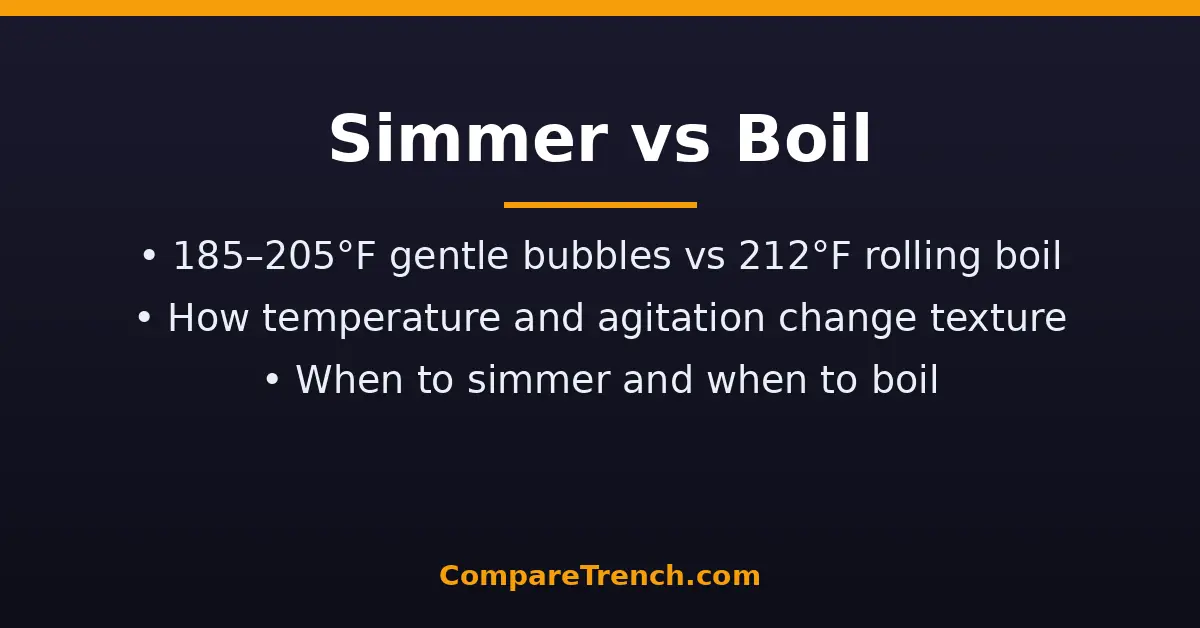
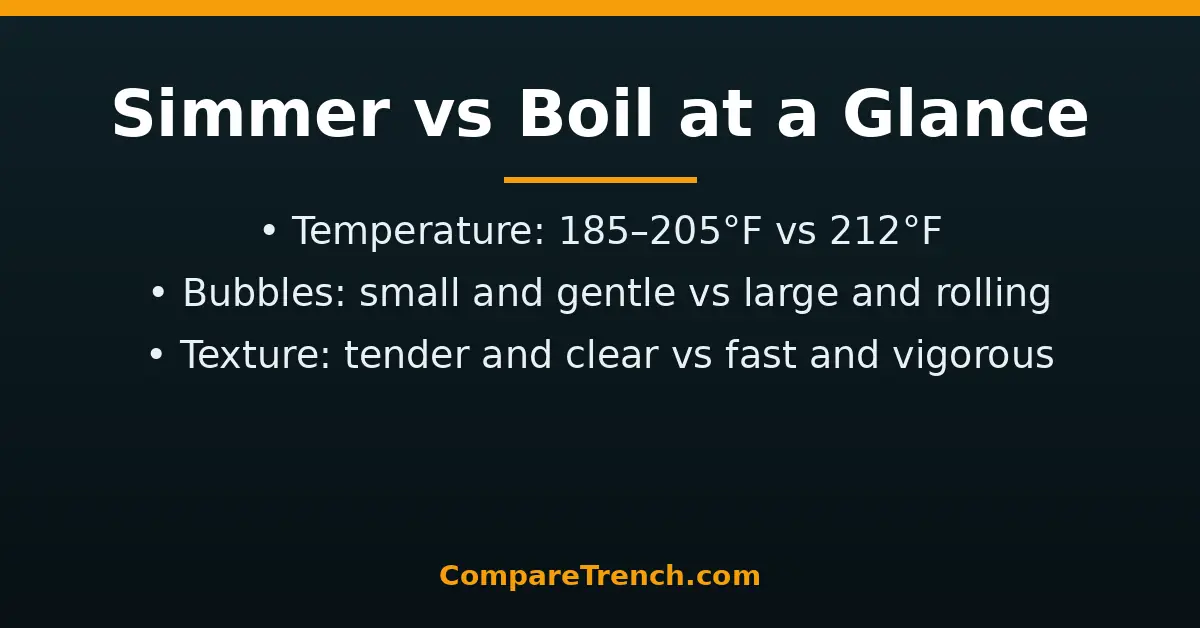
Quick Answer: Simmering cooks food in liquid held at 185–205°F (85–96°C) with small, gentle bubbles, while boiling uses liquid at a full 212°F (100°C) with large, rolling bubbles. Simmering is gentler: it keeps meats tender, stocks clear, and sauces smooth. Boiling is faster and more vigorous — the right choice for pasta, blanching vegetables, and hard-cooking eggs. That is why recipes say “bring to a boil, then reduce to a simmer”: you boil to heat the liquid quickly, then simmer so the food cooks without being damaged.
Simmer vs Boil at a Glance
| Feature | Simmer | Boil |
|---|---|---|
| Temperature | 185–205°F (85–96°C) | 212°F (100°C) at sea level |
| Bubble size | Small bubbles that rise slowly and break the surface occasionally | Large bubbles that rise rapidly and break the surface constantly |
| Surface movement | Gentle shimmer, light rippling | Vigorous churning across the entire surface |
| Agitation | Low — food stays intact | High — food gets tossed and knocked around |
| Cooking speed | Slower | Faster |
| Effect on texture | Tender, even cooking; proteins stay relaxed | Can toughen proteins and break apart delicate foods |
| Liquid clarity | Stays clear | Turns cloudy — violent bubbling emulsifies fat and protein into the liquid |
| Evaporation rate | Slow and steady | Fast — liquids reduce quickly |
| Heat input | Low to medium-low burner setting | Medium-high to high burner setting |
| Best for | Stocks, soups, stews, braises, sauces, dried beans | Pasta, blanching vegetables, hard-cooked eggs, potatoes |
| Lid strategy | Lid ajar or off to keep the temperature from climbing | Lid on speeds up boiling, but watch for boil-overs |
| Main risk | Scorching on the bottom if left unattended | Boil-overs, mushy outsides, cloudy broths |
What Simmering Actually Is
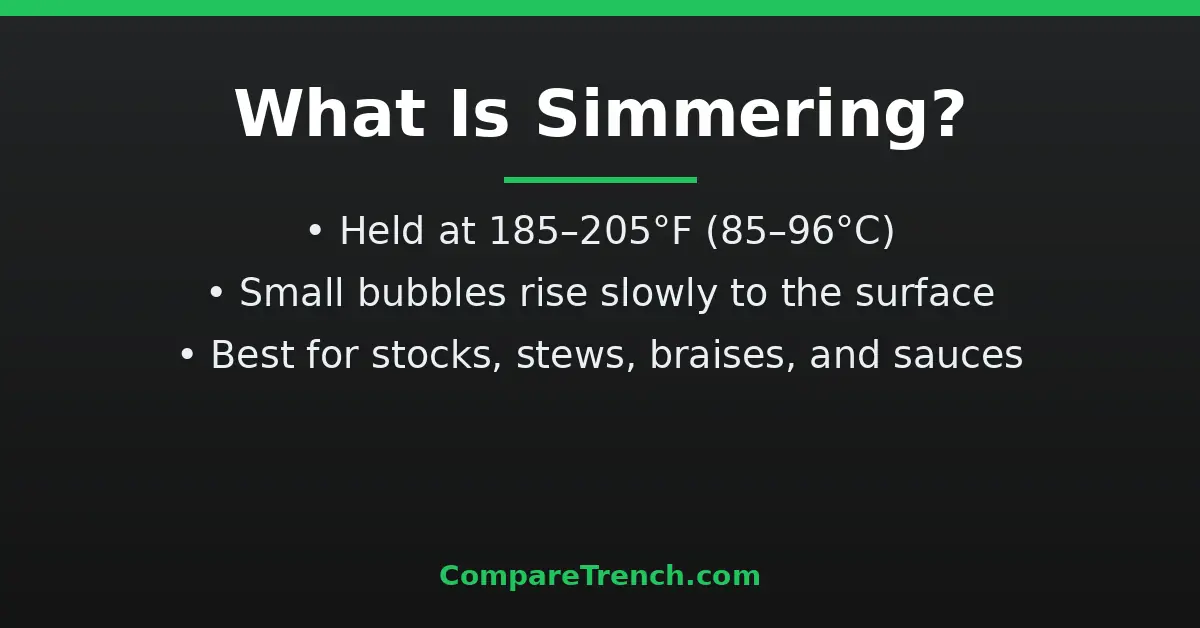
Simmering is a moist-heat cooking method in which liquid is held just below the boiling point — roughly 185–205°F (85–96°C). The visual cue is unmistakable once you know it: small bubbles form at the bottom of the pot and drift lazily to the surface, breaking it here and there. America’s Test Kitchen’s cooking class on boil versus simmer describes it precisely: small bubbles rise from the bottom of the pot and only occasionally break the surface.
Cooks also talk about simmer in degrees. A “slow” or “gentle” simmer sits near the bottom of the range, around 185–195°F, with barely any visible bubble activity — just wisps of steam and an occasional bubble. A “rapid” simmer pushes toward 205°F, with noticeably more bubble traffic but still small bubbles rather than the rolling churn of a full boil. Learning to recognize these stages is one of the most useful skills a home cook can build.
Simmering is the default for anything that benefits from time: stocks that need hours to extract flavor from bones, stews that turn tough chuck into spoonable meat, tomato sauces that thicken and sweeten slowly, and dried beans that go from chalky to creamy.
What Boiling Actually Is
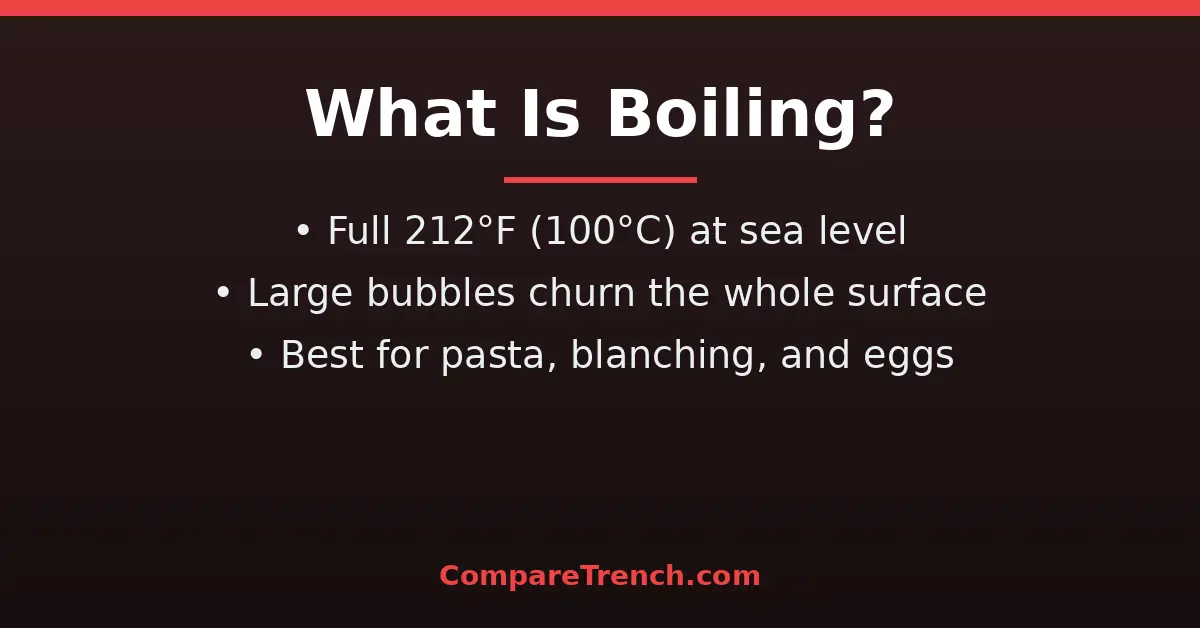
Boiling happens when liquid reaches 212°F (100°C) at sea level — the point where vapor bubbles form throughout the liquid, not just at the bottom, and race to the surface in a constant stream. A full rolling boil cannot be stirred down; the agitation is continuous and covers the whole surface. It is the most aggressive way to cook in water, and that aggression is sometimes exactly what you want.
Boiling excels at speed and surface action. Pasta needs a big pot of rapidly boiling, well-salted water so the pieces stay separated and cook evenly. Blanching vegetables — a quick dip in boiling water followed by an ice bath — sets bright color and takes the raw edge off in under a minute. Hard-cooking eggs, cooking potatoes through, and parboiling grains all benefit from the fast, even heat transfer of a boil.
One detail worth knowing: water cannot get hotter than 212°F at sea level no matter how high you crank the burner. Turning the heat up past a rolling boil does not raise the temperature — it only makes the boiling more violent and evaporates the water faster.
Temperature: The Core Difference
The fundamental difference between simmer and boil is temperature, and it is a smaller gap than most cooks expect — sometimes as little as 10–15 degrees separates a rapid simmer from a full boil. That narrow band is why a pot left on medium heat can creep from a simmer into a boil when you stop watching. The temperature difference itself matters less than what it does to the water’s behavior: below boiling, bubbles form gently at the bottom of the pot; at boiling, vapor forms throughout the liquid and the whole pot becomes turbulent.
Altitude changes the numbers. At 5,000 feet above sea level, water boils around 203°F instead of 212°F, which compresses the window between simmer and boil — judge by sight rather than temperature. A thermometer helps while you are learning, but experienced cooks read the pot: if the surface is heaving, you are boiling; if it is rippling, you are simmering.
Equipment matters too. Thin-bottomed pots create hot spots where the liquid boils locally even while the rest of the pot simmers, which is why heavy-bottomed pots and Dutch ovens — which spread heat evenly — make holding a simmer so much easier. Interestingly, other kitchen processes live in the same temperature neighborhood: espresso machines brew at roughly 195–205°F, right in simmer territory (see our difference between espresso and latte).
Why Simmering Protects Texture and Clarity
Three things happen at a simmer that a boil ruins, and they explain why patient cooks guard their simmer so carefully.
First, proteins stay tender. Muscle fibers contract and squeeze out moisture under violent heat; a hard boil seizes meat, fish, and eggs, turning them rubbery. At a simmer, tough cuts like chuck and short ribs slowly surrender their connective tissue — collagen converts to silky gelatin over hours — while the meat stays moist. That transformation is the entire point of braising and stewing, and it cannot be rushed with a boil.
Second, liquids stay clear. A stock that simmers gently produces a clean, bright broth because fat and soluble proteins rise to the surface where they can be skimmed. Boil that same stock and the turbulence emulsifies the fat and shatters the proteins into particles that stay suspended — a permanently cloudy, greasy liquid. This is the classic test separating the two methods: clear broth demands a simmer; a boil guarantees murk.
Third, emulsions stay stable. Sauces like tomato ragù, cheese sauces, and anything built on dairy are emulsions — fat suspended in liquid — and violent boiling breaks them. The sauce “splits” into an oily layer and a watery one. A gentle simmer keeps the emulsion intact while the sauce reduces and concentrates.
When Boiling Is the Better Choice
Simmering gets most of the praise, but boiling is not the enemy — it is a tool with jobs only it can do. Any time you need maximum heat transfer in minimum time, boiling wins. Pasta is the flagship example: the agitation keeps strands moving so they do not stick, and the full heat cooks the exterior and interior at the right relative pace.
Blanching is another boil-only job. Dropping green beans or broccoli into aggressively boiling water for 60–90 seconds, then shocking them in ice water, cooks them just enough while locking in vivid color. A simmer is too slow for this — the vegetables would sit in hot water longer and turn olive-drab. (A pinch of baking soda in the blanching water keeps greens even brighter; the chemistry is covered in our difference between baking soda and baking powder.)
Boiling is also the right call for hard-cooking eggs, cooking dense root vegetables through, parboiling potatoes before roasting, and sterilizing jars. In each case the food is sturdy enough to handle the turbulence, and speed is the priority. The rule of thumb: boil when the food is robust and time matters; simmer when the food is delicate or the goal is extraction and melding of flavor.
How to Hold a Steady Simmer
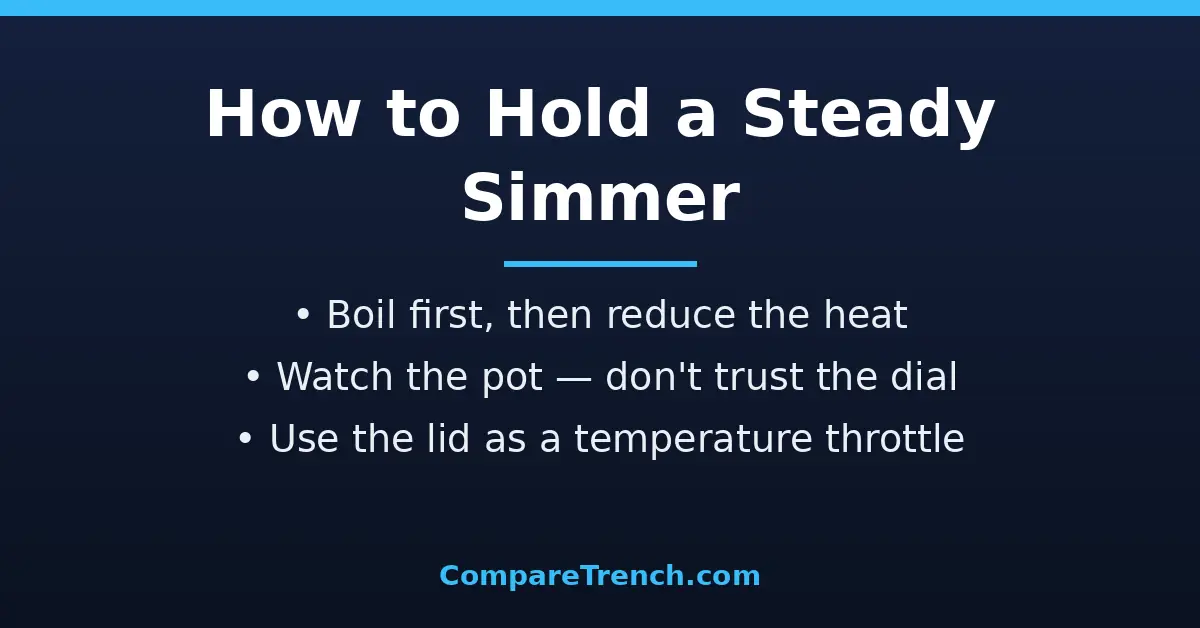
Maintaining a simmer is a watching skill, not a knob position. Start by bringing the liquid to a boil over higher heat — faster than creeping up from cold — then reduce the heat until the rolling action settles into gentle bubbling. On most home stoves this means medium-low or low, but every burner is different, so watch the pot for a minute after adjusting rather than trusting the dial.
Use the lid as a throttle. A lid traps heat and steam, which pushes the temperature up; if your simmer keeps creeping toward a boil, crack the lid or remove it entirely. Heavy pots hold a steadier simmer than thin ones because their thermal mass smooths out burner fluctuations.
Stirring matters more than people think. At a simmer, food near the bottom of the pot is hotter than food near the top, so an occasional stir evens things out and prevents the bottom layer from scorching — the main risk of long simmers. For stocks and broths, skim the foam and fat that rise to the surface in the first 30 minutes.
Common Mistakes to Avoid
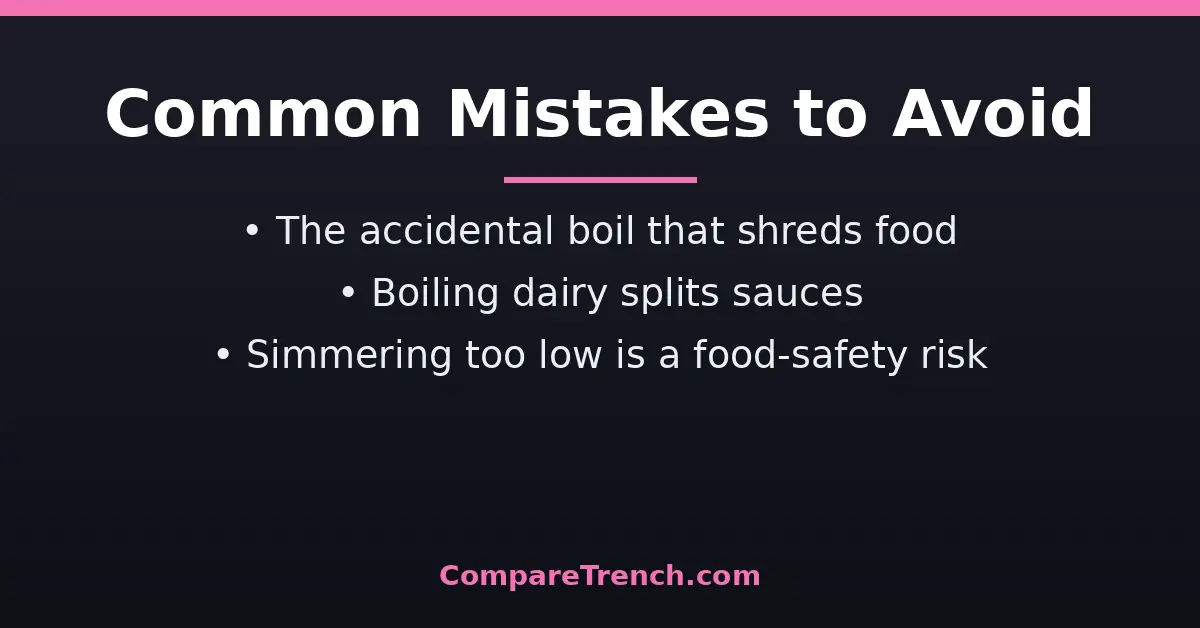
The most common mistake is the accidental boil: you set the pot to what you think is a simmer, walk away, and return to a furiously bubbling pot and shredded chicken. Check the pot a few minutes after you adjust the heat, especially on gas burners, which can drift. The second mistake is the reverse — simmering too low. If you see no bubble activity and no steam, the liquid is below simmering temperature and your food is just sitting in warm water, which is a food-safety concern for meat.
A third mistake is boiling dairy-based dishes. Milk scalds and cheese sauces split at a rolling boil; keep them at the barest simmer and stir frequently. Similarly, never boil a sauce you have just thickened with starch for longer than a minute or two — prolonged violent boiling can thin it back out.
Finally, do not overthink salted pasta water: salt raises the boiling point by a fraction of a degree, which is irrelevant. Salt it because unsalted pasta tastes flat, and use plenty of water so the temperature does not crash when the pasta goes in. For milk-based drinks where foam texture is the goal, the technique is closer to steaming — which is why drinks like those in our difference between cappuccino and latte rely on steam wands rather than a stovetop boil.
Which One Should You Choose?
Choose a simmer when the food needs time and gentleness: stocks, broths, soups, stews, braises, tomato sauces, dried beans, lentils, and delicate proteins like poached fish or chicken. Choose a boil when you need speed and vigorous action: pasta, blanching vegetables, hard-cooked eggs, potatoes, and sterilizing.
You may also like our other food and drink comparisons — and for a change of pace, see how careful distinctions work in tech in our difference between iOS and Android and difference between LCD and LED guides.
Frequently Asked Questions
What temperature is a simmer in Fahrenheit?
A simmer is 185–205°F (85–96°C). A gentle or slow simmer sits around 185–195°F with minimal bubble activity, while a rapid simmer approaches 205°F with steady small bubbles. Water boils at 212°F (100°C) at sea level, so simmering is always just below the boiling point.
Can you simmer with the lid on?
You can, but a lid traps heat and can push the pot back up to a boil. The practical approach: leave the lid off until the simmer is steady, then set it ajar to slow evaporation, or leave it off entirely if you want the liquid to reduce and thicken.
Is it okay if my soup boils instead of simmers?
Briefly — but not as a habit. Boiling a soup breaks apart delicate ingredients, clouds the broth by emulsifying fat, and can make meat tough. If you catch it boiling, just turn the heat down; a few minutes will not ruin most soups, but hours of it will give you a murky, overcooked result.
Does simmering take longer than boiling?
Yes. Because the liquid is cooler, heat transfers into the food more slowly. That extra time is the point: it allows collagen to convert to gelatin, flavors to meld, and liquids to reduce gradually without damaging the ingredients. Boiling is faster but harsher.
What is the difference between simmering and poaching?
Poaching uses even lower heat — about 160–180°F (71–82°C) — with barely any bubbles at all, reserved for the most delicate foods like eggs and fish fillets. Simmering is one step hotter and slightly more active, suitable for sturdier foods like chicken pieces, beans, and stews.
Conclusion
The difference between simmer and boil comes down to temperature and turbulence: a simmer holds liquid at 185–205°F with gentle bubbles that cook food slowly and kindly, while a boil drives it to 212°F with rolling agitation that cooks fast but rough. Simmering protects texture, clarity, and emulsions; boiling delivers the speed and surface action that pasta, blanching, and hard-cooked eggs demand. Learn to read the bubbles, control the heat with the lid and the dial, and match the method to the food — and you will have mastered one of the basic distinctions in cooking.